3 Ready Change of Control Clauses for Founders and In House Counsel
A change of control clause is a contract provision that lets one party respond, often by requiring consent, terminating the deal, or forcing the acquirer to assume every obligation, when the other party gets bought, merges, or hands the reins to new owners. Triggers usually involve a merger, an asset sale, someone crossing 30% to 50% ownership, or a board flip. If you are staring down an acquisition and wondering whether your contracts survive it, the sample language below will get you there faster than reading the whole agreement twice.
TL;DR:
Ownership thresholds for triggers are typically set at 30% or 50%, with the latter clearly giving the acquirer voting control.
Broad definitions like merger or sale of all assets can inadvertently catch routine transactions unless exclusions are carefully drafted.
Explicit successor and assumption language is essential to ensure the new owner formally takes on existing contractual obligations.
Notice periods and cure windows should be clearly defined with specific day counts to allow proper response before termination rights activate.
Regulatory and industry-specific rules, especially in government contracts and telecom, may impose additional approval or transfer requirements beyond the contract language.
Chief Legal OfficeKeep Change of Control Work MovingChief Legal Office provides senior legal leadership and a dedicated team to organize contracts, manage priorities, and support complex transactions.Learn how we help
Table of Contents
What counts as a change of control?
The anatomy of a change of control clause
Three sample clauses you can adapt
Negotiating the clause: what to push for and what to concede
Government contracts, regulated industries, and executive pay
A short checklist before you sign
When founders actually need help with this clause
How Chief Legal Office helps you get this right
Sources
FAQ
What counts as a change of control?
Founders often assume a change of control means “we got acquired.” That is one version. It is not the only one, and the gap between what people assume and what the contract actually says is where deals get delayed.
Most clauses define control by ownership percentage. A common structure ties the trigger to beneficial ownership crossing 30% or 50% of outstanding voting securities, according to a sample SEC exhibit on file with the agency. Why those two numbers? 50% is the cleaner line: cross it, and you control the vote outright.
Ownership is only one lever. The other common triggers are:
Merger or consolidation, where the company combines with another and does not survive as the same legal entity.
Sale of substantially all assets, which can trigger control provisions even when the corporate shell stays intact.
Board composition changes, often defined as a majority of directors turning over within a set period, typically 12 to 24 months.
Stock purchase versus asset purchase, a structural distinction that determines whether existing contracts transfer automatically or need fresh assignment.
The distinction between a stock deal and an asset deal matters more than most founders realize. In a stock purchase, the legal entity does not change, so contracts generally stay in force unless the change of control clause says otherwise. In an asset sale, the buyer is picking up specific assets and liabilities, and your contract may or may not come along for the ride depending on how assignment is handled. A well-drafted change of control clause should address both scenarios explicitly rather than assuming one.
Board-composition triggers deserve a second look too. They are common in executive compensation agreements and less common in commercial contracts, but they show up more often than people expect in investor rights agreements and voting agreements. If your board is expected to turn over as part of a financing round, check whether that alone counts as a change of control under any existing agreement.
The anatomy of a change of control clause
Every functional change of control clause has the same basic skeleton: a definition, a set of consequences, and mechanics for notice and cure. Miss one piece and the clause either does nothing or does too much.
Definition of the triggering event. State the ownership threshold, merger scenario, or asset sale condition precisely. Vague language here creates fights later about whether an internal reorganization or a transfer to an employee stock plan actually counts.
Exclusions. Carve out events that look like a change of control but should not trigger consequences, such as a holding company reorganization where the ultimate owners stay the same, or shares issued to an employee benefit plan.
Consequences. Specify what happens: termination rights, a consent requirement before the deal closes, acceleration of payment or vesting, or a requirement that the successor assume the agreement.
Successor-and-assign language. This is the piece people skip, and it is the one that actually protects you. A change of control definition tells you when something happened. Successor-and-assign language tells you what the new owner is legally required to do about it.
Notice and cure mechanics. Require written notice within a defined window (commonly 10 to 30 business days) and, where appropriate, a cure period before termination rights kick in.
The successor point is worth dwelling on. Federal contracting regulations offer a useful model here: under 48 CFR § 42.1204, a novation agreement ordinarily requires the transferee to assume all of the transferor’s obligations, with the original party sometimes waiving its own rights under the contract. That is the gold standard of successor protection. Without similarly explicit assumption language in a commercial contract, a buyer can walk away from obligations the seller thought were locked in.
Pro Tip: Draft your change of control definition and your successor-and-assign clause as two separate provisions. Combining them into one paragraph is how “when” and “what happens” get blurred, and blurred language is what litigators get paid to argue about.
Three sample clauses you can adapt
Below are three variations, each built for a different situation. None of these are one-size-fits-all. Read the annotations before you paste anything into a live agreement.
1. Threshold-trigger clause (ownership based)
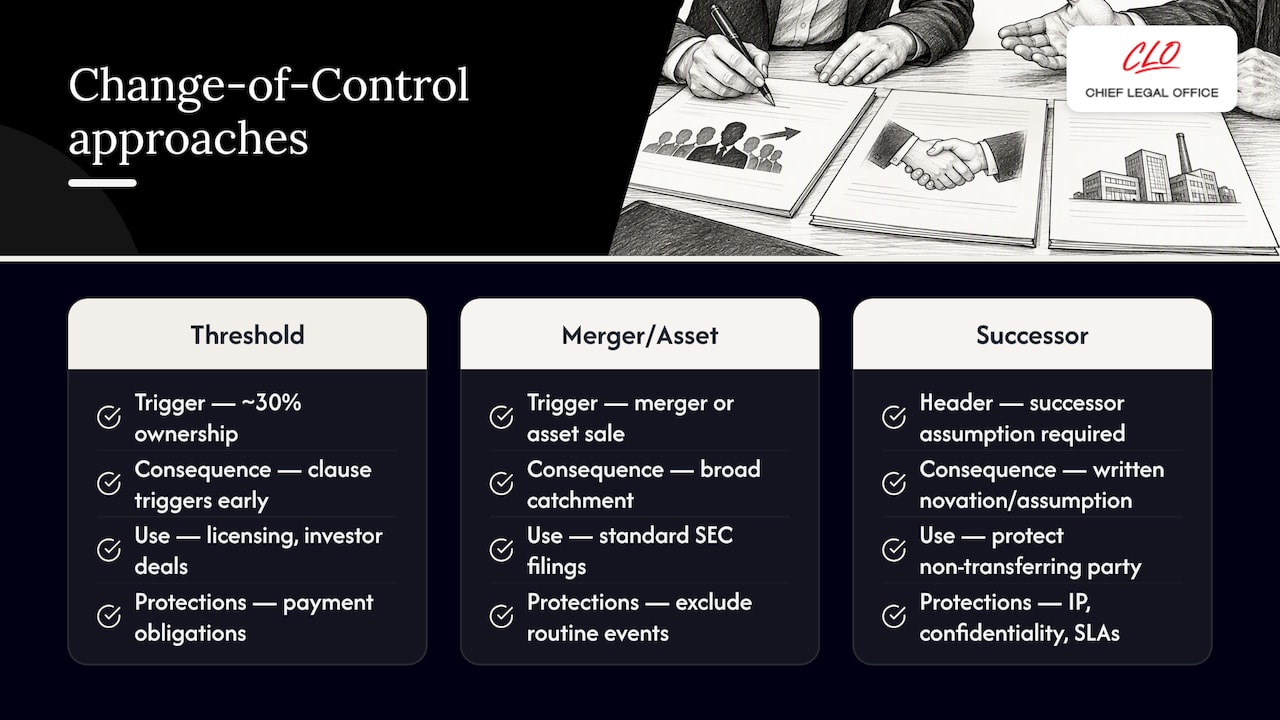
“A Change of Control shall be deemed to occur if any person or group acquires, directly or indirectly, beneficial ownership of a significant minority of the outstanding voting securities of the Company, excluding acquisitions by employee benefit plans sponsored by the Company or its affiliates.”
This version works well for licensing agreements and investor-facing contracts where you want an early warning system rather than waiting for a full acquisition to close. The 30% figure mirrors the threshold used in sample SEC change-of-control exhibits, and the employee-plan carve-out prevents routine equity compensation from accidentally tripping the clause.
2. Merger-or-asset-sale clause (broad, needs narrowing)
“A Change of Control means (a) a merger or consolidation of the Company with another entity in which the Company’s stockholders immediately prior to such transaction hold less than 50% of the voting power of the surviving entity, or (b) a sale, lease, or transfer of all or substantially all of the Company’s assets.”
This is a broad net, and broad nets catch things you did not mean to catch. Sample agreements filed with the SEC commonly exclude routine events like stock repurchases or issuances directly by the company, which is worth borrowing regardless of your industry.
3. Successor-assumption and novation clause
“This Agreement shall be binding upon and inure to the benefit of the parties and their respective successors and permitted assigns. In the event of a Change of Control, the Company shall require any successor to expressly and unconditionally assume, by written agreement, all of the Company’s obligations under this Agreement. No Change of Control shall relieve the Company or its successor of any obligation hereunder absent such written assumption.”
The clause every non-transferring party needs and almost nobody drafts carefully: a definition that names the trigger only accomplishes half the job. Without an explicit assumption or novation requirement, a buyer can inherit the benefits of your contract while treating the obligations as optional. Successor-assumption language flips that.
If you license technology, tighten “expressly and unconditionally assume” further to name specific obligations: IP license scope, confidentiality terms, and service-level commitments. A generalized assumption clause protects payment obligations well. It does not automatically protect specific performance standards unless you name them. Anyone working through technology licensing and service agreements will recognize this gap immediately, since royalty and milestone terms are exactly the kind of obligation that gets diluted in a sloppy assumption clause.
Negotiating the clause: what to push for and what to concede
Change of control provisions get negotiated harder than almost any other boilerplate section, because both sides know exactly what is at stake: one side wants exit flexibility, the other wants certainty that a sale will not gut their deal.
Set thresholds that match your actual risk. A 50% threshold is defensible for most commercial contracts. A 30% threshold makes sense when board influence or minority-blocking rights matter more than outright control.
Decide whether assignment-with-consent is enough or whether you need mandatory assumption. Consent gives you leverage to renegotiate terms with a new owner. Mandatory assumption gives you certainty but less room to walk away from a bad fit.
Negotiate cure periods, not just notice periods. A notice requirement without a cure window just tells you bad news is coming. A cure period gives the acquiring party a real chance to fix a technical breach before termination rights fire.
Watch for open-ended forfeiture language. If the clause lets the other party terminate without paying for work already delivered, that is a red flag worth fighting over.
Flag any clause that uses “control” without defining it. Undefined control is an invitation for a later dispute about what actually happened.
Pro Tip: *If you are the smaller party in the negotiation, your best leverage is often not the threshold percentage. It is the assumption language.
Government contracts, regulated industries, and executive pay
Change of control clauses do not operate in a vacuum. Certain contexts layer statutory or regulatory requirements on top of whatever your contract says, and missing them can undo a deal or trigger personal liability for directors.
Government contracts require formal novation in many cases. Under 48 CFR § 42.1204, a change in the contracting party generally requires a novation agreement, contracting-officer approval, or a waiver before the new entity can perform under the contract. Skipping this step can leave a government contract legally unperformed by anyone.
Small-business and SBA-certified contractors face ownership scrutiny beyond the contract itself. Under 13 CFR § 124.515, ownership and control changes can affect eligibility for programs like 8(a), based on affiliation rules tied to common ownership, management, or contractual relationships. A change of control that looks routine commercially can knock a supplier out of a set-aside program entirely.
Communications and telecom assets carry their own transfer rules. Under 47 CFR § 63.24, transfers reaching 50% ownership or more are often treated as a transfer of control requiring prior regulatory approval, not just notice.
Executive change-of-control payments draw fiduciary scrutiny. Delaware courts have examined whether change-of-control-triggered executive payments created conflicts of interest for the officers negotiating the deal, and full disclosure to stockholders can be what preserves deferential business-judgment review rather than the stricter entire-fairness standard, according to a Delaware court opinion on the subject. If your executive agreements include change-of-control acceleration or severance, get the disclosure right before the deal is signed, not after someone asks about it in discovery.
A short checklist before you sign
Run through this list before you finalize any contract with a change of control clause, whether you are drafting it or reviewing someone else’s.
Confirm the trigger definition matches your actual risk: ownership percentage, merger scope, or asset sale threshold.
Verify exclusions exist for internal reorganizations and employee benefit plan transfers.
Check for explicit successor-assumption or novation language, not just a generic assignment clause.
Confirm notice periods and cure windows are defined with actual day counts, not vague terms like “promptly.”
Flag downstream effects on IP licenses, customer data transfers, and third-party consents that might need separate approval. If customer data is involved, this is worth checking against your data handling and transfer practices directly.
For executive agreements, confirm Section 409A timing rules and any excise tax exposure tied to acceleration.
When founders actually need help with this clause
I have watched founders discover a change of control clause for the first time during due diligence, usually at the worst possible moment: three weeks before a term sheet is supposed to close. That is not a great time to learn that your biggest customer contract lets them walk the moment you get acquired.
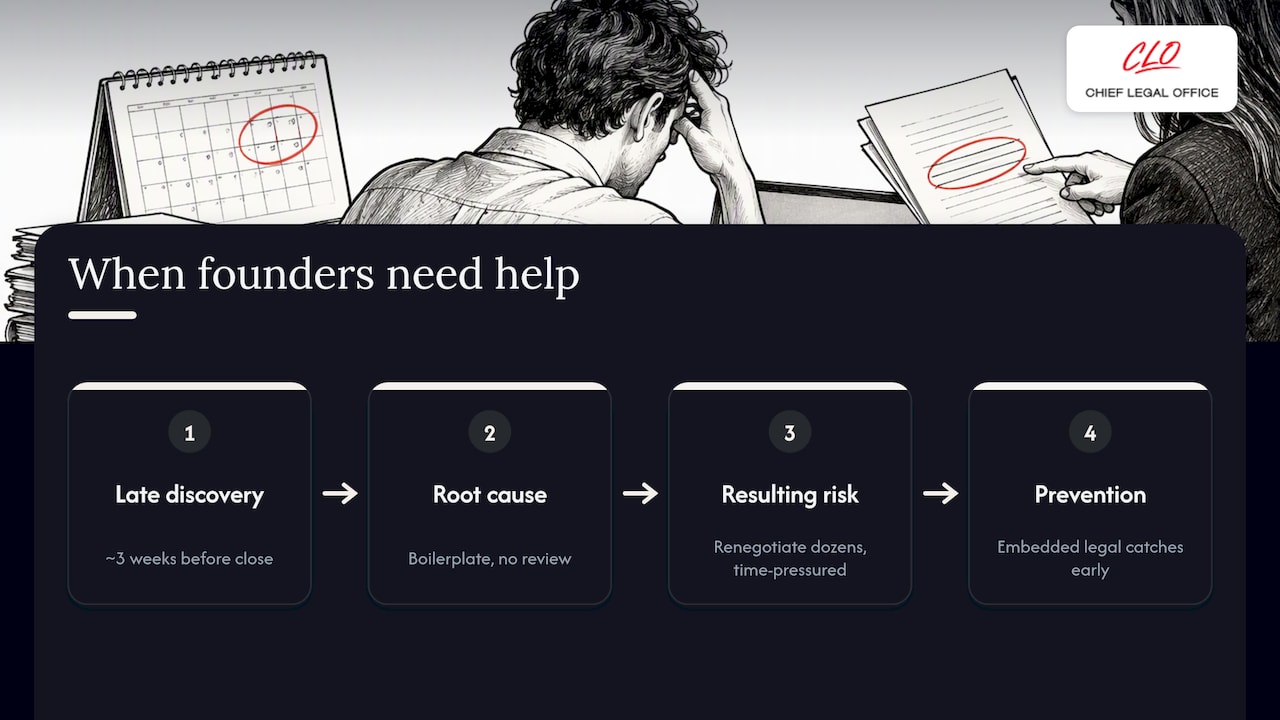
The pattern I see most often is not bad drafting. It is no drafting: contracts signed early with boilerplate nobody reviewed for this specific risk. By the time a deal is on the table, fixing it means renegotiating dozens of agreements under time pressure, which is expensive leverage to hand a counterparty.
Embedded legal leadership catches this earlier, because reviewing change of control exposure across a contract portfolio is exactly the kind of ongoing, unglamorous work that outside counsel billing by the hour rarely gets asked to do proactively.
— Amy Natasha Osteen
How Chief Legal Office helps you get this right
If you are three weeks from a term sheet and just discovered your contracts are full of surprises, that is not a drafting problem you solve alone at 11 PM with a legal pad. It is a resourcing problem, and it is exactly what a fractional in-house legal team is built to catch before it becomes urgent.

Chief Legal Office works as your legal department, not a law firm you call when something breaks. For change of control issues specifically, that looks like:
Fractional Chief Legal Office engagement to review your full contract portfolio for change of control exposure before a raise or sale, not after.
Fractional General Counsel support to negotiate the clause directly with acquirers, licensors, or investors on your behalf.
Capital Raises and M&A support to prepare board-ready diligence materials and manage the disclosure issues that come with executive change-of-control payments.
Commercial Transactions review to fix successor-assumption gaps in existing agreements before they matter.
A typical engagement starts with scoping your contract portfolio, prioritizing redlines by actual risk instead of alphabetical order, and delivering a board-ready memo your leadership team can act on. Plans start at Foundations, Embedded Access, or Strategic Growth, depending on how much ongoing legal support your company needs. If you want to talk through what that looks like for your contracts, reach out to Chief Legal Office directly.
This article is general information, not a substitute for advice from a qualified lawyer. Consult a qualified legal professional about your own circumstances before acting on anything here.
Sources
SEC filing (exhibit) showing sample change-of-control definitions
Delaware court opinion discussing conflicts and scrutiny around change-of-control transactions
FAQ
What qualifies as a change in control?
A change in control generally means a merger, a sale of substantially all assets, or an ownership shift crossing a defined threshold, commonly 30% to 50% of voting securities according to sample SEC filings. Board-composition turnover can also qualify if the contract defines it that way. The exact answer always depends on the specific contract’s definition, so the threshold in one agreement will not necessarily match another.
Can you provide a sample change of control clause?
Yes.
How do you say one agreement supersedes another?
Contracts typically use an integration or entire-agreement clause stating that the current agreement “supersedes all prior agreements, understandings, and representations” on the same subject matter. This is a separate provision from a change of control clause, though both often appear near the end of a contract’s boilerplate section.
What is Lord Denning’s red hand rule?
The red hand rule is a principle from English contract law holding that unusually harsh or unexpected clauses buried in fine print need to be pointed out clearly, sometimes described as needing “a red hand pointing to it,” or they may not be enforceable. It is occasionally invoked in disputes over surprising boilerplate terms, though it is not a standard doctrine most U.S. contract drafters rely on directly.
When should a company include a change of control clause?
Companies should include one in any contract where a future acquisition, merger, or ownership shift could materially affect either party’s willingness to keep performing, such as licensing agreements, key customer contracts, and executive employment agreements. It matters most where continuity of specific obligations, like IP licenses or service levels, is critical to the deal’s value.
Recommended
The lawyerly fine print: This article is for general information, not legal advice…