90 Day Plan for Legal Teams: Build a Clause Library and Playbook
A contract clause library is a searchable, curated collection of approved clause language, tagged and version-controlled so your team can pull the right provision without reinventing it every time. Paired with a negotiation playbook, it turns contract drafting from a slow, ad hoc scramble into something fast and consistent. If you are starting from zero, the first move is not buying software. It is inventorying your highest-volume clauses and drafting one playbook excerpt to see how the logic works in practice.
TL;DR:
Properly tagged and version-controlled clause libraries enable faster drafting and reduce legal review time for high-volume, repetitive contract provisions.
Prioritize building canonical versions of frequently negotiated or risk-heavy clauses, with no more than three to four variants to keep tiers clear.
An effective playbook clarifies how and when to use each clause, includes decision logic for approvals, and prevents unnecessary legal escalations.
Assign a dedicated owner to maintain the library, set review SLAs, track changes, and integrate it into existing tools to prevent obsolescence.
Pilot with high-value clauses first and validate automation and AI integrations on complex, high-volume contract types before expanding.
Chief Legal OfficeKeep Legal Work MovingChief Legal Office provides senior legal leadership and a dedicated team to organize recurring work, manage priorities, and support company growth.Learn about Chief Legal Office
Table of Contents
What goes inside a clause library and how it’s organized
Faster drafting and fewer surprises down the line
Which clauses to build first and how many versions you need
Linking the library to a negotiation playbook that runs without you
Who owns the library and keeps it from going stale
Making the library safe to automate and AI-ready
A 90-day plan for getting your library off the ground
How an embedded legal team keeps a clause library alive
When it’s worth building and what usually derails it
How Chief Legal Office builds and runs this for you
Resources worth bookmarking
Sources
FAQ
What goes inside a clause library and how it’s organized
A clause library is not a folder of old contracts. It is a structured set of entries, each with the clause text itself, metadata (contract type, jurisdiction, risk level), tags for searchability, a short guidance note explaining when to use it, a version history, and an approval tier showing who signed off.
Most legal teams start with the clauses that show up constantly and carry real risk:
Indemnification and limitation of liability
Intellectual property ownership and licensing
Confidentiality and data privacy
Termination and renewal terms
Service levels and statement-of-work provisions
Tagging and tiering matter more than volume. A library with 300 untagged clauses is worse than one with 40 that are properly categorized, because nobody can find anything under pressure, and a rushed search is how the wrong clause ends up in a signed contract.
Faster drafting and fewer surprises down the line
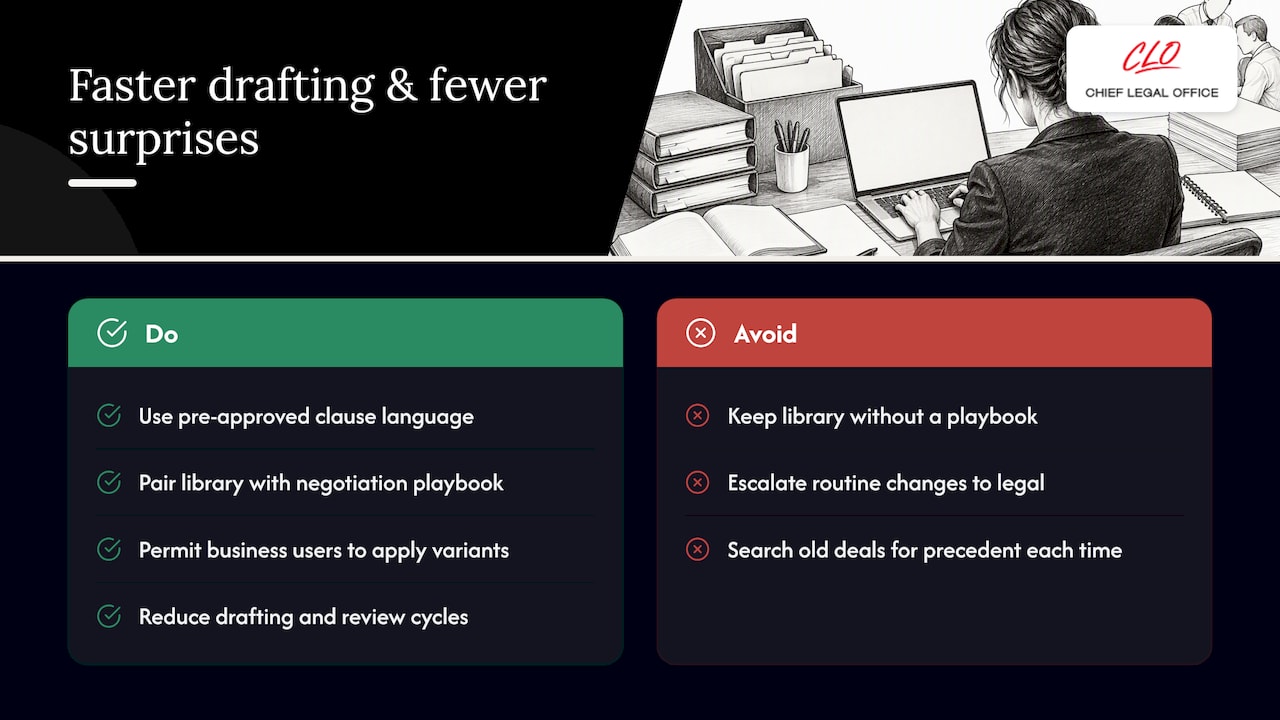
The operational payoff is concrete. Drafting and review cycles shrink because your team is selecting pre-approved language instead of drafting from scratch or hunting through old deals for precedent. Sales teams move faster because they are not waiting on legal to approve the same indemnity language for the tenth time this quarter.
A clause library paired with a clear negotiation playbook is considered essential to realizing real negotiation efficiency, according to ACC guidance on contract playbooks, because the playbook tells business users when and how to use each variant without escalating every change to legal.
That last point is the one people miss. The library gives you the language. The playbook gives you permission to use it. Without both, you still end up with every contract routed through legal for a decision someone else could have made.
Which clauses to build first and how many versions you need
Not every clause deserves the same attention. Prioritize based on how often it comes up, how much business risk it carries, and whether it touches a regulated area like data privacy or export control. A clause you negotiate weekly and one you negotiate never should not get equal engineering effort.
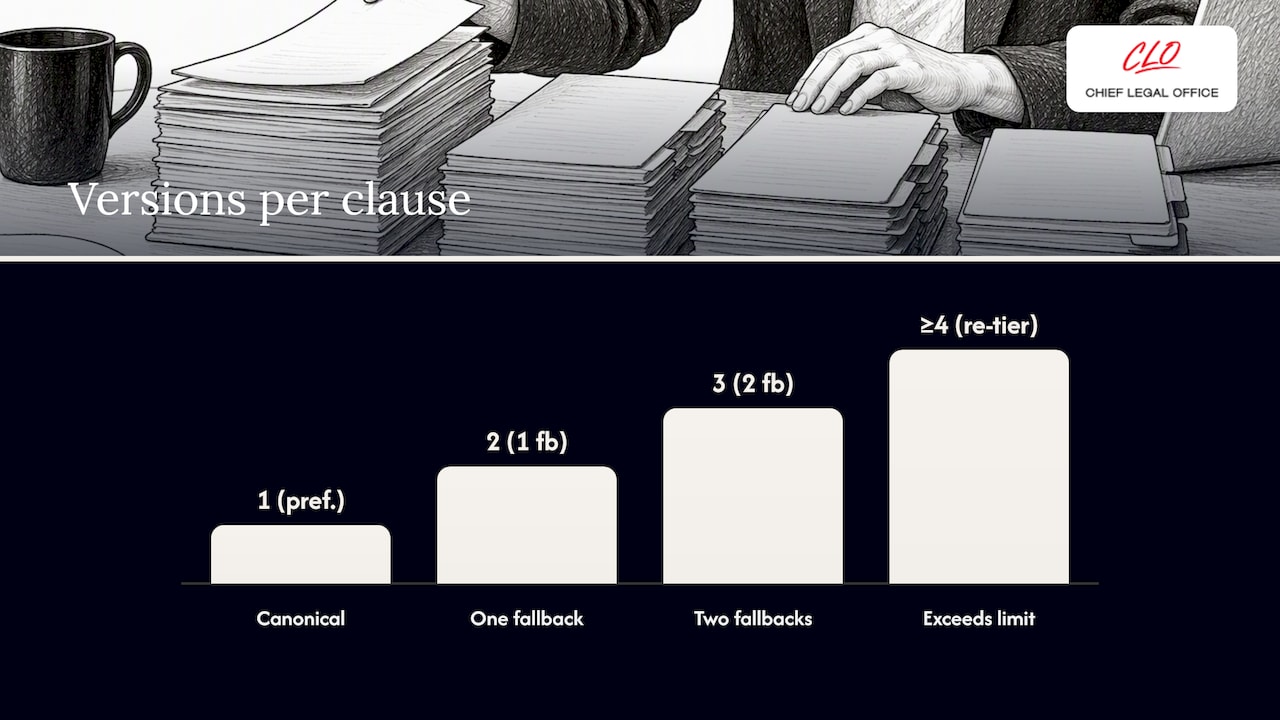
For each priority clause, build a canonical (preferred) version plus one or two fallback variants for common negotiation scenarios. More than three or four versions per clause usually signals the library needs better tiering logic, not more options.
Start with clauses tied to revenue: MSAs, SOWs, order forms
Add clauses tied to regulatory exposure: data processing, IP assignment
Build fallback language only where negotiation actually occurs
Pro Tip: Write the guidance note before you finalize the clause text. If you can’t explain in two sentences why a clause exists and when to deviate from it, the clause isn’t ready to publish.
Linking the library to a negotiation playbook that runs without you
A library without a playbook is a dictionary nobody has been taught to read. The playbook is where the operational leverage lives. A good one covers the purpose of each clause, acceptable fallback options, an approver matrix, and clear walk-away thresholds.
ACC’s playbook samples organize this into columns: the section and issue, standard agreement language, the purpose or meaning behind it, likely customer objections and responses, and acceptable alternatives. That structure is worth copying directly rather than reinventing.
Tiering brings this to life:
Preferred: the standard, house-favored clause, usable by anyone without escalation.
Acceptable: a fallback that sales or contract admin can accept within defined limits.
Requires approval: a deviation that needs legal sign-off before it goes out.
Redline territory: anything outside the above, routed straight to legal.
A simple decision rule might read: a sales rep can accept the fallback liability cap when deal value is under a set threshold and the service level commitment matches the standard SLA. Below that line, no phone call to legal required. Above it, the deal waits.
Pro Tip: Write your decision logic in plain “if this, then that” language. If a non-lawyer can’t apply the rule without calling you, the rule needs to be simpler.
Who owns the library and keeps it from going stale
A clause library rots fast without ownership. Assign a named owner (usually legal ops or a senior contracts lawyer), set an approval SLA for new or edited clauses, and put a review cadence on the calendar rather than leaving it to whenever someone remembers.
Version history and an audit trail are not optional extras. When a clause changes, you need to know who approved it, when, and why, especially if a dispute later turns on which version was in effect at signing.
Assign one accountable owner, not a committee
Set approval SLAs so requests do not sit for weeks
Log every change with date, approver, and reason
Control access by role: view, suggest, edit, publish
Make the library available inside the tools people already use, like Word add-ins or CLM plug-ins, so nobody has to leave their draft to find approved language
Making the library safe to automate and AI-ready
Authoring integrations matter because friction kills adoption. If pulling the right clause requires opening a separate portal, most people will draft from memory instead, which defeats the purpose. Vendor tools like Conga’s clause-playbook interface show how this works in practice: select a clause variant, drop it into the document, save the new version back to the repository, all without switching windows.
Automation and AI review are only as good as what feeds them. A poorly curated library will just automate bad language faster, producing confident-looking redlines built on outdated or unapproved clauses.
Confirm every clause in the library has current legal sign-off before connecting it to any tool
Pilot with a small set, ten to twenty high-value clauses, in a single template
Measure whether review time actually drops before expanding further
Pro Tip: Run your AI or automation pilot on your messiest, highest-volume contract type first. If it can’t handle that one cleanly, it’s not ready for the rest.
A 90-day plan for getting your library off the ground
Treat this as a project with a start and end date, not an open-ended initiative that never quite gets finished.
Weeks 1 to 2: Inventory your most-used contracts and pull out the clauses that repeat most often.
Weeks 3 to 4: Prioritize clauses by business risk and negotiation frequency, then draft canonical versions.
Weeks 5 to 6: Build metadata, tags, and tiering for each entry, plus guidance notes.
Weeks 7 to 9: Pilot the library and a draft playbook inside one contract type with one team.
Weeks 10 to 11: Train the stakeholders who will use it daily: sales, contract admin, product owners.
Week 12: Measure results and adjust before rolling out more broadly.
Loop in legal ops, contract admin, the sales or product leaders who negotiate deals, and IT for integration support. Track time to first draft, the share of contracts using approved clauses instead of custom language, and how often deals still get escalated to legal.
How an embedded legal team keeps a clause library alive
A library dies without a maintenance owner. At Chief Legal Office, this typically sits with senior Fractional General Counsel oversight for playbook design and approval tiers, with paralegals handling day-to-day updates, tagging, and version control, so the library stays current instead of becoming another abandoned shared drive.
When it’s worth building and what usually derails it
Build a clause library once your contract volume is real and repeatable, not for a company still negotiating five bespoke deals a year. The investment pays off when you are drafting the same three agreement types repeatedly and want to automate parts of that process.
The pitfalls are predictable: clauses tagged inconsistently, a library with no playbook attached, and nobody assigned to maintain it after launch. My rule of thumb: if you cannot name the person who owns the library six months from now, do not build it yet.
— Amy Natasha Osteen
How Chief Legal Office builds and runs this for you
Building a clause library well takes governance discipline most growing companies do not have time to develop internally. Our Fractional General Counsel and Commercial Transactions services embed senior legal leadership to design the playbook, tier the clauses, and keep the library current as your business changes.
Plans start with Foundations and scale up through Embedded Access and Strategic Growth as your contract volume grows. If you want a legal department that treats your clause library as a living system instead of a one-time project, see current plans and pricing.
Resources worth bookmarking
Start with ACC’s contract playbook guidance and its sample playbook excerpts. For a look at how AI content risk intersects with contract language governance, see this commentary on managing AI content risk.
Sources
FAQ
Can you provide an example of a contract clause?
A limitation of liability clause is a common example: it caps one party’s financial exposure at a defined amount, often tied to fees paid under the agreement. A clause library typically stores approved versions of this clause with guidance on when each applies.
What is a contract clause?
A contract clause is a distinct provision within an agreement that addresses one specific issue, such as confidentiality, termination, or indemnification. Each clause functions as a self-contained rule that governs how the parties handle that particular topic.
What are the 7 rules of a contract?
Definitions of “the 7 rules of a contract” vary by source, but most frameworks point to core requirements like offer, acceptance, consideration, capacity, mutual consent, legality, and clear terms. Consult a licensed attorney to confirm which principles apply to your specific agreement and jurisdiction.
How do I draft a contract clause?
Start by defining the clause’s purpose in plain language, then draft the operative text, and finally add a guidance note explaining when to deviate from it. Building it alongside a negotiation playbook makes it easier for non-lawyers to apply consistently without constant legal review.
Recommended
The lawyerly fine print: This article is for general information, not legal advice…