Build a Runnable Playbook: Contract Lifecycle Management for Legal Ops
Contract lifecycle management (CLM) is the process and technology that let an organization control every contract from first request through renewal, so legal, sales, procurement, and finance teams reduce risk, close deals faster, and stop losing money to missed deadlines. Done well, it turns contracts from scattered PDFs into a system you can actually run a business on. Legal ops teams, GC offices, procurement, and finance all lean on it for the same reason: nobody wants to find a $200,000 auto renewal clause the week after it fired.
TL;DR:
Most contract risks and missed renewals occur during post-signature management, which is often neglected without dedicated ownership or automation.
Effective CLM software combines a searchable repository, AI data extraction, workflow automation, and integrated e-signatures to prevent version control, renewal, and tracking failures.
Scaling CLM requires flexible data models, adaptable workflows, and secure integrations with CRM and finance systems, especially as contract volume and complexity increase.
Implementing CLM successfully starts with centralizing existing contracts, standardizing templates, and piloting on high-volume, low-complexity contract types before full automation.
Continuous oversight and diligent legal enforcement, supported by a fractional legal team, are essential to sustain CLM benefits and ensure compliance over time.
Chief Legal OfficeMake Contracts Easier to RunChief Legal Office provides senior legal leadership and a dedicated team to organize contracts, manage priorities, and keep work moving.Learn how we help
Table of Contents
What Are the Stages of the Contract Lifecycle?
Why Does Contract Lifecycle Management Matter for the Bottom Line?
What Breaks When You Run Contracts on Spreadsheets and Email?
What Does CLM Software Actually Do?
How Do You Roll Out CLM Without Breaking Everything?
What KPIs Actually Prove CLM Is Working?
What Are the Non-Negotiable Rules for a Contract Playbook?
How Should CLM Connect to the Rest of Your Tech Stack?
How Do Fractional Legal Teams Actually Run CLM Day to Day?
What Legal and Regulatory Rules Apply to CLM?
How Do You Manage Contract Risk Without Slowing Everyone Down?
Can CLM Systems Scale and Customize as You Grow?
How Secure Is CLM Data, and What Should You Check?
How Do You Get a Team to Actually Use the New Process?
What’s the One Move That Pays Off Fastest?
How Chief Legal Office Helps You Build and Run a CLM Playbook
Sources
FAQ
What Are the Stages of the Contract Lifecycle?
Every contract moves through the same basic stages, whether anyone is managing them on purpose or not. The difference between a company that has this under control and one that does not is whether someone owns each handoff.
Request and intake. Someone in sales, procurement, or HR needs a contract. The best-run legal teams triage these requests immediately, routing low-risk, high-volume requests (an NDA, a standard vendor order) to self-serve templates and reserving lawyer time for anything with real negotiation risk. Skip this step and every request lands in the same inbox with the same urgency, which means nothing gets prioritized correctly.
Template authoring and clause libraries. Instead of drafting from scratch every time, mature legal teams pull from a library of pre-approved clauses: standard limitation of liability language, indemnification, termination for convenience. This is where consistency gets built in, before anyone starts negotiating.
Drafting and negotiation. This is where things usually go sideways without structure. Redlines fly back and forth by email, multiple people edit different versions, and nobody is sure which draft is the “real” one. Contract lifecycle management exists specifically to solve this by governing the contract from negotiation through execution with a single tracked version.
Approvals and gating. Nothing gets signed until it clears the right internal sign-offs, finance for pricing exceptions, legal for non-standard terms, a department head for budget. Gating means the approval has to happen before signature, not as an afterthought.
Execution and e-signature. Digital signature tools capture a legally sound audit trail: who signed, when, from what device, and what version. That trail matters far more than people realize until they’re in a dispute or an audit and need to prove exactly what was agreed to.
Post-signature operation. This is the stage most companies neglect entirely. A signed contract creates ongoing obligations: renewal dates, payment terms, service levels, deliverables. Someone has to track whether those obligations are actually being met.
Renewal, termination, and archival. The contract either renews, gets renegotiated, or ends. Either way, it needs a clean record for future reference, audits, or litigation.
Here’s the shorthand version of what each stage requires:
Intake: triage by risk and volume, route accordingly
Authoring: standardized templates, pre-approved clause libraries
Negotiation: single source of truth, tracked redlines
Approval: defined gates by contract type and dollar value
Execution: e-signature with a verifiable audit trail
Operation: obligation tracking tied to real dates and deliverables
Renewal/close: proactive alerts, clean archival
Most companies handle the first few stages reasonably well. It’s the post-signature stage where the wheels come off, because nobody assigned anyone to watch it.
Why Does Contract Lifecycle Management Matter for the Bottom Line?
Poor contract oversight is not a paperwork problem. It’s a revenue problem wearing a paperwork costume.
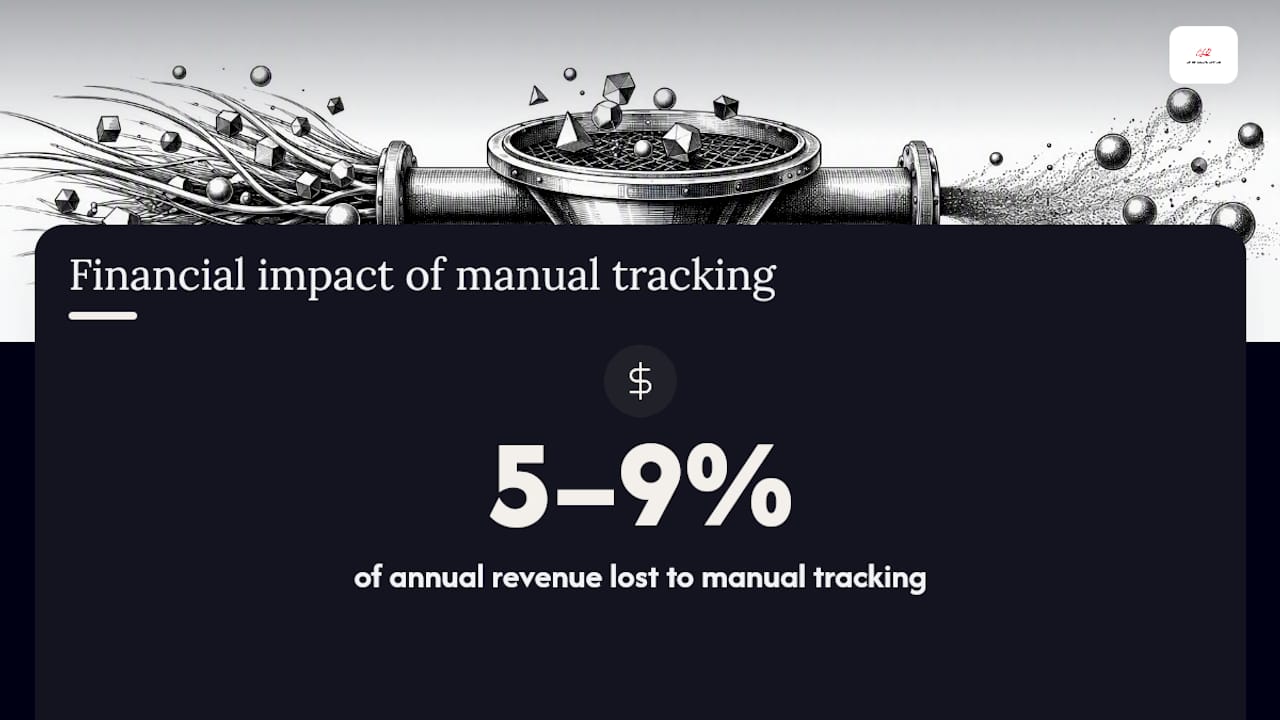
By the numbers: Manual contract tracking commonly costs organizations an estimated 5 to 9% of annual revenue through missed renewals, compliance gaps, unclaimed rebates or credits, and the sheer time wasted hunting for agreements that should have been easy to find.
For a company doing substantial revenue, a noteworthy amount may be lost through cracks nobody’s watching. Some of that is auto-renewals nobody caught in time, locking the company into another year of a vendor contract someone wanted to renegotiate. Some of it is volume discounts and rebates that expired unclaimed because nobody tracked the trigger date.
Cycle time is the other lever. When contracts move through a defined workflow with clear owners at each stage instead of bouncing around inboxes, deals close faster. Sales teams notice this immediately, because a contract stuck in legal limbo for three weeks is a deal that a competitor might close first.
Audit readiness is the quieter benefit, but it’s often the one that matters most when a company is raising capital or getting acquired. Investors and acquirers want to see every material contract, its terms, its status, and its obligations, organized and retrievable in hours, not weeks. A company that can produce this instantly looks like a company that has its act together. One that can’t looks like a liability waiting to be discovered in due diligence.
Finally, there’s scale. A company can grow contract volume significantly without adding headcount proportionally, but only if the underlying process is structured enough to absorb the growth. Without that structure, every new contract adds friction rather than volume.
What Breaks When You Run Contracts on Spreadsheets and Email?
Spreadsheets and email are where most companies start, and where most companies eventually get burned. The failure modes are predictable enough that you could set a calendar reminder for them.
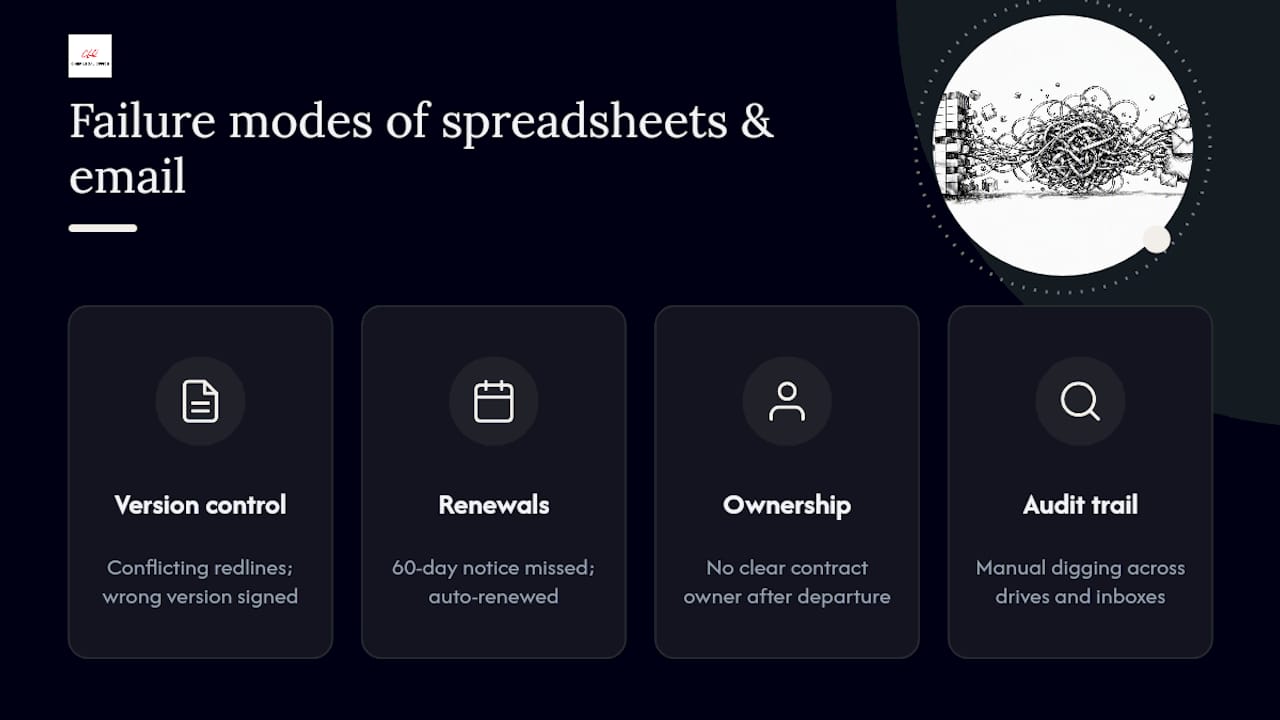
Version control falls apart during negotiation. Someone emails a redline. Someone else emails a different redline of an earlier draft. Three days later, nobody is entirely sure which version is authoritative, and someone signs the wrong one. This isn’t a hypothetical: manual contract management creates exactly this kind of version-control failure, and it becomes a real liability the moment a dispute lands and both sides are holding different “final” versions.
Renewal windows get missed. A vendor contract with a 60-day auto-renewal notice period sits in someone’s inbox, unflagged, until day 61. Now the company is locked into another 12 months of a service it wanted to cancel or renegotiate.
Contracts end up with no clear owner. The salesperson who negotiated the deal left the company eight months ago. Nobody currently at the company knows the contract exists, let alone what it obligates you to do.
Audit trails become archaeology projects. When a regulator, auditor, or acquirer asks for every contract touching a specific vendor or clause, someone has to manually dig through shared drives, personal inboxes, and whatever the last person who “owned” that relationship happened to save.
The pattern across all four failure modes is the same: nobody assigned clear ownership, and nothing forced structure onto the process. Spreadsheets don’t send alerts. Email doesn’t enforce version control. Both require a human to remember, and humans forget, especially when they’re juggling forty other things.
What Does CLM Software Actually Do?
CLM software is not one feature. It’s a set of capabilities that each solve one of the failure modes above, and understanding the mapping helps you evaluate any platform on substance rather than sales pitch.
Repository with structured metadata turns a folder of PDFs into a searchable system where you can filter by expiration date, contract type, dollar value, or counterparty in seconds instead of hours.
AI extraction automatically tags key dates, payment terms, and obligations out of the contract text itself, which is the single highest-value early capability because it makes reporting and alerts possible without manual data entry. Legal teams increasingly rank AI-driven extraction among the highest-impact use cases in the category.
Workflow automation routes contracts through approval gates automatically, escalating to the right person when a deadline or dollar threshold is hit, instead of relying on someone remembering to forward an email.
Templates and clause libraries enforce legal-approved language before a document ever reaches negotiation, which is what actually prevents the version-control chaos described above.
Integrations and e-signature connect the contract to your CRM and finance systems and capture a clean, verifiable signing record, closing the loop from request to execution to renewal.
None of these capabilities matter individually as much as they matter together. A repository without metadata is just a filing cabinet with better lighting. Workflow automation without templates just moves bad drafts faster.
How Do You Roll Out CLM Without Breaking Everything?
The mistake most companies make is trying to automate a process they never actually standardized. That’s like putting a sports car engine into a car with no steering wheel. Here’s the sequence that actually works, in three phases.
Centralize. Get every existing contract into one place, even the ones sitting in someone’s downloads folder from 2021. Upload legacy agreements, capture basic metadata (parties, dates, dollar value, renewal terms), and stop signing anything new outside the system. This single step is what makes reporting and automation possible at every later stage, because you can’t automate what you can’t see.
Standardize. Build your template library, classify contract types by risk level, assign an owner to every category, and write down your playbook: who approves what, what gets escalated, what’s non-negotiable. This is the unglamorous work that nobody wants to do first, which is exactly why most companies skip it and pay for it later.
Automate. Only now do you turn on automated approval routing, renewal alerts, and integrations with your CRM and finance systems. Automating a messy process just moves the mess faster.
For the pilot, resist the urge to automate everything at once. Pick one high-volume, low-complexity contract type, a standard NDA or a vendor renewal, and run the full playbook on just that category first. A contract playbook built around a single pilot scope tends to generate fast, visible wins that build support for the wider rollout, because a stakeholder who sees renewal alerts actually catch a $40,000 contract before it silently renews becomes your best advocate for phase two.
Pro Tip: Don’t pilot on your most complex contract type to “prove the system can handle anything.” Pilot on your simplest, highest-volume type. You want a fast, visible win, not a six-month slog that makes the whole program look slow.
Change management matters here more than the software choice. Give stakeholders (sales, procurement, finance) a clear, simple reason the new process helps them specifically: faster approvals for sales, fewer surprise renewals for finance, less time chasing signatures for procurement. Nobody adopts a new process because legal asked nicely. They adopt it because it makes their job easier.
What KPIs Actually Prove CLM Is Working?
If you can’t measure it, you can’t defend the budget for it at the next leadership meeting. A handful of metrics tell you almost everything you need to know.
Cycle time, broken down by stage: how long from request to draft, draft to redline-complete, redline to approval, approval to signature. A single “days to close” number hides where the actual bottleneck lives.
Renewal pipeline and missed-renewal rate: how many contracts are coming up for renewal in the next 30, 60, and 90 days, and how many slipped past their notice window in the last quarter.
Percentage of contracts with an assigned owner: this number should be at or near 100%. Anything less is a pile of contracts nobody is watching.
Obligations met versus outstanding: are service levels, deliverables, and payment terms actually being tracked and honored after signature, or does the contract get filed and forgotten?
Given that manual tracking commonly costs 5 to 9% of annual revenue, even modest improvement in missed-renewal rate or cycle time translates directly into dollars, not just process satisfaction.
Refresh these numbers monthly at minimum, weekly if you’re early in a rollout and still catching problems. A simple dashboard with a bar chart of cycle time by stage and a countdown list of upcoming renewals does more good than a fifty-tab spreadsheet nobody opens.
What Are the Non-Negotiable Rules for a Contract Playbook?
Every legal team eventually learns these rules the hard way. You can learn them now instead.
Classify before you draft. Every incoming request gets sorted by risk and type before anyone touches a template, which determines the entire approval path that follows.
Use legal-approved templates only, with a controlled clause library that non-lawyers can pull from for standard terms without reinventing language every time.
Gate signatures. No payment, no work, no delivery starts before the contract is fully executed. This sounds obvious until you see how often a sales team starts onboarding a client the week before the contract actually gets signed.
Assign an owner to every contract, with a renewal alert threshold set well before the actual deadline (60 or 90 days out, not seven).
Formalize your close procedure. When a contract ends or terminates, there’s a defined process for archival and audit trail retention, not just “someone drags it into a folder eventually.”
These are described as non-negotiable best practices for good reason: skip any one of them and the whole system degrades back into the spreadsheet chaos you were trying to escape.
Pro Tip: The gating rule is the one teams break first under deal pressure. Sales wants to start work before signature “because the client is basically committed.” Hold the line here. It’s the single easiest way to avoid a contract dispute with no signed agreement to back you up.
How Should CLM Connect to the Rest of Your Tech Stack?
A contract system that doesn’t talk to your CRM or finance software just creates a second place to enter the same data, which means someone eventually stops updating one of them.
Prioritize CRM and finance integrations first. These are the systems already tracking deal value, customer records, and payment terms, so connecting your contract data to them eliminates duplicate entry immediately.
Understand the API-first versus connector-based tradeoff. API-first platforms give you more flexibility for custom workflows but require more setup work; pre-built connectors are faster to deploy but less flexible if your stack is unusual.
Keep your metadata model consistent. If “contract value” means something different in your CLM system than it does in your CRM, every report built on top of both systems will quietly lie to you.
Check security and permissions carefully. Who can view, edit, or approve which contract types, and is every action logged for audit purposes?
Validate AI extraction accuracy before trusting it fully. Run it against a sample of contracts you’ve already reviewed manually and check the error rate before relying on it for compliance-critical dates.
Companies building custom integrations or extraction workflows sometimes bring in specialized development partners; firms like LogicBranch work specifically in this kind of AI-driven SaaS integration space. Legal teams evaluating this path should treat it the same way they’d evaluate any vendor: pilot small, verify accuracy, then scale.
How Do Fractional Legal Teams Actually Run CLM Day to Day?
Designing a playbook on paper is the easy part. Enforcing it every single week, when someone in sales wants to skip the approval gate “just this once,” is where most programs quietly die.
A fractional in-house legal team assigns real ownership to each contract category and holds the line on gating, because there’s a dedicated team watching it instead of a founder trying to remember between board meetings and product launches. The team sets up renewal alert thresholds, keeps the template library current as the business changes, and reports cycle time and compliance metrics the same way an internal legal department would, without the company needing to hire a full legal staff to get there. Chief Legal Office works this way with growing technology companies specifically, because that’s where contract volume tends to outpace internal legal capacity the fastest.
What Legal and Regulatory Rules Apply to CLM?
CLM itself isn’t a regulated activity, but the contracts flowing through it almost always touch rules that are. Data privacy terms in vendor agreements need to reflect actual obligations under frameworks like the California Consumer Privacy Act if you’re handling personal data. Industry-specific requirements (HIPAA for healthcare-adjacent agreements, GLBA for financial data) need to show up in the actual clause language, not just get mentioned in a compliance memo somewhere else.
The compliance risk in CLM usually isn’t a missing clause. It’s an outdated one. A template written two years ago may reference a regulatory standard that’s since changed, and if nobody’s responsible for reviewing the template library periodically, that stale language keeps getting signed into new contracts indefinitely.
This is exactly where structured CLM earns its keep: it reduces compliance gaps by making it possible to search every active contract for a specific clause or obligation in minutes, instead of manually rereading hundreds of documents when a regulation changes. If a new data privacy rule lands, you want to know within the hour which contracts need an amendment, not find out during an audit six months later.
For companies operating across multiple jurisdictions, or industries with sector-specific rules, this is also where it makes sense to loop in legal leadership rather than treat compliance review as a template-library housekeeping task. A quick governance check on AI governance and privacy obligations, for instance, catches issues a generic template review would miss entirely.
How Do You Manage Contract Risk Without Slowing Everyone Down?
Risk management in CLM isn’t about adding more approval steps. It’s about routing risk to the right reviewer instead of routing everything to everyone.
Start by tiering contracts by actual exposure: a standard NDA carries almost no risk and should move through in minutes with minimal review. A multi-year enterprise agreement with custom liability terms carries real exposure and deserves real attention. The mistake most legal teams make is treating every contract like the second category, which is how a two-person legal team ends up buried reviewing routine paperwork instead of the deals that actually matter.
Build risk flags directly into your intake process: unusual indemnification language, liability caps above a set threshold, non-standard termination terms, and unfamiliar counterparties should all trigger automatic escalation to a senior reviewer. Everything else follows the standard template path.
The other half of risk mitigation happens after signature, not before. A contract with a strong indemnification clause is worthless if nobody’s tracking whether the counterparty is actually meeting their service-level obligations. Obligation tracking, tied to real calendar reminders and real owners, catches the breach while it’s still fixable instead of after it’s become a six-figure dispute. This is also where commercial transaction support from an experienced legal team pays for itself, because catching a risky clause before signature is dramatically cheaper than litigating it after.
Can CLM Systems Scale and Customize as You Grow?
The CLM setup that works for 50 contracts a year will not survive 500. This is where a lot of companies get burned buying a system built for their current size instead of their size in two years.
Scalability in CLM comes down to whether the underlying data model can absorb new contract types, new business units, and new jurisdictions without a full rebuild. A system with rigid, hardcoded contract categories will need constant workarounds as the business diversifies. A system built on flexible metadata fields adapts by adding new tags, not rebuilding the whole structure.
Customization matters just as much on the workflow side. A 20-person startup and a 500-person company need very different approval chains, and the system should let you adjust routing rules as your org chart changes, without needing a developer every time you add a new approver.
The practical test: as contract volume grows into the hundreds or thousands, manual workarounds compound into errors and revenue leakage fast. If your current process would break under triple the volume, that’s the signal to invest in a more scalable structure now, before the breaking point arrives at the worst possible time, mid fundraise, mid acquisition, or mid audit.
How Secure Is CLM Data, and What Should You Check?
A contract repository holds some of the most sensitive information a company has: pricing terms, customer data, IP assignments, litigation history. Treating it with less security rigor than your financial systems is a mistake plenty of companies only notice after something goes wrong.
At minimum, verify that any CLM system supports role-based permissions, so someone in sales can’t view legal’s litigation hold notes and someone in finance can’t edit contract terms they had no part in negotiating. Every access and edit should generate a logged, timestamped audit trail, both for internal accountability and because that trail is exactly what you’ll need to produce if a dispute or regulatory inquiry ever asks who touched a document and when.
Data residency and encryption standards matter more for companies with customers or operations spanning multiple jurisdictions, since contract data itself may be subject to the same data-transfer rules as any other regulated personal information. Before choosing or configuring a system, confirm where data is actually stored and whether that satisfies your specific regulatory footprint, rather than assuming a vendor’s general compliance claims cover your exact situation.
How Do You Get a Team to Actually Use the New Process?
The best-designed CLM playbook fails if the people using it every day route around it. Training and change management aren’t an afterthought here. They’re half the project.
Start training with the people who feel the most pain today, usually sales or procurement, because they’re the ones currently waiting weeks for contract turnaround. Show them specifically how the new process shortens their wait, not just how the system works in the abstract. People adopt tools that solve their problem, not tools that solve legal’s problem.
Keep the initial rollout narrow. Train on one contract type and one workflow first, let people get comfortable, then expand. Trying to train the whole organization on the entire system in one session guarantees that most of it gets forgotten by the following week.
Assign a point person outside of legal, someone in sales ops or procurement, who champions the new process day to day and can answer quick questions without every query landing back on legal’s desk. That single change dramatically increases adoption speed, because people are far more likely to ask a peer a quick question than file a ticket with legal.
What’s the One Move That Pays Off Fastest?
If you take one thing from this: centralize your contracts and pilot the renewal pipeline before you touch anything else. It’s the fastest path to a visible win, because catching one missed renewal pays for the whole effort. The trap is trying to automate a messy process before you’ve standardized it. Fix the process first. The software should enforce discipline you already have, not manufacture discipline you don’t.
— Amy Natasha Osteen
How Chief Legal Office Helps You Build and Run a CLM Playbook
You don’t need to hire a full-time General Counsel to get your contract process under control. Chief Legal Office is the alternative to sitting between “founder handles everything” and “build a whole legal department”: a fractional in-house legal team designs your templates, sets the approval gates, assigns real ownership, and then actually enforces the playbook week after week, instead of leaving you a binder nobody opens.
That’s the part most companies underestimate. Writing a contract playbook takes a few weeks. Enforcing it for the next three years, catching the renewal nobody flagged, updating the template when a regulation changes, is the ongoing work that determines whether the whole thing actually protects you. Chief Legal Office’s Fractional Chief Legal Office model puts a senior legal leader and a full support team on this specifically, so growing technology, private equity, and mission-driven companies get real legal department structure without the cost or delay of a full-time hire. If your contract volume is starting to outpace what a founder or a single outside lawyer can track, take a look at the pricing plans, Foundations, Embedded Access, and Strategic Growth, and reach out to talk through which level of support fits where your company is right now.
Sources
The claims and figures in this article draw on a mix of legal industry analysis and operational research into contract management costs and practices.
FAQ
What Is Contract Lifecycle Management?
Contract lifecycle management is the process and technology used to control a contract from initial request through drafting, negotiation, approval, signature, and renewal. It governs the contract at every stage to reduce compliance gaps and improve visibility into obligations and deadlines.
What Is the CLM Process Flow?
The typical flow runs through seven stages: request and intake, template authoring, drafting and negotiation, approval, execution and e-signature, post-signature obligation tracking, and renewal or archival. Each stage needs a defined owner and a clear handoff to the next, or the process breaks down at exactly the points spreadsheets and email can’t enforce structure.
What Is the Difference Between CMS and CLM?
A contract management system (CMS) usually refers to a basic repository for storing and retrieving signed contracts, similar to a filing cabinet with search. CLM covers the entire process end to end, including drafting, negotiation workflows, approval routing, and post-signature obligation tracking, not just storage after the fact.
What Is the Difference Between a CRM and CLM?
A CRM tracks customer relationships, deal stages, and sales pipeline data, while CLM manages the actual contract documents and their legal obligations. The two systems work best connected: CRM data (deal value, customer record) should feed directly into the contract without anyone re-entering it manually.
What Does CLM Support From Chief Legal Office Cost?
Chief Legal Office’s ongoing plans for fractional in-house legal support, which include CLM playbook design and enforcement, are listed as Foundations, Embedded Access, and Strategic Growth at published monthly rates. Exact scope and fit depend on company size and contract volume, so a direct conversation is the fastest way to find the right plan.
The lawyerly fine print: This article is for general information, not legal advice…