In House Legal Teams: Pilot a Contract Playbook on 10–15 Deals
A contract playbook is a clause-by-clause instruction manual that tells negotiators exactly what to offer, what to accept as a fallback, and when to stop and escalate. The payoff is speed: reviewers stop reinventing positions on every NDA or MSA, legal risk stays consistent across deals, and fewer routine questions land on senior counsel’s desk. The smartest way to build one isn’t to write a comprehensive legal encyclopedia. It’s to pick one contract type and get it right.
TL;DR:
A contract playbook should include a preferred clause, one or two fallback options, and a clear escalation point for each key issue.
Building a focused, six-clause playbook for high-volume contract types like NDAs often leads to higher adoption than creating an exhaustive manual.
Regular maintenance, owner accountability, and integration with contract management tools are crucial to keep playbooks current and effective.
Most successful playbooks are developed through pilot projects on live deals, with feedback used to refine positions rapidly.
Partnering with experienced legal teams or fractional services can ensure proper creation, implementation, and ongoing updates.
Chief Legal OfficeBuild a Legal Function That ScalesChief Legal Office helps growing technology companies organize recurring legal work, manage priorities, and prepare for what comes next.Learn about Chief Legal Office
Table of Contents
What Is a Contract Playbook, and Who Actually Uses One?
Why a Playbook Pays for Itself Fast
The Three-Tier Structure Every Entry Needs
How to Build Your First Contract Playbook This Quarter
Where Contract Management Software and AI Actually Help
Turning the Document Into Daily Habit
How a Fractional Legal Team Keeps Playbooks From Going Stale
What Most Playbook Advice Gets Backwards
Get a Playbook Built by People Who’ve Run Legal Departments
Sources
What Is a Contract Playbook, and Who Actually Uses One?
A contract playbook is not the same thing as a template, and it’s not a clause library either, though people mix these up constantly.
A template is a starting document. A clause library is a repository of pre-approved language. A playbook is the decision layer that sits on top of both: it tells a reviewer which clause to pull, why, and what to do if the other side pushes back. Think of it as the difference between a cookbook and a pantry. The pantry has ingredients. The playbook tells you what to cook and how much salt is too much.
Legal operations teams, in-house counsel, contract managers, and increasingly sales and procurement staff handling first-pass reviews all lean on playbooks. They’re most useful for:
High-volume agreements like NDAs and vendor terms
Recurring commercial contracts such as MSAs and order forms
Any deal type where the same three or four issues (liability caps, indemnification, termination rights) come up over and over
If your team negotiates the same clause fight every week, that’s the signal you need a playbook.
Why a Playbook Pays for Itself Fast
The business case is simple: a playbook converts legal judgment into something repeatable, so contracts move faster without anyone cutting corners on risk.
Teams that adopt one typically see:
Shorter review cycles, because reviewers aren’t drafting positions from scratch
Fewer escalations, since most deviations already have a pre-approved fallback
Consistent risk posture across deals, instead of “whoever reviewed it that day” variance
Documented approvals that make audits and diligence far less painful
Data on where negotiations actually get stuck, which tells you what to fix next
Pro Tip: Track which clauses trigger the most fallback usage in your first quarter. That list is your roadmap for what to renegotiate at the master-agreement level with high-volume counterparties.
The best-practice structure behind most effective playbooks is a three-tier hierarchy, which is worth understanding before you build anything.
The Three-Tier Structure Every Entry Needs
Every clause entry in a usable playbook follows the same skeleton: a preferred position, one or two fallback positions, and a walk-away trigger. This three-tier hierarchy is what separates a real playbook from a folder of old contracts.
Each entry should capture:
Preferred position: your opening ask, in exact language a negotiator can paste into a redline
Fallback A and B: acceptable retreats, also pre-drafted, not left for someone to improvise mid-call
Walk-away trigger: the point where the deal stops or gets escalated, no exceptions
Rationale: two sentences explaining the business or regulatory reason behind the position
That rationale line matters more than people expect. Legal ops guidance is consistent on this: without a short “why,” a playbook turns into a rigid rulebook that negotiators either follow blindly or ignore entirely. Neither is good.
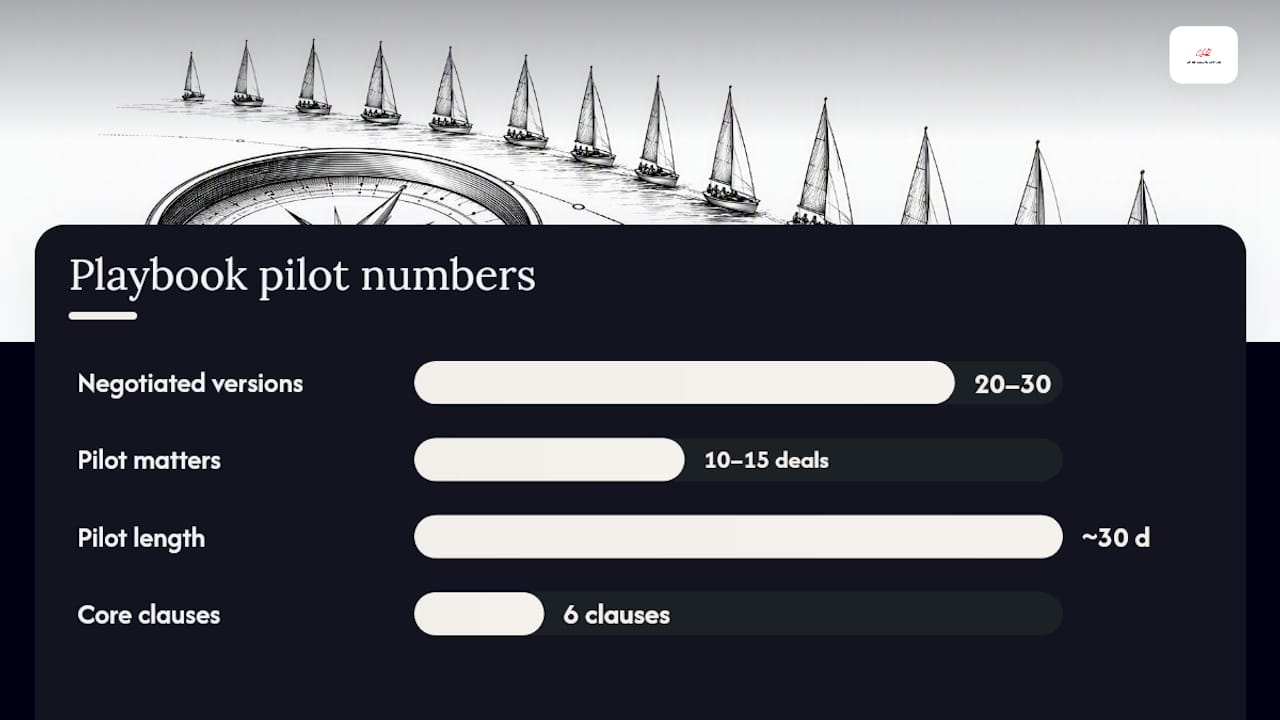
Organize entries by contract type first, then by clause topic within each type, so a reviewer working an NDA never has to wade through MSA indemnification language to find what they need. For a first build, prioritize the clauses that generate the most back-and-forth: limitation of liability, indemnification, termination for convenience, data protection, IP assignment, and governing law. Six clauses, done well, beats sixty done halfway.
How to Build Your First Contract Playbook This Quarter
Building a playbook is less about legal drafting and more about project management. A five-step process works reliably for teams doing this for the first time.
Plan: pick one contract type. NDAs are the classic starting point because volume is high and stakes per deal are low.
Assess: pull your last 20 to 30 negotiated versions of that contract and look for patterns. Where did redlines cluster? Interview whoever actually approves exceptions today.
Prepare: draft the preferred, fallback, and walk-away language for each priority clause, with a rationale for each.
Implement: run a pilot. Apply the playbook to 10 to 15 real matters over about 30 days and collect feedback from whoever used it.
Maintain: assign an owner, set a review cadence, and version every update so nobody’s working from a stale copy.
Starting small isn’t a compromise. A tight, six-clause playbook for a high-volume contract gets adopted faster and used more consistently than an ambitious library nobody finishes building.
Pro Tip: During the pilot, ask reviewers one question after every deal: “Did the playbook answer your question, or did you have to guess?” That single data point tells you more than a formal survey.
Where Contract Management Software and AI Actually Help
Technology’s job here is enforcement, not judgment. Embedding your playbook positions into a contract management (CLM) platform and clause library means the fallback language is one click away instead of buried in someone’s inbox from eighteen months ago.
The realistic capabilities worth using:
Automatic deviation detection that flags when incoming redlines fall outside your approved positions
Risk scoring and routing that sends higher-risk deviations straight to the right approver
AI-assisted pattern mining across past negotiations to surface where concessions cluster
Dashboards tracking review time, escalation rate, and fallback usage by clause
The catch: AI tools mining historical redlines can just as easily surface bad old concessions as good ones. Every AI-suggested fallback needs a human decision-maker to sign off before it becomes policy. Tools like AddBack’s pre-deal intelligence platform can add useful analytics layers here, but the playbook itself, and who approves what goes in it, stays a legal decision.
Turning the Document Into Daily Habit
A playbook nobody reads is just a longer template. Adoption depends on training, access controls, and a governance rhythm that keeps the thing alive.
Give new hires the playbook as an onboarding task rather than a reference document they discover on their own. Role-based access matters too: junior reviewers might see preferred and fallback positions, while walk-away triggers and legal-only rationale stay visible to senior staff. Your escalation matrix should name actual people, not just titles, with the practical detail (email, Slack handle) that gets a question answered same-day instead of stuck in a queue.
Set review cadence at quarterly, plus trigger-based updates when law or business terms shift
Assign a single named owner accountable for version control
Track KPIs: average review time, escalation rate, percentage of preferred positions accepted, and how often the document gets updated
Pro Tip: If your escalation rate climbs quarter over quarter, that’s not a compliance problem. It usually means your fallback positions are stale and the market has moved past them.
How a Fractional Legal Team Keeps Playbooks From Going Stale
Most playbooks fail not at creation but at maintenance. Someone builds a great one, then six months pass, market terms shift, and nobody owns the update. Some fractional legal service providers structure Client Success Teams specifically to prevent that gap: a senior attorney owns the playbook’s legal judgment, while paralegals and legal administrators handle the version control and routine upkeep that otherwise falls through the cracks.
A practical contrast worth internalizing: a six-clause NDA playbook and a full MSA playbook are different projects with different owners and update rhythms. Start with the NDA, prove the model works, then expand into MSAs or vendor terms only once the first playbook is actually being used daily. Adding contract types before the first one sticks is the fastest way to create scope creep and an abandoned project. Meet the team behind this approach.
What Most Playbook Advice Gets Backwards
Most of the content out there treats a contract playbook like a legal document project: hire a drafting team, write exhaustive positions for every clause in every contract type, ship a 200-page manual, declare victory. That approach is why so many playbooks die in a shared drive within a year.
The evidence points somewhere else. A tight, six-clause playbook for one high-volume contract beats a comprehensive library nobody finishes, every time. The reason is adoption, not quality. A reviewer will actually open a document that answers their question in thirty seconds. They will not open a 200-page manual under deal pressure, no matter how well it’s drafted.
The other place conventional advice falls short is treating the playbook as a static artifact instead of training infrastructure. The real value shows up when new hires learn your company’s risk tolerance by working through the playbook, not by shadowing a senior lawyer for six months. That’s a faster, cheaper way to build institutional judgment than most legal teams realize.
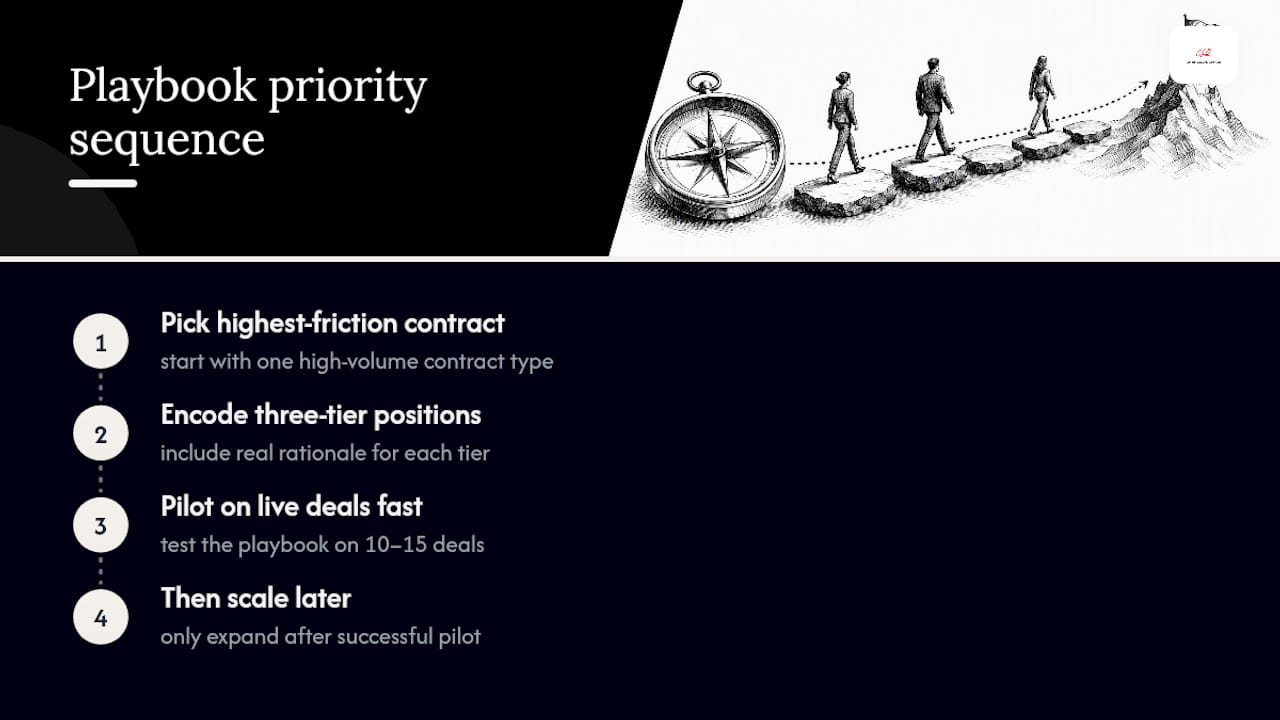
If you’re starting from zero, prioritize in this order: pick the highest-friction contract type, encode three-tier positions with real rationale, pilot on live deals fast, and only then think about scaling. Comprehensive can wait. Useful can’t.
— Amy Natasha Osteen
Get a Playbook Built by People Who’ve Run Legal Departments
Building a playbook is straightforward on paper. Doing it while also running deal review, managing outside counsel, and answering the CEO’s questions about a term sheet is where most in-house teams get stuck. That’s the practical gap Chief Legal Office fills, not with another consultant handing you a template, but with a Client Success Team that drafts the playbook, pilots it on your real contracts, and stays accountable for keeping it current.
The relevant services include playbook creation and clause library design, escalation governance, ongoing contract review support, and integration guidance for whatever CLM or AI tooling your team already runs. Growth-stage technology companies and their investors use this to get playbook infrastructure without hiring a full legal department first. If you’re ready to talk through what a first playbook would look like for your contracts, start with a conversation about fractional General Counsel services.
Sources
Contract Playbook Template: Key Clauses and Components - LegalClarity
How to Create Contract Playbooks Your Legal Team Will Actually Use - Bloomberg Law
Contract playbooks: the handbook every in-house lawyer needs - Lexology
How to Create Contract Playbooks Your Legal Team Will Actually Use - How to Contract
Recommended
The lawyerly fine print: This article is for general information, not legal advice…