Stop the Five Risky Clauses: Contract Review Process for GCs
A good contract review process catches the five clauses that cause most of the trouble before signature, not after. Start by triaging every incoming contract, then read liability, indemnity, termination, IP, and data terms first. The rest of the checklist, playbook, and governance steps below build from there.
TL;DR:
Prioritize reviewing liability, indemnity, termination, IP, and data terms first, as these clauses most frequently cause disputes and legal issues.
Triage contracts by risk level and total contract value, assigning different review SLAs for low-risk and high-risk deals to ensure timely processing.
Develop a standardized playbook with accept, fallback, and walk-away positions for key clauses to prevent repetitive debates and streamline negotiations.
Use AI tools for initial data extraction and renewal reminders, but keep high-risk clause review strictly human-led to maintain accuracy and judgment.
Ensure contracts are routed to appropriate reviewers at intake, filed with full metadata, and regularly audited to catch discrepancies and enforce process discipline.
Chief Legal Officechieflegaloffice.comBuild Contract Review That ScalesChief Legal Office provides senior legal leadership and a dedicated team to organize contracts, manage priorities, and keep legal work moving.Learn about Chief Legal Office
Table of Contents
Key Takeaways
What Contract Review Actually Does for the Business
Who Should Review Contracts, and Who Signs Off
The Mistakes That Cost the Most, and the Fast Fix
The Step-by-Step Contract Review Checklist
Building a Playbook and SOP That Actually Scales
Where Software and AI Actually Help
How a Fractional Legal Department Runs This in Practice
Three Rules Worth Adopting This Quarter
How Chief Legal Office Builds This for You
Where to Find the Original Procedures
Sources
FAQ
Key Takeaways
Read the high-impact clauses first: liability, indemnity, termination/renewal, IP, and data/DPA terms drive most disputes.
Triage every contract by risk and total contract value (TCV), then enforce a different service-level agreement (SLA) for each tier.
Write accept, fallback, and walk-away positions into a playbook so reviewers stop re-litigating the same fights.
Use software for first-pass extraction and renewal calendaring, but keep a human on anything flagged high-risk.
Route contracts to the right reviewer at intake instead of letting them land on whoever’s desk is open.
What Contract Review Actually Does for the Business
Contract review isn’t a compliance ritual. It’s how a business confirms that a deal will hold up when things get tense: when a customer wants out early, when a vendor’s product breaks, when an investor asks who owns your code.
Done right, it delivers three things: enforceability, a ceiling on how much a bad outcome can cost you, and clarity on what happens if either side wants to leave. Done poorly, it creates the opposite. Auto-renewal clauses nobody flagged turn into contracts you can’t exit for another year. Uncapped indemnities turn a $50,000 vendor deal into unlimited exposure. Missing exhibits mean the deal everyone thinks they signed isn’t the deal on paper.
None of that requires bad lawyering. It just requires no process at all, which is the default state for most growing companies.
Who Should Review Contracts, and Who Signs Off
A contract manager or paralegal handles intake and low-risk paper. The business owner supplies deal context: value, timeline, what actually got negotiated verbally. In-house counsel reviews the substantive clauses. Your general counsel (GC) or outside counsel only sees what crosses a dollar or risk threshold.
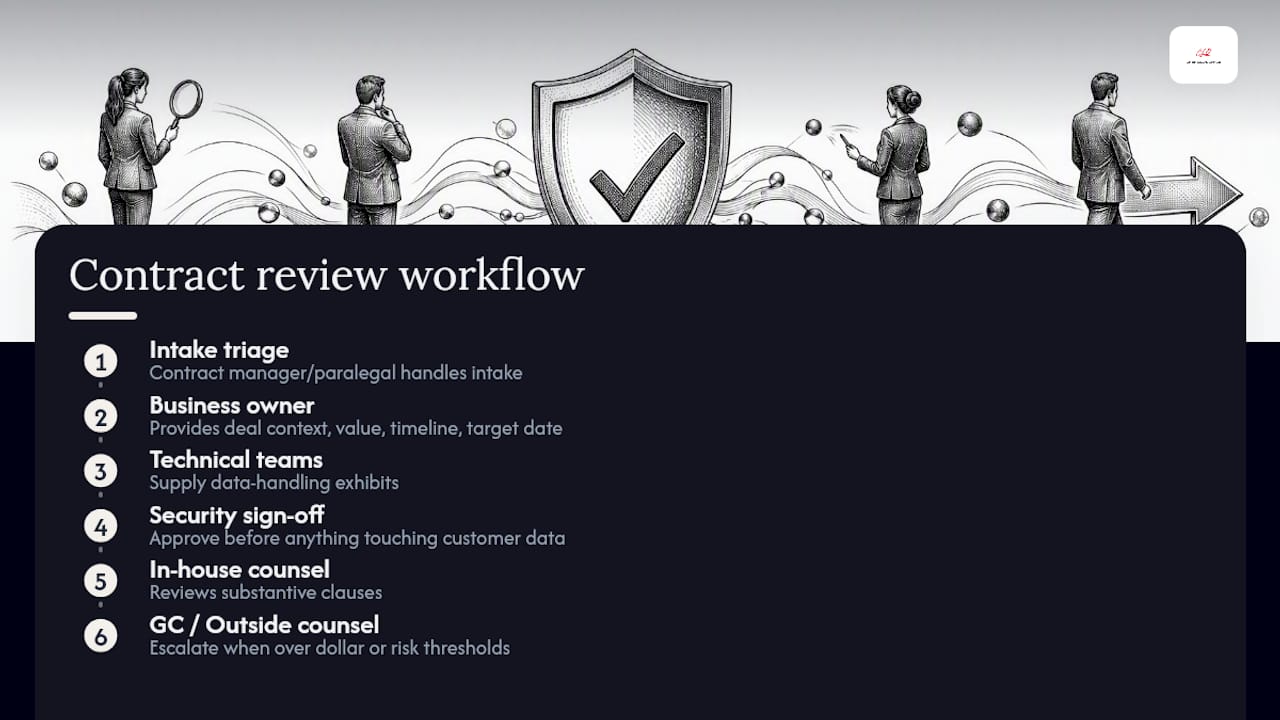
At intake, each role owes the process something specific: the business owner brings deal terms and target signature date, technical teams supply data-handling exhibits, and security signs off before anything touching customer data moves forward.
The Mistakes That Cost the Most, and the Fast Fix
Most contract review problems trace back to a handful of repeatable errors.
Reading everything with equal attention. Fix: read the five high-impact clauses first, every time, regardless of contract length.
Reviewing without deal context. Fix: require an intake form capturing TCV, target date, and counterparty before review starts.
No repository or calendar. Fix: file every executed contract with metadata and set renewal reminders the day it’s signed.
Escalating based on gut feel. Fix: set numeric thresholds (dollar value, liability cap, data sensitivity) that trigger escalation automatically.
Pro Tip: Insist on one consolidated redline per round of negotiation. When five people send five separate mark-ups, you’re not negotiating a contract anymore, you’re running a scavenger hunt for the current version.
The Step-by-Step Contract Review Checklist
Here’s the operational sequence, the one you can hand to a paralegal or operations lead and expect them to run without hand-holding.
Intake. Capture the legal entity involved, counterparty contact, contract type, TCV, target signature date, what categories of data the deal touches, and who owns the deal internally. Skipping this step is the single biggest reason reviews stall, because someone always has to go chase down information that should have arrived on day one.
Triage. Assign a tier based on risk and dollar value. A low-risk NDA with standard terms might clear quickly while a complex, data-heavy master services agreement (MSA) with a high total contract value (TCV) could take several days. Time allocations per tier work best when they’re communicated to the business at intake, so nobody’s surprised when a complex deal doesn’t move at NDA speed.
Clause-priority pass. Read liability, indemnity, termination/renewal, IP, and data/DPA terms first, and record every deviation from your standard positions. This is the step people skip when they’re rushed, and it’s the one that actually matters. A contract with a beautifully clean payment schedule and an uncapped indemnity clause is still a bad contract.
Negotiate. Produce a single consolidated redline. Track concessions as you make them, not from memory two weeks later when someone asks why you agreed to a 90-day termination notice. Map your fallback position before you send the redline, so you’re not improvising when the other side pushes back.
Approvals and execution. Route the contract through your approval matrix based on tier. Prepare the execution copy, and check that every exhibit referenced in the body is actually attached. A signed contract missing Exhibit B isn’t a signed contract, it’s a problem waiting for someone to notice.
Post-signature. File the executed copy with full metadata, calendar every renewal date and ongoing obligation, and audit a sample of executed contracts quarterly to catch drift between what your playbook says and what actually got signed.
Stage | Owner | Typical SLA |
|---|---|---|
Intake | Contract manager/paralegal | Same day |
Triage | Contract manager | Within 1 business day |
Clause review (low tier) | Paralegal or junior counsel | 1 to 2 days |
Clause review (high tier) | In-house counsel or GC | 3 to 5 days |
Execution | Business owner + counsel | Same day once approved |
Post-signature filing | Contract manager | Within hours of signature |
This sequence mirrors what university and public-entity legal offices already run at scale. The University of Texas System’s contract review procedures formalize intake forms, threshold review amounts, and stepwise routing precisely because institutions can’t afford ad hoc review when hundreds of contracts move through their office every year. A practical checklist for in-house teams follows the same logic: intake, clause priorities, redline discipline, approvals, and calendaring, in that order.
Building a Playbook and SOP That Actually Scales
A playbook only works if it removes decisions, not just documents them. For every recurring clause, write down your preferred position, your fallback, and your walk-away line. When indemnity comes back uncapped, your team shouldn’t be debating philosophy. They should be checking the playbook.
Clause positions: accept/fallback/walk-away language for liability caps, indemnity, termination/renewal, IP ownership, and data protection terms.
Tiered routing with numeric triggers: for example, contracts under $25,000 with no data exposure route to a paralegal; anything above $250,000 or touching regulated data escalates to the GC.
SOP essentials: intake field requirements, an approval matrix by tier, defined AI autonomy settings, and clear ownership of playbook version control.
Governance: sample a percentage of executed contracts each quarter, review clause positions annually, and manage changes to the playbook the same way you’d manage a policy update.
A structured playbook that pairs clause positions with tiered routing is what separates a legal function that scales from one that burns out its best reviewer on every deal.
Where Software and AI Actually Help
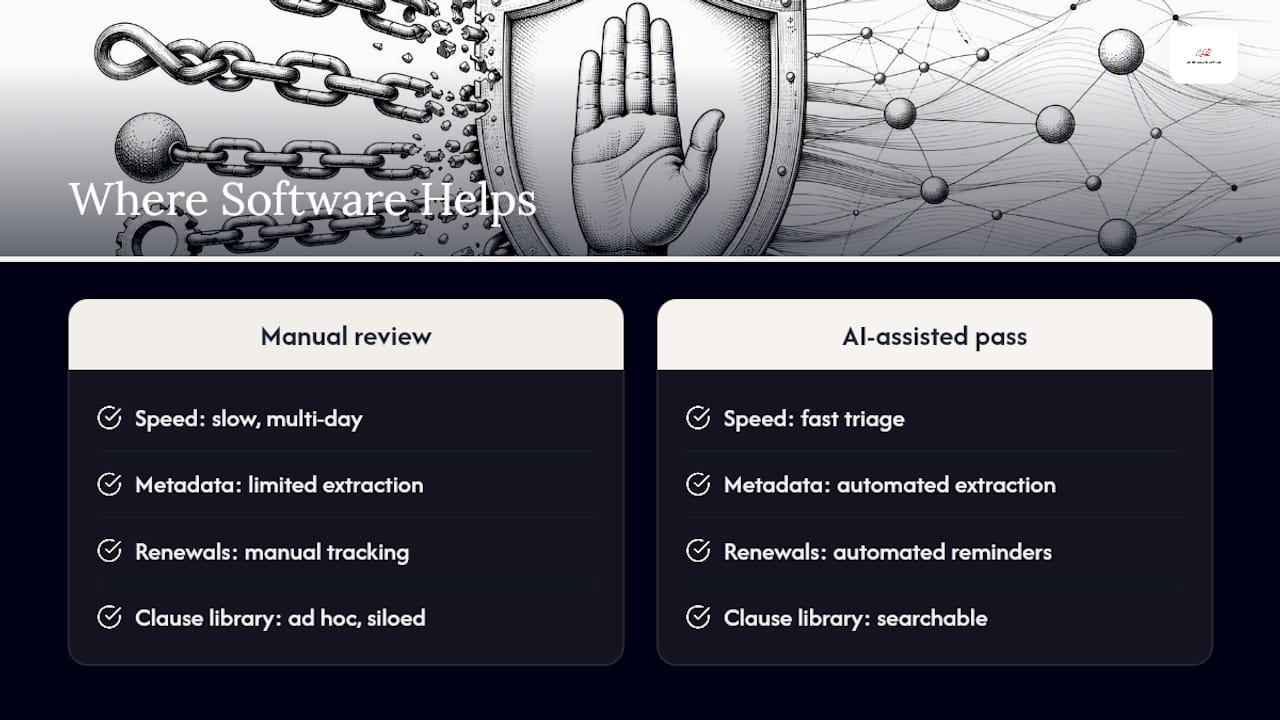
Artificial intelligence is genuinely useful for one job: getting through the first pass fast. Use it to extract metadata, flag deviations from your playbook, and surface renewal dates before you’d otherwise notice them. Don’t let it decide your fallback position on an indemnity clause. That’s still a judgment call.
The real wins are triage speed, searchable clause libraries, automated renewal reminders, and cycle-time analytics that show you where reviews actually bottleneck. Manual review benchmarks show full-cycle reviews can stretch across many days when done entirely by hand, while AI-assisted first passes shrink that considerably, though high-risk clauses still need a human set of eyes.
The safeguard that matters most is an SOP that names the autonomy level you’re granting the tool, whether that’s assistive, supervised, or fully autonomous, paired with regular accuracy audits so the tool’s behavior doesn’t quietly drift from what your playbook actually says.
How a Fractional Legal Department Runs This in Practice
A fractional in-house legal department applies this exact structure, just staffed differently. A senior GC leads the account, sets the playbook, and owns escalation decisions. Routine reviews route to attorneys and paralegals at the appropriate tier. Executive-level questions, like a major customer renegotiation or an investor’s data terms, stay with the senior lead, while technology-specific contract issues get routed to whoever on the team has actually handled that fact pattern before.
Three Rules Worth Adopting This Quarter
If you only fix three things, fix these. Triage every contract at intake and give each tier its own SLA. Write fallback positions for the five clauses that cause the most fights, and publish the playbook so it’s not living in someone’s head. Then calendar and audit: store executed contracts with full metadata, and run a quarterly sample audit so drift gets caught before it becomes a pattern.
None of this is complicated. It’s just unglamorous, and unglamorous work is exactly the kind that founders postpone until a renewal clause bites them.
— Amy Natasha Osteen
How Chief Legal Office Builds This for You
Most companies don’t need a lecture on contract review, they need someone to actually run it. That’s the gap Chief Legal Office fills: ongoing ownership of your contract review function, not a one-off consultation.
A typical engagement includes a working playbook with accept/fallback/walk-away positions for your recurring contract types, an intake form your team actually uses, a routing SOP with defined tiers, staffing across multiple review tiers, and a quarterly audit to catch drift before it costs you. For contracts involving forensic data recovery or vendor security obligations, we also coordinate with technical partners like Recovera Forensics when a deal requires that kind of specialized review.
If you’re tired of contract review happening in the gaps between everything else you’re supposed to be doing, take a look at our fractional General Counsel services and see what a dedicated team looks like for a company your size.
Where to Find the Original Procedures
The University of Texas System’s contract review procedures show intake and threshold rules in full. The in-house team checklist offers a template you can adapt directly.
Sources
FAQ
What Is the Contract Review Process?
It’s the sequence a business follows to evaluate a contract before signing: intake, risk triage, a focused read of high-impact clauses, negotiation, approval, execution, and post-signature filing.
How Long Should a Contract Review Take?
It depends entirely on the tier. A standard NDA can clear in under an hour, while a data-heavy MSA with a high dollar value can reasonably take several days.
What Is a Contract Review Checklist?
It’s a step-by-step list covering intake metadata, clause priorities, redline practices, approval routing, execution verification, and post-signature calendaring, built so nothing gets missed under deadline pressure.
What Is the Turnaround Time for a Contract Review?
Turnaround varies by tier and complexity, but setting a clear SLA per tier at intake, rather than promising one blanket turnaround time for every contract, is what keeps the business side from getting frustrated.
How Do You Redline a Contract Correctly?
Produce one consolidated redline per negotiation round instead of letting multiple stakeholders send separate mark-ups, and track every concession as you make it so the fallback position stays visible to the whole team.
Recommended
The lawyerly fine print: This article is for general information, not legal advice…