First 72 Hours: CLO Data Breach Response Plan for U.S. Companies
A legally defensible data breach response plan must be approved before an incident happens, tested through real exercises, and able to coordinate containment, forensics, regulatory notification, and communications within hours, not days. The moment you discover a breach, your first move is simple: assemble your Incident Manager, isolate affected systems without destroying evidence, and get legal and forensic partners on the phone.
TL;DR:
Confirm the breach quickly, isolate affected systems to preserve evidence, and involve legal and forensic teams without powering down devices unless properly documented.
Notify affected individuals within 60 days under HIPAA, report breaches affecting 500 or more to HHS within the same timeframe, and coordinate with vendors and regulators early.
Maintain offline copies of response plans and signed scope agreements with forensic vendors to ensure readiness and legal defensibility during investigations.
Use pre-approved messaging templates tailored to each audience and synchronize communications with legal and forensic teams to avoid legal liability.
Prioritize identifying high-value data, map specific breach scenarios, and establish clear activation criteria to prevent response delays during incidents.
Chief Legal Officechieflegaloffice.comKeep Breach Response Legally ReadyChief Legal Office provides senior legal leadership and a dedicated team to help technology companies manage complex, ongoing legal work.Learn about Chief Legal Office
Table of Contents
Step-by-step operational checklist for the first 0 to 72 hours
U.S. legal and regulatory obligations: notification timing and portals
Forensics and evidence preservation: protecting legal defensibility
Communications and notification templates: who, when, and what to say
Post-incident review and plan improvement
Roles and responsibilities for a breach response team
Risk assessment and breach scenario identification before plan development
Criteria and thresholds for activating the breach response plan
Integration with cybersecurity tools and monitoring systems for early detection
Data classification and prioritization to focus response efforts
Coordinating with third-party vendors or partners during a breach
Crisis communications strategy, spokesperson designation, and media handling
Chief Legal Officer perspective: practical trade-offs and escalation guidance
How we support breach response and ongoing readiness
FAQ
Sources
Step-by-step operational checklist for the first 0 to 72 hours
The first 72 hours decide whether your breach becomes a manageable incident or a multi-year legal headache. Speed matters, but speed without discipline destroys the evidence you will need later. Here is the sequence we recommend to every client who calls us mid-crisis.
Confirm and classify. Verify the incident is real, assign an Incident Manager, and classify severity based on data type and scope.
Contain without destroying. Isolate affected hosts from the network, rotate compromised credentials, and take system snapshots before anyone starts “cleaning up.”
Preserve evidence. Stop remediation that could overwrite logs, and begin forensic imaging with documented chain of custody.
Call your contacts. Loop in your forensic vendor, outside incident counsel, cyber insurer, and, where relevant, law enforcement.
Set checkpoints. Reassess scope and legal exposure at the one hour, 24 hour, and 72 hour marks, and decide when regulators or the public need to hear from you.
The FTC’s data breach response guidance recommends disconnecting affected devices from the network rather than powering them down, since shutting a machine off can wipe the very memory forensic investigators need. If you must power down, document why and what was likely lost. The FTC also points to law enforcement contacts worth having ready before you need them, including local police, the FBI, and the U.S. Secret Service depending on the nature of the breach.
Your forensic vendor and cyber insurer should already be named in your plan. Scrambling to find them while your network is compromised is how companies end up hiring the wrong firm under pressure, at the wrong price, with no prior relationship.
Pro Tip: Keep a printed, offline version of your incident response plan and contact list. If your network is down, your digital copy of the plan is down with it.
U.S. legal and regulatory obligations: notification timing and portals
This is where founders get nervous, and for good reason: the notification landscape is a patchwork, not a single federal rule.
HIPAA covered entities and business associates have a hard deadline: notify affected individuals without unreasonable delay and no later than 60-day calendar days after discovery, under the HHS Breach Notification Rule.
Breaches affecting 500 or more individuals must also be reported to HHS within that same 60-day window, through the HHS breach portal.
Every state has its own breach notification law. Triggers, timelines, and required content vary, so check the jurisdiction where affected individuals live, not just where your company is headquartered.
The FTC expects quick, truthful communication and practical mitigation steps, and its guidance includes model notification language you can adapt rather than draft from scratch under pressure.
The 60 day HIPAA clock is a ceiling, not a target. HHS guidance sets that deadline, but “without unreasonable delay” is the operative phrase, and regulators read it literally.
Public companies carry an additional layer. Once you determine a cybersecurity incident is material, you generally need to disclose it on Form 8-K, using Item 1.05 or Item 8.01 depending on where you are in the assessment. Recent SEC filings show companies disclosing incidents while materiality assessments are still ongoing, which tells you something important: waiting for perfect certainty is not a defensible strategy.
Forensics and evidence preservation: protecting legal defensibility
Sloppy evidence handling turns a bad week into a bad lawsuit. Volatile memory, access logs, and system images degrade or disappear fast, and once they are gone, you cannot unclose them.
Image affected systems and preserve cloud logs before anyone “fixes” anything.
Document timestamps and maintain a clear chain of custody for every piece of evidence collected.
Vet forensic vendors on scope of work, chain-of-custody procedures, deliverables, and confidentiality terms, not just price or availability.
Validate backups thoroughly before restoring from them. A “clean” backup that still contains the attacker’s foothold just reintroduces the problem.
CISA’s StopRansomware guidance recommends isolating impacted systems and taking network snapshots before coordinating with law enforcement or CISA directly.
Pro Tip: When you engage a forensic firm, get a signed scope of work that includes chain-of-custody procedures and a commitment to a forensically sound report. You will likely need that report surviving a regulator inquiry or a lawsuit later.
Communications and notification templates: who, when, and what to say
Getting the message right matters as much as getting it out fast. Rushed, inconsistent communication creates legal exposure on top of the breach itself.
Map your audiences first. Board and executives, employees, customers, business partners, regulators, media, and investors each need different timing and different content.
Hit the minimum notification elements. What happened, what data types were involved, what you are doing about it, and how recipients can reach you. HIPAA notifications carry additional required content under HHS rules.
Use pre-approved holding statements. A template drafted calmly in advance beats a statement drafted in a panic at 2 a.m.
Coordinate timing with legal and forensics. Sending a customer notice before you know the scope invites a correction later, and corrections erode trust faster than delay does.
Pro Tip: Draft your holding statements and notification templates before you need them. Editing a template under deadline pressure is far safer than writing one from scratch.
Post-incident review and plan improvement
Once the immediate fire is out, the real work starts. Run a blameless postmortem: assemble the timeline, the evidence, and input from every team involved, without turning it into a finger-pointing exercise. People hide information when they fear blame, and hidden information is exactly what you cannot afford.
Prioritize remediation by business impact, not by what is easiest to fix first.
Assign owners and deadlines for every fix, or it will not happen.
Run tabletop exercises regularly, and keep an offline, printed copy of your plan.
Document everything. Regulators and insurers will ask for records later, and “we think we did that” is not an answer anyone wants to give under oath.
Roles and responsibilities for a breach response team
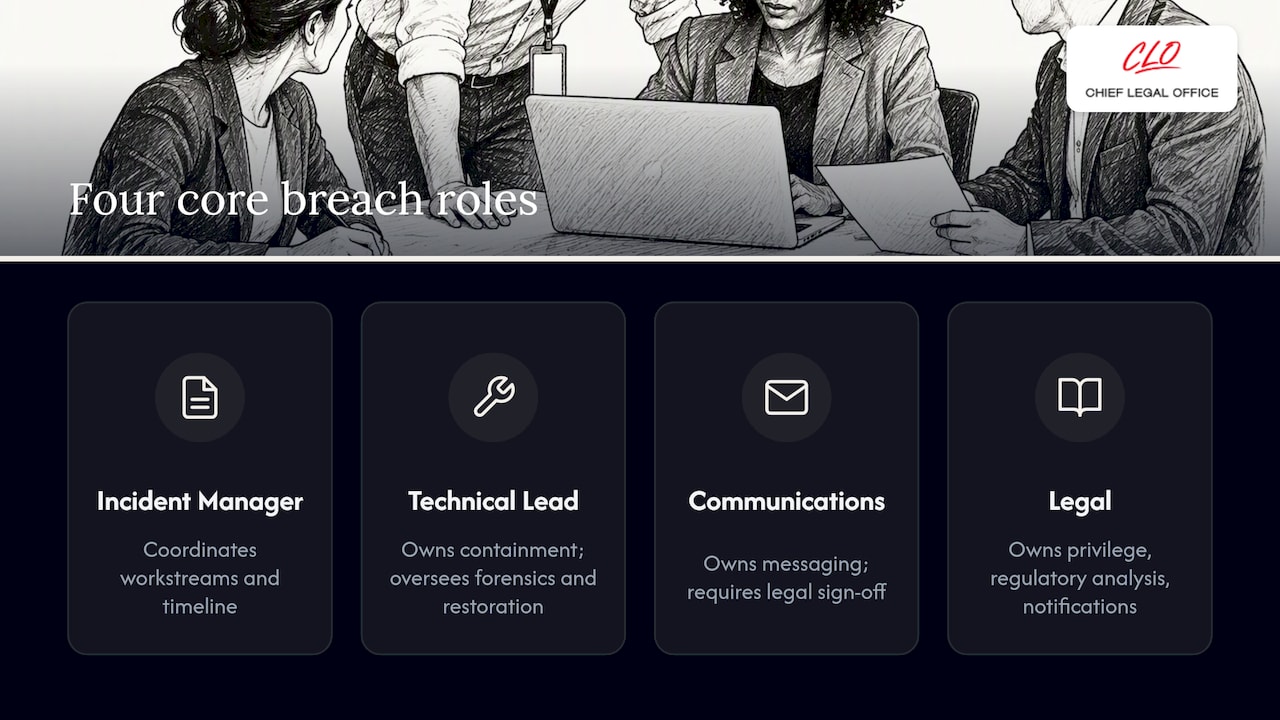
A plan without clear ownership is just a document nobody reads until it is too late. Your core team needs four roles, minimum.
The Incident Manager runs the show: coordinating workstreams, tracking the timeline, and making sure decisions get made instead of debated endlessly. The technical lead owns containment, forensic coordination, and system restoration, working directly with your forensic vendor. Communications owns messaging across every audience, from employees to media, and should never improvise without legal sign-off. Legal (in-house, outside counsel, or both) owns privilege, regulatory analysis, and notification obligations, and should be looped in from the first hour, not the third day.
Smaller companies often collapse two or three of these roles into one overworked person, which is how critical steps get missed. If you do not have a General Counsel, someone still needs to own the legal function during a breach: deciding what gets reported, to whom, and by when. That is precisely the gap a fractional General Counsel exists to fill, and it is worth deciding who holds that seat before an incident forces the question.
Risk assessment and breach scenario identification before plan development
You cannot write a useful response plan without first knowing what you are responding to. Start by identifying your highest-value data assets: customer records, payment information, protected health information, proprietary source code, and figure out where each one lives and who can touch it.
From there, map realistic breach scenarios specific to your business. A SaaS company worries about credential stuffing and API abuse. A health technology company worries about protected health information exposure under HIPAA. A company handling payment data worries about card skimming and vendor compromise. Each scenario carries different notification obligations and different stakeholders, so your plan should name them explicitly rather than treating “a breach” as one generic event.
This groundwork also tells you where your biggest gaps are: unpatched systems, vendors with excessive access, or departments with no security training. Fix what you can before an incident forces your hand, and document the rest as known risks your plan is built to address.
Criteria and thresholds for activating the breach response plan
Not every security alert deserves a full incident response activation, and treating every anomaly as a five-alarm fire burns out your team fast. Your plan needs clear activation criteria written down in advance, not improvised in the moment.
Typical triggers include confirmed unauthorized access to sensitive systems, evidence of data exfiltration, ransomware deployment, or a vendor notifying you of a compromise affecting your data. Severity tiers help too: a low-severity event might warrant monitoring and a ticket, while a confirmed breach of regulated data triggers full plan activation, including legal and executive notification within the hour.
Write these thresholds into the plan itself, and give your Incident Manager clear authority to activate without waiting for a committee vote. Hesitation at this stage is where companies lose the most valuable hours.
Integration with cybersecurity tools and monitoring systems for early detection
A response plan is only as good as your ability to detect the problem in the first place. Security information and event management tools, endpoint detection platforms, and intrusion detection systems should feed directly into your incident response workflow, not sit in a separate dashboard nobody checks until Monday.
The goal is to shrink the gap between compromise and discovery. The longer that gap, the more data exposed, the more systems touched, and the harder your legal and notification analysis becomes. Configure alerts to automatically notify your Incident Manager or security lead, and make sure your monitoring tools log enough detail to support the forensic investigation that follows. A clean, continuous log is worth more after a breach than almost any other piece of evidence you will have.
Data classification and prioritization to focus response efforts
When an incident hits, you cannot treat all data equally, and you should not try. Classify your data in advance: public information, internal business data, confidential data, and regulated data such as protected health information, Social Security numbers, or payment card details.
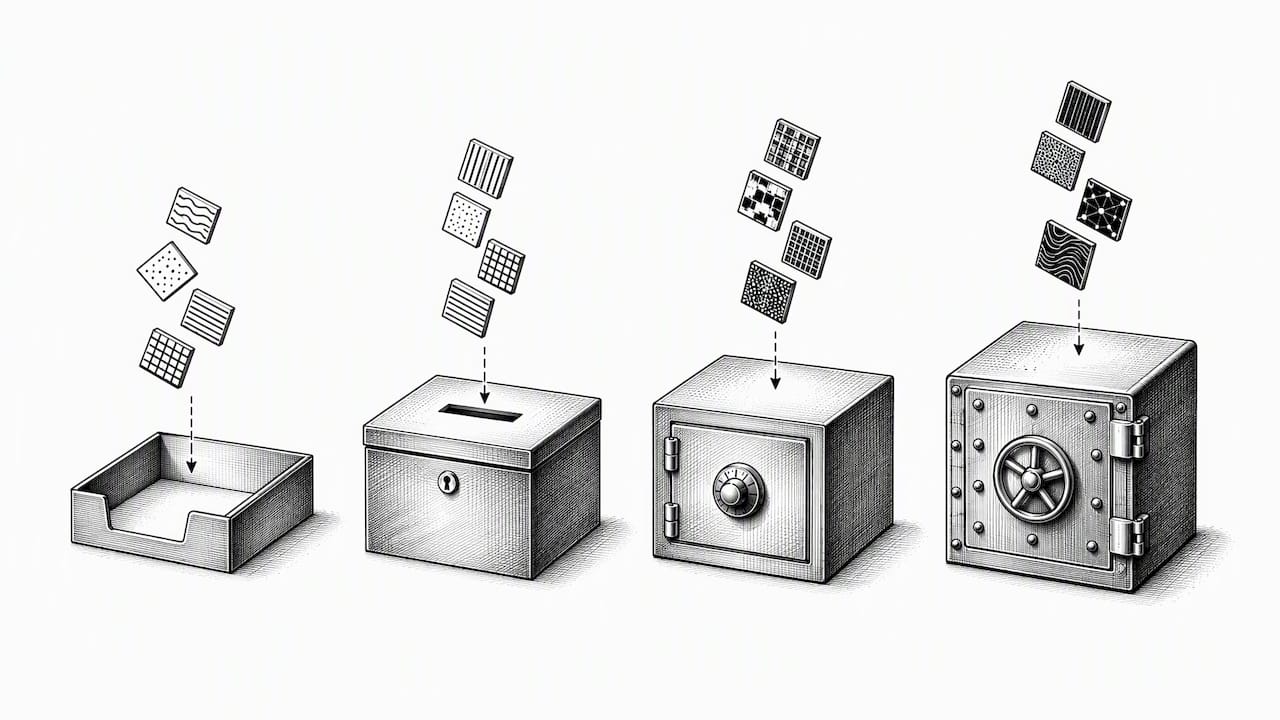
This classification does two things during a breach. First, it tells your technical team where to focus containment efforts, since a compromised server holding regulated data demands faster action than one holding marketing assets. Second, it tells your legal team which notification obligations apply. A breach touching only internal operational data might require no external notification at all, while one touching health records triggers the HIPAA clock immediately.
Build this classification into your systems now, through tagging, access controls, and data inventories, so that when an incident happens, you already know what you are protecting and why it matters.
Coordinating with third-party vendors or partners during a breach
Modern breaches rarely stay inside your own walls. Vendors, contractors, and software partners often hold a copy of your data or access to your systems, and a weak link anywhere in that chain becomes your problem too.
Your incident response plan should name key vendors and specify who contacts them, and when. Review your vendor contracts for breach notification clauses: many require vendors to notify you within a set window, and your own notification obligations to regulators or customers may hinge on timely vendor cooperation. If a vendor caused the breach, you still likely bear the notification responsibility to your own customers, so do not assume the vendor’s response plan covers your exposure.
Coordinate forensic access carefully too. If a vendor’s systems need investigation, get that agreed to in writing before an incident, not negotiated for the first time while the clock is running.
Crisis communications strategy, spokesperson designation, and media handling
Pick your spokesperson before you need one. Scrambling to figure out who talks to the press during an active breach guarantees mixed messages, and mixed messages guarantee a worse story than the breach itself deserved.
Designate one spokesperson, typically a senior executive or communications lead, and make sure every other employee knows to route media inquiries to that person rather than answering informally. Train that spokesperson on what to say and, just as important, what not to say: speculation about cause, scope, or fault before forensics confirms the facts is how companies end up issuing embarrassing corrections.
Build your holding statement before the breach, not during it. A short, honest, pre-approved statement acknowledging the incident and promising updates buys you time to get the facts right without looking evasive. Coordinate every public statement with legal and forensics before it goes out, since a premature claim about what data was or was not affected can become a liability all its own.
Chief Legal Officer perspective: practical trade-offs and escalation guidance
In the first 24 hours, legal counsel will ask for the same things every time: scope of the breach, evidence preserved so far, who has been notified internally and externally, and your insurer’s contact information. Escalate to the board the moment materiality becomes a live question, not after you have already decided the answer. The hardest trade-off is always speed versus evidence preservation, and counsel will usually push for controlled disclosure over a rushed one, because a correction later costs more credibility than a short delay now.
— Amy Natasha Osteen
How we support breach response and ongoing readiness
When a breach hits, you need someone who already knows your business making the calls, not a lawyer meeting your company for the first time at the worst possible moment. Through our fractional Chief Legal Office model, we embed senior in-house legal leadership into your company before an incident happens, so when one does, we are already at the table.

During an active breach, our team coordinates incident counsel, manages regulatory filings, reviews notification language against HIPAA, state law, and SEC requirements, and leads the post-incident review once the dust settles. Our investigations and litigation support services extend that coverage if the breach triggers a regulatory inquiry or civil claim.
Deployable incident counsel and a dedicated Client Success Team, not a single lawyer juggling your matter alongside a dozen others.
Review of notification content, timing, and regulatory filings across HIPAA, state law, and SEC obligations.
Post-incident governance support, including updated policies and a tested, documented plan.
Plan | Monthly fee | Best fit |
|---|---|---|
Foundations | $1,000 | Early-stage companies building their first legal function |
$2,000 | Growing companies needing regular legal coordination | |
Strategic Growth | $5,000 | Companies managing complex risk, transactions, or regulatory exposure |
Pricing for all three plans is on our pricing page. If your incident response plan has not been reviewed or tested in the past year, consider scheduling a plan review or tabletop exercise within the next 30 days, before you need it under pressure.
This article is general information, not a substitute for advice from a qualified lawyer. Consult a qualified legal professional about your own circumstances before acting on anything here.
FAQ
What should be the first step after discovering a data breach?
Assemble your Incident Manager, isolate affected systems without powering them down, and contact legal and forensic partners immediately. The FTC’s guidance recommends disconnecting devices from the network rather than shutting them off, to preserve forensic evidence.
How long do we have to notify people after a HIPAA breach?
Covered entities and business associates must notify affected individuals without unreasonable delay and no later than 60 calendar days after discovery, under the HHS Breach Notification Rule. Breaches affecting 500 or more individuals also require notice to HHS within that same window.
Do public companies have to disclose a data breach to the SEC?
Public companies that determine a cybersecurity incident is material generally must disclose it on Form 8-K, often under Item 1.05 or Item 8.01. Recent SEC filings show companies disclosing incidents even while materiality assessments are still ongoing.
Should we keep a printed copy of our incident response plan?
Yes. CISA guidance recommends maintaining offline, printed copies of your incident response plan and key contacts, since network outages during an incident can make digital copies inaccessible.
Can a fractional legal team help during an active breach?
Yes, when that team already understands your business and systems before the incident occurs. A fractional General Counsel can coordinate notification decisions, regulatory filings, and forensic vendor management during a breach, much like an in-house legal department would.
Sources
Data Breach Response: A Guide for Business | Federal Trade Commission
Example SEC filing referencing cybersecurity incident disclosure
The lawyerly fine print: This article is for general information, not legal advice…