6 Buckets Investors Expect: Data Room Checklist for Founders & Legal
You need a pitch deck, financials covering the most recent period available, a comprehensive cap table accounting for all equity instruments, your incorporation documents, signed IP assignments, an org chart, and every contract that could blow up the deal if it surprised an investor mid-diligence. Before you upload a single file, create an initial folder named accordingly with an index and a concise cover note. That one folder, done right, shortens diligence by days and tells investors you run a tight operation before they’ve read a single financial statement.
TL;DR:
Fully reconcile all financial figures in your pitch deck with actual financial statements to avoid contradictions that can derail investor confidence.
Ensure the cap table includes all dilutive instruments and provides a pro forma view after the raise, with clear valuation caps and discounts for SAFEs.
Organize documents in a consistent, numbered folder structure and use standardized naming conventions to facilitate easy navigation and version control.
Implement staged access levels and track investor activity with analytics to tailor communications and prevent sensitive information leaks.
Involve a legal team early to verify that contracts, IP assignments, and material disclosures are accurate and redacted appropriately, speeding up due diligence.
What Goes in a Data Room Checklist for Investors?
Investors expect the same six buckets every time, regardless of whether you’re raising a $500,000 pre-seed round or a $15 million Series A. The depth changes with stage. The categories don’t.
Corporate and governance documents. This is the boring stuff that kills deals when it’s missing. Include your certificate of incorporation, bylaws, board consent forms, stock purchase agreements, and every amendment to any of the above. Don’t just upload the original charter and call it done. If you amended your certificate of incorporation twice, include both amendments plus the original. Investors want the paper trail, not just the current state.
Financials. Include profit and loss statements, balance sheets, and cash flow statements. For an early-stage company, monthly financials covering the prior year or most recent months available matter more than a five-year projection nobody will believe. Attach your financial model as a working file, but also export a clean PDF summary of the assumptions driving it. recent bank statements that help confirm the numbers in your model actually match reality. This is where deals stall, so get it right the first time.
Cap table. This needs to be fully diluted, meaning it accounts for every option pool, SAFE, convertible note, and warrant, not just the shares currently issued. Include a pro forma table showing what ownership looks like after the round you’re raising closes. If you have outstanding SAFEs from a previous bridge, list the valuation cap and discount terms for each one. A cap table with unclear details that does not reconcile can quickly undermine investor confidence, according to a due diligence checklist from StartupFundraising.
Legal and contracts. “Material” means any agreement that would change how an investor values or trusts the business if they didn’t know about it. That includes customer contracts above a meaningful revenue threshold, vendor agreements with exclusivity or non-compete clauses, loan agreements, and any pending or threatened litigation. Redact pricing terms from customer contracts you’re not ready to disclose broadly, but don’t redact the existence of the contract itself. Investors can tell the difference between prudent redaction and hiding something.
Team and HR. List founder and key employee offer letters, equity agreements, and any employment contracts with non-compete or non-solicit clauses. Redact Social Security numbers, home addresses, and salary details for non-executive staff. Include an org chart. You don’t need to disclose every hourly contractor’s home address to prove you have a functioning team.
Product and customer evidence. Growth metrics, retention curves, and customer logos matter, but anonymize sensitive accounts. If your biggest customer is a healthcare system that would object to being named in a data room forty investors might see, refer to them as “Enterprise Healthcare Customer A” and keep the identifying details in a side letter available on request. Include security and compliance documents (SOC 2 report, penetration test summary, privacy policy) if you have them. If you don’t, say so plainly in your index rather than leaving a silent gap investors have to ask about.
How Should You Organize Data Room Folders and Files?
A logical folder structure with consistent naming signals institutional discipline. Using a numbered folder system helps maintain consistent order across viewers, whether they’re on desktop, mobile, or a data room provider’s clunky in-browser preview.
Here’s a folder tree that works for most fundraising and M&A data rooms:
Folder | Contents |
|---|---|
00_Start_Here | Index, cover note, Q&A tracker link |
01_Corporate | Charter, bylaws, cap table, board consents |
02_Financials | P&L, balance sheet, cash flow, bank statements |
03_Legal_Contracts | Customer, vendor, loan agreements |
04_IP | Patents, trademarks, assignment agreements |
05_Team_HR | Org chart, offer letters, equity agreements |
06_Product_Customers | Metrics, case studies, roadmap |
07_Security_Compliance | SOC 2, pen test, privacy policy |
For file names, use a consistent file naming pattern that begins with the date, followed by a descriptor and version number. This lets anyone sort a folder chronologically or alphabetically and still find the latest version fast. Never rely on a file named FINAL_final_v2_reallyfinal.xlsx. Everyone has seen that file. Nobody trusts it.
Your index needs five fields for every document: document name, owner, version, as-of date, and location. Add a sixth column labeled “where to start” and flag the three or four documents an investor should open first (usually the deck, the financial summary, and the cap table).
Default to PDFs for anything that doesn’t need to be edited or recalculated. Keep one working Excel model under tighter access control, since raw spreadsheets carry hidden tabs, stray formulas, and metadata that reveal more than you intend. Sanitizing files before upload by stripping hidden tabs and metadata is a five-minute task that prevents a very awkward reply-all.
How Do You Control Access and Track Investor Activity?
Not every investor should see everything on day one. A staged access model moving from teaser to NDA to full access protects sensitive information while still moving deals forward quickly.
Tier 1 (teaser): Deck, one-page financial summary, and market overview, shared before any NDA.
Tier 2 (NDA-gated): Full financials, cap table, and material contracts, released once mutual NDAs are signed.
Tier 3 (deep diligence): Detailed customer contracts, employee agreements, and IP filings, released to investors who’ve issued a term sheet or entered exclusivity.
Set permissions to view-only by default, apply watermarks with the viewer’s name and timestamp, and restrict downloads on your most sensitive contracts. Set expiration dates on access grants so a passed-on investor isn’t still browsing your cap table six months later.
Most data room platforms give you engagement analytics that reveal what investors actually care about: time spent per folder, which documents got opened twice, and who never opened the legal folder at all. If an investor spends 40 minutes in your cap table folder and never opens the product roadmap, that tells you exactly what to address on your next call.
Run a single, centralized Q&A tracker instead of scattered email threads. Assign an owner to every question and a response deadline, usually 24 to 48 hours for anything routine.
Pro Tip: Route every investor question through one tracker, even the ones that arrive by text or in a hallway at a conference. Fragmented Q&A across five channels is how founders lose track of a commitment they made and get called out for it three weeks later.
How Do You Build and Maintain a Data Room Step by Step?
Building an investor-ready room isn’t a weekend project, but it’s not a quarter-long ordeal either. Here’s the timeline that actually works.
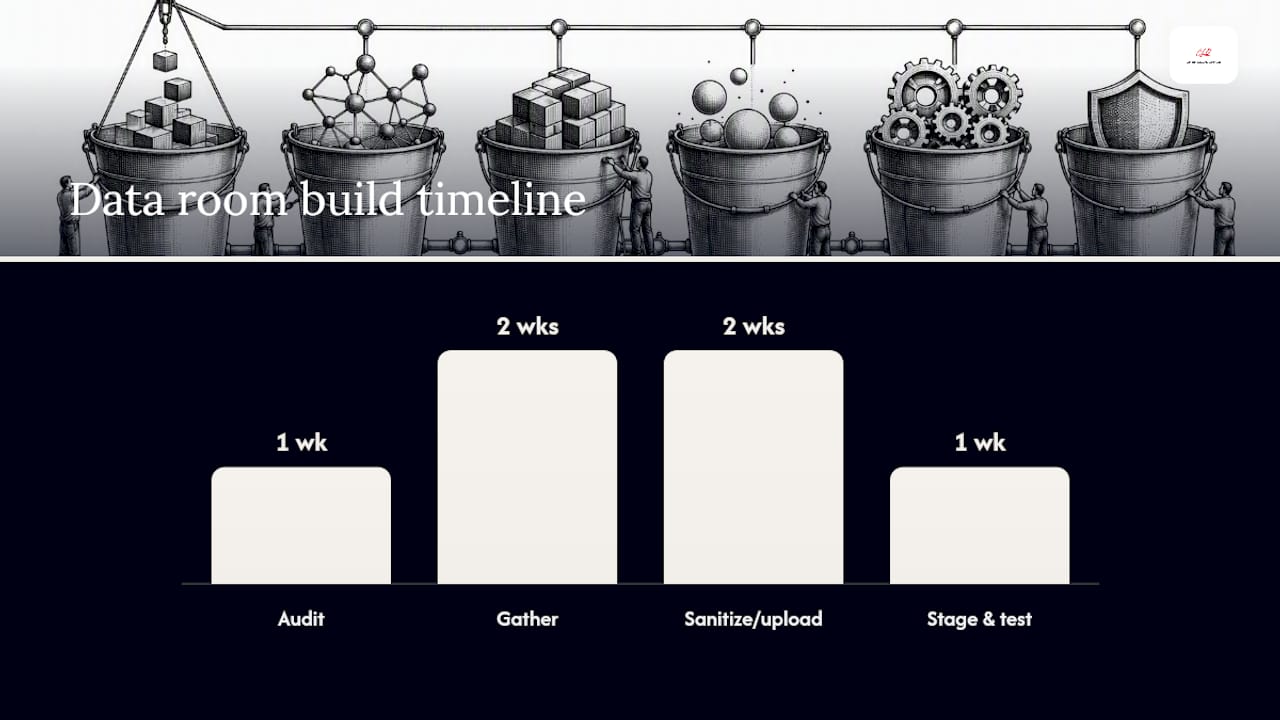
Week 1, audit. List everything your business is legally and financially required to have. Assign an owner to each category: founder owns corporate docs and the pitch materials, finance owns financials and the model, legal owns contracts and IP, product owns metrics and customer evidence.
Weeks 1 to 2, gather. Pull every document from wherever it’s scattered (email, Google Drive, a lawyer’s file server) into one staging folder that nobody outside your core team can see yet.
Weeks 2 to 3, sanitize and upload. Strip metadata, convert working files to clean PDFs, redact sensitive personal information, and upload into the numbered folder structure with correct file names.
Week 3, stage and test. Build your access tiers, write the index and cover note, then have someone outside the founding team try to navigate the room cold. If they get lost, an investor will too.
Preparing the room two to three months before you start raising gives you buffer room for the inevitable missing signature or outdated cap table entry. Before sharing access with any investor, run a pre-flight check: confirm every document opens, every link works, and the index matches what’s actually in each folder.
Once you’re raising, keep financials updated regularly and perform periodic comprehensive reviews of the entire room, checking that nothing has gone stale since the last update.
What Should Pre-Seed, Seed, and Series A Data Rooms Include?
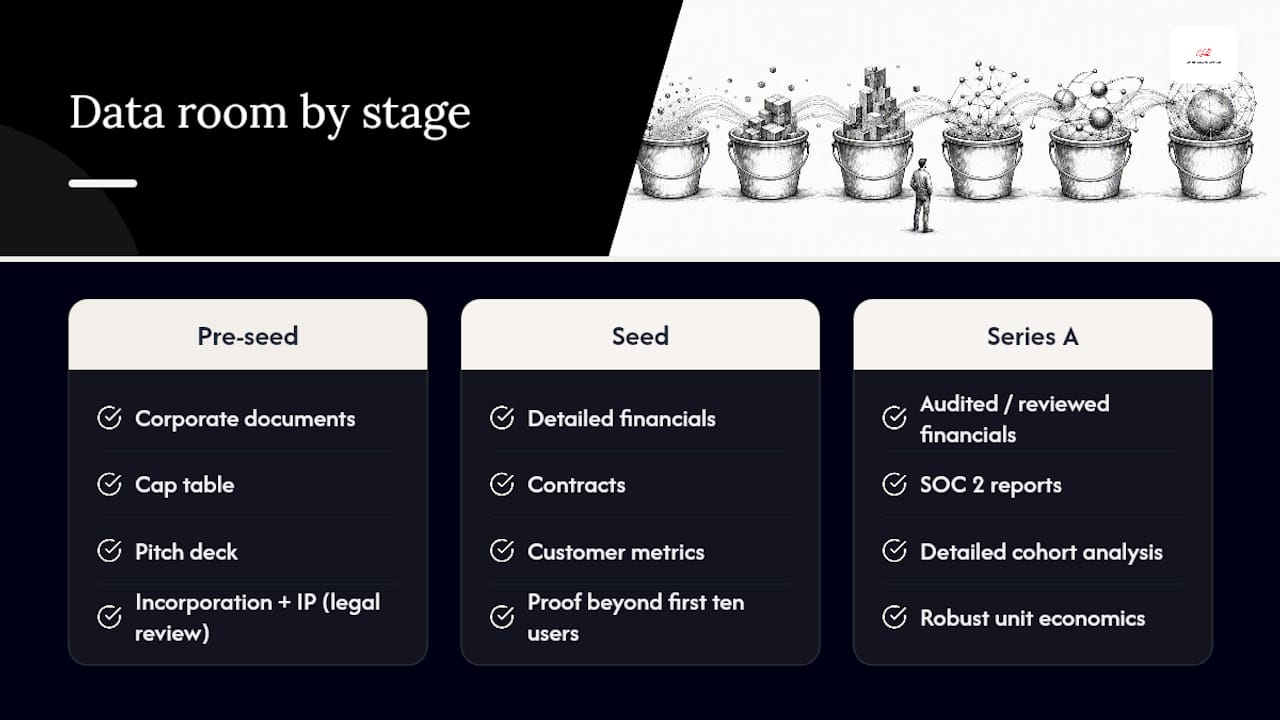
Early-stage data rooms may be simpler in scope. Founders can usually build the corporate documents, cap table, and deck themselves, but incorporation paperwork and IP assignments are worth a quick legal review since mistakes there compound expensively later. Skip deep customer PII at this stage. You likely don’t have enough customers to warrant it, and oversharing early creates cleanup work later.
Mid-stage rounds include progressively detailed financials, contracts, and customer metrics. Investors want proof the product works for someone beyond your first ten friendly users.
Series A and beyond means a full diligence set: audited or reviewed financials where available, SOC 2 reports, detailed cohort analysis, and unit economics that hold up under a sharper investor’s spreadsheet. Series A rooms need deeper cohort and unit-economics evidence than seed rooms do, and investors at this stage will notice if you’re still running pre-seed-level documentation.
If you have a genuine gap, whether that’s an unaudited financial statement or a missing SOC 2, say so directly in your index with a short remediation timeline. A clear plan reads far better than silence an investor discovers on their own.
What Are the Most Common Data Room Mistakes?
Inconsistencies between data room numbers and pitch materials can significantly delay deals. Contradictory figures between the deck and the underlying financials are one of the most common deal killers investors report, right alongside absent IP assignment agreements and unreconciled cap tables.
Reconcile every number in your deck against the actual financial statements before sharing the room.
Fix cap table gaps and unrecorded equity grants immediately, and document any correction with a brief explanation.
Never upload a raw, unsanitized spreadsheet as your primary financial document. Provide a clean PDF summary and keep the working model under restricted access.
Get missing IP assignments and unsigned agreements signed now, or write a one-paragraph remediation plan if that’s not possible yet.
Redact personal information (SSNs, home addresses, full salary details) instead of oversharing it out of habit.
Why Legal Ownership of Data Room Readiness Matters
Most of these problems (a cap table that doesn’t reconcile, an IP assignment nobody remembered to sign, a redaction that goes too far or not far enough) are legal problems wearing a spreadsheet costume. A founder juggling fundraising, product, and payroll shouldn’t also be the one deciding what’s “material” enough to disclose. That’s a job for someone who owns contracts, IP assignments, and litigation summaries full time, which is exactly why legal needs a seat at the table before the room opens, not after an investor flags the gap.
— Amy Natasha Osteen
How Chief Legal Office Helps You Build an Investor-Ready Data Room
Chief Legal Office gives you a legal team that already knows where the bodies are buried in your contracts, because they’re the ones who filed them. Instead of a founder guessing what counts as “material” or a solo fractional GC squeezing diligence prep between everything else, you get a full team, led by a senior in-house attorney, that can own the room end to end: fixing cap table gaps, chasing down unsigned IP assignments, managing the Q&A tracker, and deciding what gets redacted and what doesn’t.
Founders raising their first institutional round get the most value here, since that’s exactly when a messy room costs the most in negotiating leverage. The result is a diligence process that moves faster because nobody’s discovering problems in real time. If you want a legal team that treats your fractional general counsel relationship as an actual department rather than a phone-a-friend arrangement, request an intake conversation and see what a properly run data room looks like before your next raise starts.
The lawyerly fine print: This article is for general information, not legal advice.