Stop Audits for CLOs: Delegation of Authority Matrix, Pilot 10–15
A delegation of authority matrix is a document that maps who can approve what, up to what dollar amount, and under what conditions, across your company. If you don’t have one, start today: pull your last 20 contracts and ask who actually signed off on each one. Name a matrix owner before the end of the week. Some fractional in-house legal departments specialize in building these, and the pattern is always the same: the companies that wait get burned first.
TL;DR:
Nearly 90% of companies have a DOA policy, but many struggle with enforcement, system mismatches, and regularly updating the matrix.
Building an effective DOA matrix involves inventorying actual decisions, setting data-driven thresholds, and testing with real scenarios before ratification.
Assigning clear ownership and implementing routine reconciliation processes are essential to keep the matrix aligned with actual operations and audit standards.
Automated system configuration and regular exception logging are critical to prevent unapproved transactions and address drifts between policy and practice.
Engaging specialists or fractional legal teams helps ensure the matrix remains current, enforceable, and embedded into daily decision-making workflows.
Chief Legal OfficeMake Authority Work in PracticeChief Legal Office helps growing technology companies organize legal work, set priorities, and keep governance processes aligned with daily operations.Learn about Chief Legal Office
Table of Contents
What Is a Delegation of Authority Matrix?
Why Does a DOA Matrix Matter for Governance?
How Do You Build a Delegation of Authority Matrix?
Who Owns the Matrix Once It’s Live?
What Should a DOA Matrix Template Look Like?
What Do Experienced In-House Teams Get Right?
Where Formal Authority Quietly Drifts From Reality
Let Chief Legal Office Build and Run Your DOA Program
Sources
FAQ
What Is a Delegation of Authority Matrix?
A delegation of authority (DOA) matrix is a table that connects three things: a role, a decision type, and a dollar or risk threshold. Sales can approve discounts up to a certain percentage. Finance can release payments up to a certain amount. Legal has to review any contract with a nonstandard indemnity clause, no matter the value. That’s the whole concept. The complexity comes from getting the details right.
A DOA matrix is different from a DOA policy, though the two work together. The policy is the narrative document that explains the philosophy: why authority is delegated, who can sub-delegate, what happens when someone is out of office. The matrix is the operational table that turns that philosophy into rows and columns someone can actually check against a live transaction. Most organizations need both. In fact, 54% of surveyed companies use a combined memo-and-matrix format, pairing a short policy memo with the matrix as an attachment or exhibit.
Scope matters more than most first drafts admit. A single matrix rarely covers everything well. Decide upfront which of these domains your matrix will govern:
Contracts and vendor agreements
Procurement and purchase orders
Payment release and treasury actions
Hiring, compensation, and HR decisions
Capital expenditures and budget approvals
Signatory authority on legal documents and bank accounts
If you operate multiple legal entities, business units, or countries, build the matrix so it scopes cleanly by entity and geography. A regional VP’s authority in one subsidiary should never quietly apply to another just because the org chart looks similar. For more complex organizations, adding RACI columns (Responsible, Accountable, Consulted, Informed) next to the approval column clarifies who executes a decision versus who merely needs to know about it.
Why Does a DOA Matrix Matter for Governance?
A delegation of authority is a core piece of corporate governance. It defines the powers and limits attached to every role, and it’s what auditors, boards, and regulators point to when they ask, “Who approved this, and were they allowed to?” EY’s research on corporate governance frames it as foundational infrastructure for internal control, not a nice-to-have compliance artifact.
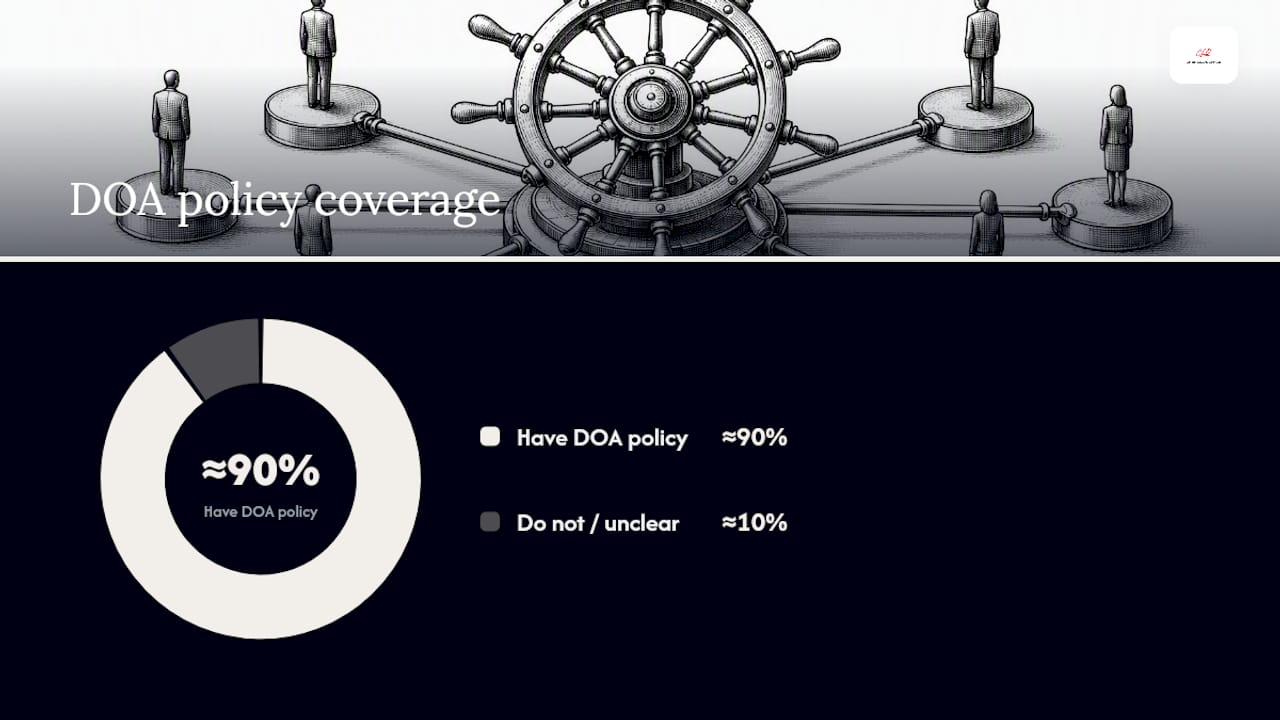
Here’s the uncomfortable statistic: nearly 90% of companies maintain a DOA policy, but many struggle with enforcement, training, and keeping it updated. Having a document is not the same as having a working system. The gap between the two is where most audit findings live.
The failure modes are predictable:
Drift. The org chart changes, but the matrix doesn’t get updated for months.
System mismatch. Your ERP or contract lifecycle management (CLM) tool has different approval chains than your written policy.
No exception route. Someone needs approval outside the standard tiers, and there’s no documented process, so they just wing it.
If you want your matrix to survive an audit or a board inquiry, build in these trust signals from day one: board or committee ratification of the policy, a named policy owner (not “legal” as an abstraction, an actual person), regular reconciliation between the matrix and your operating systems, a logged exception process, and records from test scenarios you ran before rollout.
How Do You Build a Delegation of Authority Matrix?
Building a DOA matrix is a project, not a form you fill out in an afternoon. Here’s the sequence that actually works.
Charter the project. Name a policy owner (usually the general counsel, CFO, or a board committee), a matrix owner who maintains the document day to day, process owners for each functional area, and system owners who control the ERP or CLM configuration.
Inventory real decisions. Pull actual transactions from the last 12 months, not hypothetical ones. Talk to process owners in procurement, sales, and finance. Most mid-size companies land somewhere between 10 and 200 distinct decision types, depending on how granular you get. Fewer than 10 usually means you’re missing categories; more than 200 usually means you need to consolidate similar decisions into tiers.
Design the tiers and thresholds. Set dollar thresholds using actual transaction data, not guesses. If 80% of your vendor contracts fall under $25,000, that’s a natural line for a tier. Layer in risk, not just dollar value: a $10,000 contract with an unlimited indemnity clause is riskier than a $200,000 contract with standard terms. Distinguish standard transactions (fast-tracked) from nonstandard ones (routed to legal or a higher tier regardless of amount).
Write the rules that govern edge cases. Can a director sub-delegate to a manager? What happens when the named approver is on leave? Does a $500,000 capital decision need one signature or two working jointly? Set cumulative limits too. Otherwise, someone splits a $150,000 purchase into three $50,000 invoices to stay under a threshold, and technically no single approval violated the matrix.
Reconcile with your systems. This is the step almost everyone skips, and it’s the one most audit findings trace back to. If your policy says a $75,000 contract needs VP approval but your CLM tool routes it for director approval, the system wins in practice, whatever the policy says on paper.
Pilot before you ratify. Run 10 to 15 real scenarios through the draft matrix. Include edge cases on purpose: an urgent payment on a holiday weekend, a contract that touches two business units, a decision where the named approver just left the company. Log every exception the pilot surfaces, fix the matrix, and then take it to the board or governance committee for ratification.
Roll out and train. Get sign-off from every functional stakeholder, configure the systems to match, and set clear rules for how exceptions get logged and reviewed going forward.
Pro Tip: Don’t set thresholds by asking department heads what they want. Ask what they’ve actually been approving for the last year, then set the threshold slightly above the top of that range. It removes the ego negotiation and grounds the number in reality.
Research on delegation depth backs this up: authority levels work best when they track task complexity and where specialized knowledge actually sits in the organization, not just seniority. The person closest to the transaction detail often understands the risk better than the person three levels up.
Who Owns the Matrix Once It’s Live?
A DOA matrix that gets ratified and then forgotten is worse than no matrix at all, because now everyone assumes there are guardrails that no longer function. Treat it as an operating program with four distinct roles, not a static file in a shared drive.
The policy owner (typically the board, CFO, or general counsel) sets the philosophy and ratifies changes. The matrix owner (often someone on the finance or risk team) maintains the document and processes update requests. Process owners in procurement, legal ops, and HR flag when their function’s decisions no longer match reality. System owners in IT keep the ERP and CLM approval chains configured to match the written matrix.
Cadence keeps the whole thing honest:
Cadence | Activity |
|---|---|
Weekly or biweekly | Process routine change requests to roles or thresholds |
Monthly | Reconcile the matrix against system-configured approval chains |
Quarterly | Sample a batch of approved transactions to check for compliance |
Annual | Full recalibration of thresholds against updated transaction data |
Event-driven | Update immediately after a reorg, acquisition, or new entity formation |
Watch four metrics on an ongoing basis: reconciliation mismatches between the matrix and your systems, exception frequency (a spike usually means a threshold is wrong), expired or orphaned delegations tied to people who’ve left, and high-risk approvals that cluster near a threshold line, which often signals someone is structuring transactions to avoid a review.
Multi-entity organizations and companies in active M&A need extra discipline here. Every new entity or acquired business brings its own informal authority habits, and decision rights on paper frequently diverge from how decisions actually get made day to day. Reconciling that gap after a close is where a matrix owner earns their keep.
What Should a DOA Matrix Template Look Like?
You don’t need custom software to start. A well-structured spreadsheet or a table inside your CLM tool works fine, as long as it has the right columns. An authority delegation matrix template with example rows can shorten your build time considerably, since starting from a blank page tends to stall projects for weeks.
Structure each row with these columns: decision ID, decision type, condition (standard or nonstandard), dollar threshold, approver role, RACI designation, escalation path, evidence required, system workflow ID, effective date range, and version number.
Three example rows to illustrate the pattern:
Before rollout, run through a short checklist: governance sign-off on the final policy, pilot scenarios completed and exceptions resolved, system mapping confirmed against the matrix, training delivered to every approver, an exception-logging process documented, and version control in place so you can show an auditor exactly which matrix version governed a transaction on any given date. Archive every prior version. When someone asks why a transaction from 14 months ago was approved at a level that seems wrong today, the only good answer is pulling up the matrix that was actually in effect then.
What Do Experienced In-House Teams Get Right?
Fractional in-house legal departments build DOA programs for a living, which is different from writing one policy and moving on. Chief Legal Office structures this around named ownership: a senior attorney who serves as matrix owner, working alongside your finance and operations leads to reconcile the matrix against your ERP or CLM system.
Exceptions get logged and reviewed, not waved through informally
System reconciliation happens on a set cadence, not only when something breaks
Training gets delivered to actual approvers, not just filed in a handbook
If your company doesn’t have bandwidth for this internally and isn’t ready for a full-time general counsel, that’s exactly the gap a fractional legal department is built to fill.
Where Formal Authority Quietly Drifts From Reality
I’ve watched the same pattern play out across companies at very different stages: the DOA policy says one thing, and six months later, everyone’s operating by a different, unwritten set of rules that nobody ratified. It’s not malicious. People just route around a threshold that feels too low or a signer who’s slow to respond, and the workaround becomes the new normal.
The fix isn’t a longer policy. It’s a habit: pick one quarter this year and run a reconciliation between your matrix and your actual approved transactions. You’ll find the drift fast, and it’s far cheaper to fix in a quiet quarter than during due diligence.
*— Amy Natasha Osteen
Let Chief Legal Office Build and Run Your DOA Program
Most companies either write a DOA policy once and let it fossilize, or they never formalize one at all because no single person owns the project. Chief Legal Office is built to close that gap. Instead of a policy sitting in a drive with no owner, you get a senior attorney who acts as your named matrix owner, reconciles the document against your ERP or CLM system on a set cadence, and trains your approvers so the matrix actually gets used.

An engagement typically starts with a decision inventory and stakeholder interviews, moves through drafting and system mapping, and includes a pilot phase before board ratification, the same sequence outlined above, run by a team that’s done it before. If your company is scaling past the point where a founder can eyeball every contract, it’s worth a conversation. Visit the fractional general counsel services page to see how an engagement is structured and get a sense of timeline and scope for your situation.
Sources
For deeper benchmarking on how companies structure and enforce delegation policies, the Society for Corporate Governance’s research and EY’s governance guide cover common practices and gaps. For a ready-made template, the OWASP authority delegation matrix offers a solid starting structure. For the academic angle on decision rights, Harvard Business School’s library covers the formal-versus-effective authority gap in depth.
FAQ
What Is a Delegated Authority Matrix?
It’s a table mapping specific roles to specific decision types and thresholds, showing exactly who can approve what, up to what dollar amount, and under what conditions.
What Is a DOA Matrix?
DOA stands for delegation of authority. A DOA matrix is the operational document, usually paired with a policy memo, that lays out approval rights across the organization.
What Is a Delegation Matrix?
It’s another common name for the same tool: a structured chart connecting roles, decision types, and approval thresholds so authority isn’t left to guesswork or informal habit.
What Are the Three Pillars of Delegation of Authority?
Definitions vary across organizations, but most frameworks converge on three elements: clearly assigned responsibility, matching authority to act, and accountability for the outcome of the decision.
How Often Should a DOA Matrix Be Updated?
Reconcile it against your systems monthly, sample transactions quarterly, and run a full recalibration annually, with immediate updates after any reorg, acquisition, or major role change.
Recommended
The lawyerly fine print: This article is for general information, not legal advice…