Early Case Assessment: GC Playbook to Control Discovery Costs
Early case assessment (ECA) is a short, structured process that gives counsel enough facts, custodians, and cost projections to decide whether to settle, narrow discovery, or fight. It runs on proportionality principles under Rule 26(b)(1), triggers as soon as litigation is reasonably anticipated, and ends with a decision memo, not a warehouse of documents. Companies with an embedded legal team tend to do this well because someone already owns the process before the lawsuit lands.
TL;DR:
Early case assessment should produce a short decision memo, including damages range, privilege risks, custody mapping, and phased discovery plans.
Proportionality under Rule 26 guides all ECA steps, emphasizing moving the needle on merits or cost rather than exhaustive data collection.
Sampling and analytics help estimate review volume and refine search terms early, reducing overall review costs and improving defensibility.
Well-documented preservation notices and scope-restricted holds mitigate spoliation risks and satisfy Rule 37(e) requirements.
Embedding legal teams in the ECA process ensures faster, cost-effective assessments, with clear scope, timeline, and strategic leverage during negotiations.
Chief Legal OfficeBring Legal Leadership Into DiscoveryChief Legal Office provides senior legal leadership and a dedicated team to organize complex litigation work and keep strategic decisions moving.Explore Chief Legal Office
Table of Contents
What early case assessment covers and how it differs from early data assessment
Why ECA matters: proportionality under Rule 26 and strategic consequences
A step-by-step ECA workflow counsel can implement
Preservation and spoliation risk: a defensible checklist tied to Rule 37(e)
Data assessment and analytics: sampling, validation, and practical techniques
Production planning and the recommended ECA deliverable
How to use ECA results to control cost and negotiate discovery mechanics
How an embedded legal department runs ECA in practice
A GC’s five-minute pre-26(f) checklist
How Chief Legal Office helps: embedded legal teams that run defensible ECA
Sources
FAQ
What early case assessment covers and how it differs from early data assessment
People sometimes use “early case assessment” and “early data assessment” as if they mean the same thing. They don’t, and mixing them up wastes money.
ECA is the legal and strategic screening: what are the claims, who are the key players, what is this likely to cost, and what should we do about it. Early data assessment is the technical layer underneath it: mapping systems, sampling data, and estimating review volume. ECA uses the output of data assessment, but it is not the same job, and a good fractional legal team keeps the two workstreams separate so nobody confuses a data map for a legal strategy.
A solid ECA answers a short list of questions:
What are the key facts and the strongest and weakest points in the claims or defenses?
Who are the custodians, and where does the relevant evidence likely live?
What is the realistic damages range, and what assumptions drive it?
Where are the privilege risks, and who needs to see what?
What will discovery cost under different scope scenarios?
The output should be a short decision memo, a recommended discovery plan broken into phases, and a set of budget scenarios tied to those phases. Nothing more elaborate is required at this stage.
Why ECA matters: proportionality under Rule 26 and strategic consequences
Rule 26(b)(1) makes proportionality part of the definition of discoverable material, not an afterthought you raise when a request feels excessive. The rule weighs the issues at stake, the amount in controversy, the parties’ resources, and whether the burden of discovery outweighs its likely benefit, according to analysis of Rule 26(b)(1). That framework is the backbone of ECA: every step should trace back to whether it moves the needle on merits or cost.
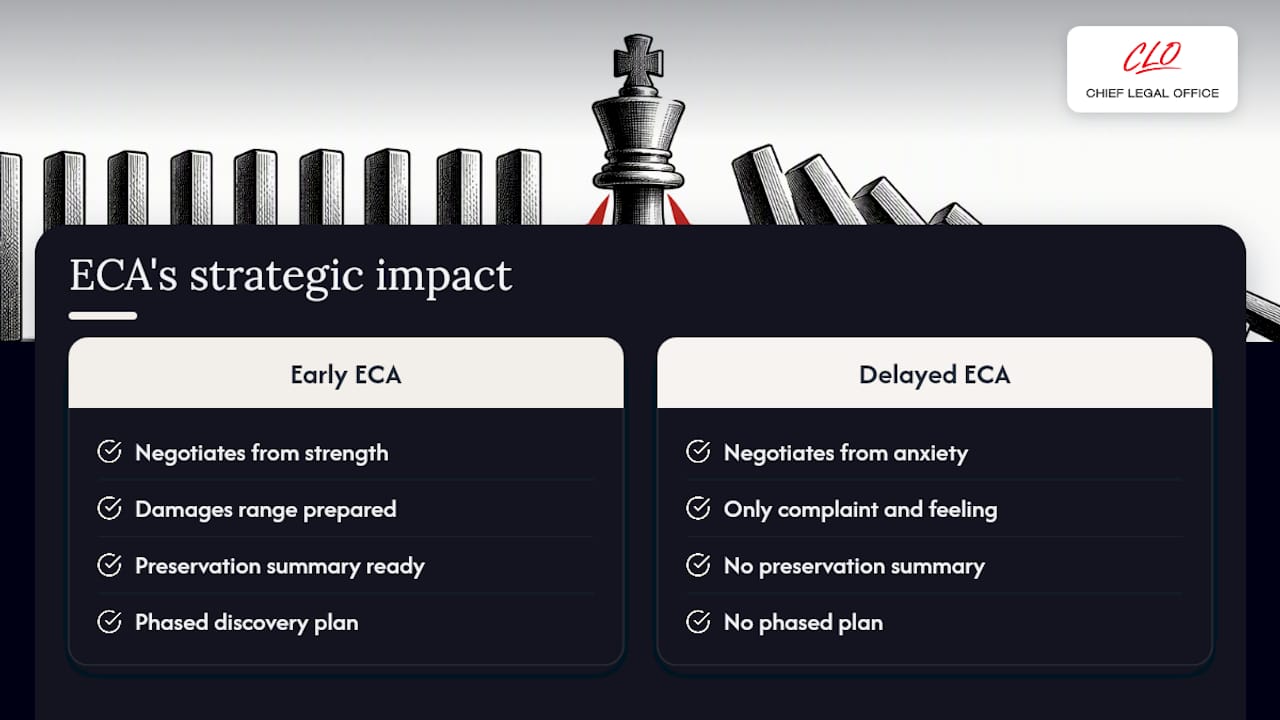
Done early, this changes your posture. A company that walks into a settlement conversation with a damages range, a preservation summary, and a phased discovery plan negotiates from strength. A company that walks in with only a complaint and a bad feeling negotiates from anxiety. Courts also reward this behavior. Judges consistently favor early cooperation on scope and format over fights that could have been resolved with a phone call, a preference echoed throughout federal ESI guidelines.
A step-by-step ECA workflow counsel can implement
ECA works best as a sequence, not a checklist you tackle in random order. Here is the order that tends to hold up:
Frame the claims and defenses first. Write down what each side needs to prove before you go looking for evidence, so your information gathering has a target.
Interview stakeholders and map custodians and systems. Talk to the people who actually touched the events, not just the ones copied on emails, and build a preliminary custodian list. Our operational workflow for internal investigations covers this step in more detail.
Trigger proportionate preservation. Issue a litigation hold scoped to what you actually know at this point, not everything the company has ever generated.
Collect a targeted first tranche. Pull data from the highest-value custodians and sources rather than trying to capture everything at once.
Search, deduplicate, cluster, and sample. Use these techniques to cut volume and surface patterns before committing to full review.
Assess liability, damages, privilege, and operational impact. Translate what you found into a business answer: how exposed are we, and what does defending this cost the operation.
Model discovery cost and recommend a path. Settle, negotiate a phased discovery plan, or move to targeted production, backed by numbers.
Pro Tip: Timebox each step. An ECA that drags on for months has usually stopped being an assessment and started being litigation by another name.
Preservation and spoliation risk: a defensible checklist tied to Rule 37(e)
Preservation obligations begin when litigation is reasonably anticipated, not when a complaint is filed. Once that trigger hits, the practical checklist looks like this:
Identify custodians and data sources tied to the anticipated claims.
Suspend auto-deletion policies that would otherwise wipe relevant data.
Issue a written litigation hold and confirm receipt from every custodian.
Note any retention exceptions and the business reason behind them.
Revisit and adjust the hold as the issues and custodian list evolve.
Rule 37(e) does not require preserving every conceivable source of information. Courts evaluate whether reasonable steps were taken and whether lost electronically stored information can be restored or replaced, according to FJC guidance on the 2015 amendments. That means a scoped, well-documented hold often protects you better than a sweeping one you cannot actually execute. Document what you preserved, why, and when you narrowed scope. That record is what saves you when someone later claims spoliation.
Data assessment and analytics: sampling, validation, and practical techniques
Analytics make ECA fast and defensible when you use them to ask better questions, not to replace judgment. Sampling early helps you estimate review volume and tune search terms before you commit budget to a full collection, an approach the EDRM identification standards treat as standard practice.
A few techniques carry most of the weight:
Email-thread analysis to collapse redundant chains and surface the substantive messages.
Clustering and near-duplicate detection to group related documents and cut review volume.
Random sampling and frequency analysis to validate whether your search terms are actually catching what matters.
Iterative refinement, tightening or loosening search criteria as sampling results come in.
Document your methodology and its limits as you go. Sampling produces estimates with a margin of error that should be documented clearly to maintain defensibility.
Pro Tip: Run a sample before you finalize search terms, not after. Adjusting terms once you’ve already collected everything is expensive and avoidable.
Production planning and the recommended ECA deliverable
Rule 34 requires producing electronically stored information in the form it is ordinarily kept or in a reasonably usable form, and that decision belongs in ECA, not in a fight six months later, per Rule 34’s text. Decide early whether native files, extracted text, metadata, or summary reports actually answer the questions at stake.
The deliverable that ties all of this together is a short decision memo covering the chronology, the claims and defenses, key witnesses and documents, damages assumptions, privilege and preservation risks, a phased discovery plan with budget ranges, and recommended next steps with named owners and dates. Use that memo in settlement talks and bring it into the Rule 26(f) conference. It is the difference between showing up prepared and showing up hopeful.
How to use ECA results to control cost and negotiate discovery mechanics
Once you have ECA data, you have leverage. Use it on the specific mechanics that actually drive discovery cost:
Narrow custodians, date ranges, and file types to what the facts support, not what feels safest.
Propose phased discovery, starting with the highest-value sources and expanding only if warranted.
Offer sample-validated search terms instead of open-ended keyword lists.
Agree on production formats up front to avoid reprocessing later.
Negotiate a protective order and a Rule 502(d) order so inadvertent privilege disclosures don’t turn into separate litigation.
District ESI guidelines and local Rule 26(f) checklists recommend naming an e-discovery liaison who actually understands your systems and formats, since that person can resolve half of these issues before they become disputes, according to the Southern District of California’s checklist%20Conference%20Checklist.pdf). Bring these levers into the meet-and-confer as proposals, not concessions. You already did the work to justify them.
How an embedded legal department runs ECA in practice
An embedded legal team runs ECA the way it should be run: as a business decision with legal inputs, not a legal project the business waits on. Priorities get set jointly with leadership, claims get framed against actual operational exposure, and the work gets split across roles instead of piling onto one person. A typical structure includes senior lead counsel for judgment calls, a paralegal or legal operations lead for custodian mapping and document logistics, an IT liaison for collection and systems, and a vendor coordinator for outside review resources.
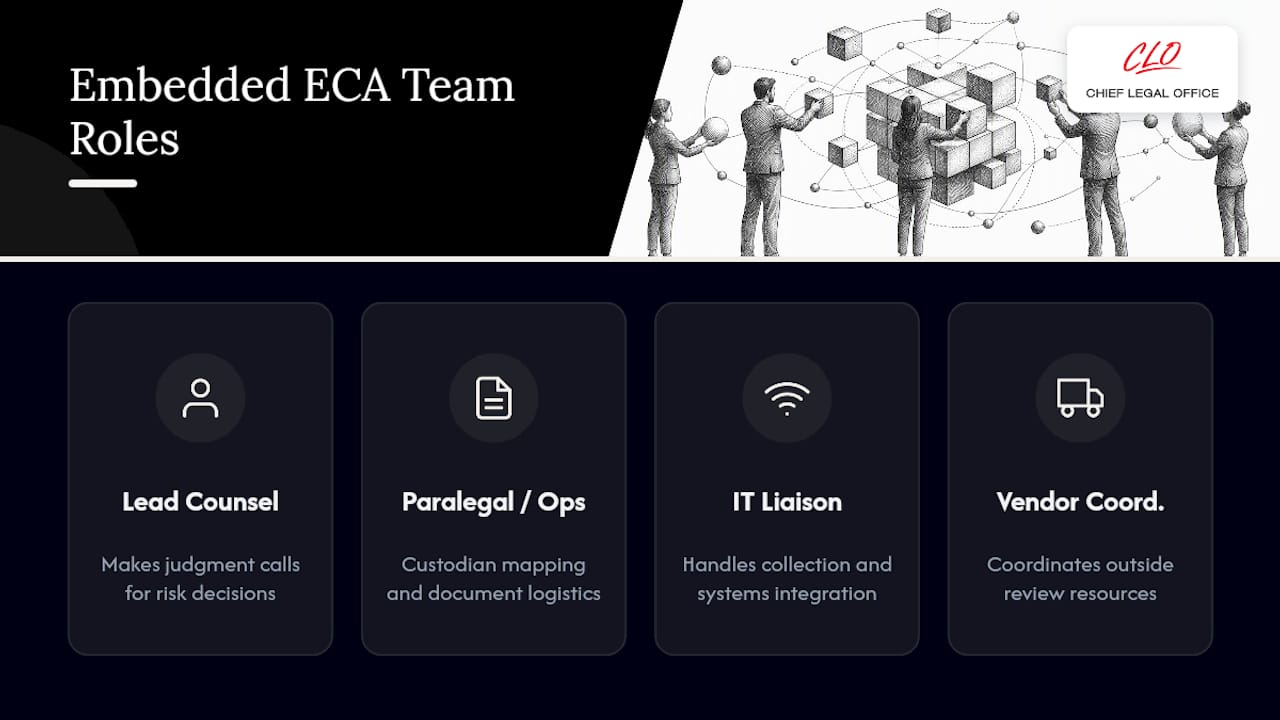
Chief Legal Office builds its Client Success Teams around this structure, so ECA does not stall because the one lawyer on staff is also handling contracts and board questions that week. The goal stays the same either way: a defensible process that respects both the rules and the budget.
A GC’s five-minute pre-26(f) checklist
Before any Rule 26(f) conference, I run five quick checks: do we know our top documents, have we confirmed the custodian list, do we have a real budget range, is our preservation snapshot current, and have we proposed a phasing plan.
In the room, two lines do a lot of work: “We propose limiting the first phase to these five custodians and this date range” and “We’re comfortable with a 502(d) order to keep privilege review efficient for both sides.” Bring a one-slide summary of scope, cost, and timing. It keeps the conversation on your terms.
— Amy Natasha Osteen
How Chief Legal Office helps: embedded legal teams that run defensible ECA
Running a proper ECA takes judgment and hands, and most companies have neither in surplus when a dispute lands. Chief Legal Office’s Investigations & Litigation Support service exists for exactly this gap: a senior former General Counsel leads the framing and strategy, backed by a team that handles custodian mapping, preservation logistics, and vendor coordination, so the decision memo gets built without pulling your executives off their actual jobs.
Outside counsel is still the right call for trial work and specialized motions. But for the assessment phase, where the real cost decisions get made, an embedded team that already knows your business tends to move faster and cheaper than a firm meeting you for the first time. If you want a legal department built for this, see our pricing for Foundations, Embedded Access, and Strategic Growth, or start with our Fractional General Counsel service to get a senior lead on your next matter.
This article is general information, not a substitute for advice from a qualified lawyer. Consult a qualified legal professional about your own circumstances before acting on anything here.
Sources
Federal Rule of Civil Procedure 26(b)(1) — law review analysis
Guidelines for the discovery of electronically stored information (EDSI)
FAQ
What is the meaning of case assessment?
Case assessment means evaluating the facts, claims, exposure, and likely cost of a legal matter early enough to make an informed decision about settling, narrowing discovery, or litigating. It draws on proportionality principles under Rule 26(b)(1) to keep the analysis focused on what actually affects the outcome.
How much does eDiscovery cost?
Cost varies widely based on data volume, custodian count, review complexity, and how much of the process is phased versus done all at once, so there is no single reliable figure to quote. A well-run ECA process, including sampling and targeted collection, is specifically designed to shrink that cost by narrowing scope before full review begins.
What is an example of eDiscovery?
A common example is collecting email and shared-drive files from a handful of key custodians named in a dispute, then using search terms and sampling to narrow that collection down to the documents that actually matter to the claims. Production is then made in the form required by Rule 34, whether native files, extracted text, or another reasonably usable format.
How does eDiscovery work?
eDiscovery generally moves through identifying relevant data sources, preserving them under a litigation hold, collecting targeted data, searching and reviewing it for relevance and privilege, and producing what is required in an agreed format. Court ESI guidelines recommend discussing each of these stages cooperatively at the Rule 26(f) conference to avoid disputes later.
Recommended
The lawyerly fine print: This article is for general information, not legal advice…