Founders’ 7 Point Force Majeure Clause Playbook for In House Teams
A force majeure clause suspends contract performance when an extraordinary event, one the contract actually lists or describes, causes the failure to perform. It does not excuse you from a bad deal, rising costs, or a supplier who simply ran late. Before you invoke it, check three things: does the event list or catch-all cover what happened, did you send notice the way the contract requires, and are your payment obligations actually excluded from relief.
TL;DR:
A force majeure clause only excuses specific obligations when an event listed or similar to those listed actually causes the failure to perform.
The clause requires proper notice within a set timeframe and proof that the event directly caused nonperformance; vague notice can invalidate the claim.
Including detailed, industry-specific events like pandemics or supply chain disruptions improves protection, but overly broad language invites disputes over scope.
Courts interpret these clauses narrowly, emphasizing contract language and notice compliance, not broad catch-alls or external circumstances like market shifts.
Proper drafting, clear notice procedures, and ongoing mitigation records are essential, as the clause only suspends, not cancels, obligations and is highly jurisdiction-dependent.
Chief Legal OfficeMake Legal Work Ready for What’s NextChief Legal Office provides senior legal leadership and a dedicated team to organize contracts, manage risk, and support growing companies.Learn about Chief Legal Office
Table of Contents
What Is a Force Majeure Clause, and How Does It Work?
Sample Force Majeure Clauses You Can Adapt
How Do You Draft a Force Majeure Clause That Holds Up?
How Do Courts Interpret Force Majeure Clauses, and Where Do Claims Fail?
Tailoring Force Majeure Relief by Obligation and Industry
Chief Legal Office’s Take: What Founders Actually Need From This Clause
Force Majeure vs. Frustration and Impossibility: What’s the Difference?
What Happens to the Contract After You Invoke Force Majeure?
Negotiating Force Majeure Clauses Across Jurisdictions
Adapting Force Majeure Clauses for Different Contract Types
The Real Problem With Most Force Majeure Advice
How Chief Legal Office Helps You Get Force Majeure Right
Sources
FAQ
What Is a Force Majeure Clause, and How Does It Work?
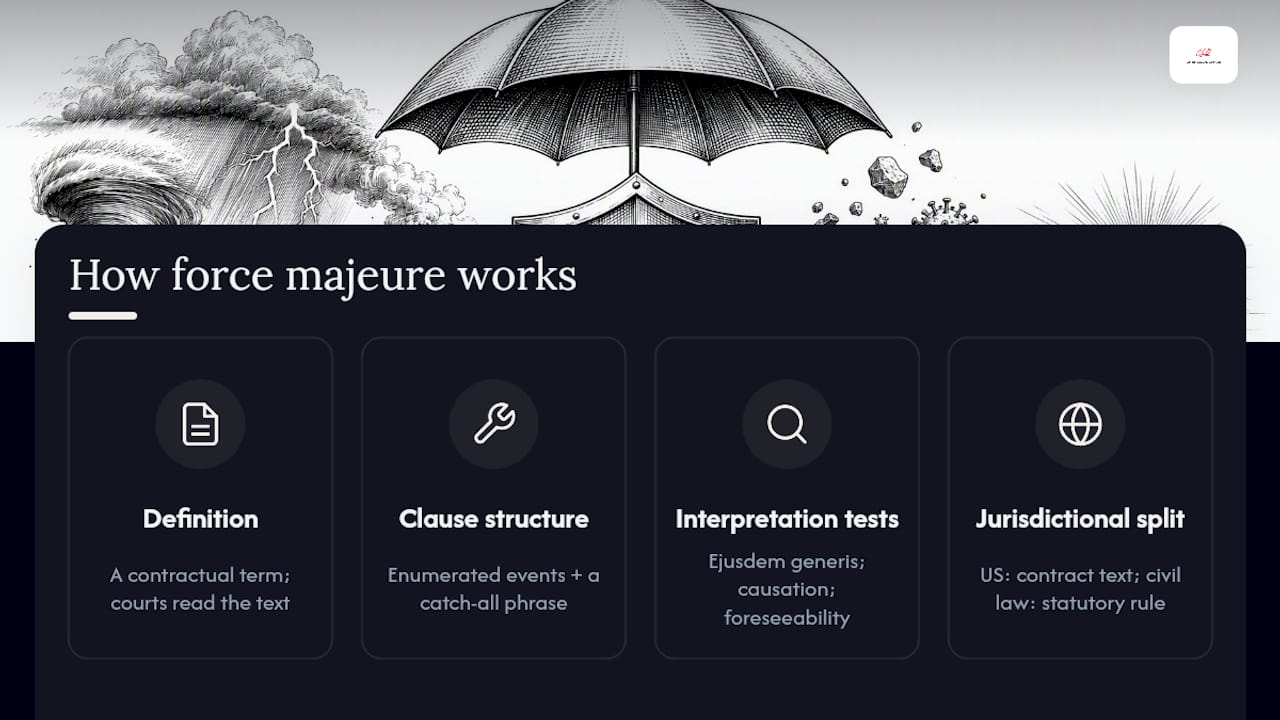
Here’s the thing most people get wrong about force majeure: it is not a legal right that exists in the air, waiting to rescue you. It is a creature of contract. Courts in the United States look almost entirely at the words on the page rather than applying some uniform national rule, according to Cornell’s Legal Information Institute. If your contract does not mention pandemics, a pandemic probably will not save you. If it does not mention government shutdowns, good luck arguing one anyway.
This is different from the common-law doctrines you might have heard about in a business school case study: impossibility, frustration of purpose, and commercial impracticability. Those are backstops courts apply when a contract is silent. Force majeure is what happens when the parties decided in advance, in writing, who bears the risk of an earthquake, a war, or a factory fire. It is a private allocation of risk, not a judicial rescue mission.
Most clauses work in two layers. First, an enumerated list: fires, floods, war, strikes, government action. Second, a catch-all phrase like “or any other event beyond the reasonable control of the parties.” Courts interpret that catch-all narrowly using a principle called ejusdem generis, meaning the general phrase only covers events similar in kind to the ones already listed. A vague catch-all after a list of natural disasters will not stretch to cover a cybersecurity breach unless the drafter thought to add it.
Then there is causation. The event has to be the actual reason you could not perform, sometimes described as “but for” causation. If your factory was already behind schedule before the flood hit, the flood is not doing the legal work you want it to do. Courts also look at foreseeability: if the risk was reasonably predictable when you signed, some judges will hold you to the deal anyway, on the theory you should have negotiated around it.
State law varies here too. Comparative research on force majeure across jurisdictions, including a widely cited analysis in the Fordham International Law Journal, shows that common-law systems like the United States rely almost entirely on contract text, while civil-law countries often build force majeure into their statutes. That gap matters the moment you sign a cross-border deal.
Sample Force Majeure Clauses You Can Adapt
Templates are a starting point, not a finish line. Sites like Law Insider host thousands of real-world examples, but copying one without tailoring it to your deal is how companies end up arguing over words they never meant to include. Below are three versions, from bare-bones to heavily engineered, with notes on what each choice buys you and what it costs.
The concise clause (good for low-risk, short-term contracts):
“Neither party shall be liable for delay or failure to perform due to causes beyond its reasonable control, including acts of God, war, and government action, provided the affected party gives prompt notice and uses reasonable efforts to resume performance.”
This is fast to negotiate and reads clean, but “reasonable control” and “prompt notice” are vague enough to fight over later. Fine for a low-stakes vendor agreement. Risky for anything involving real money over a long term.
The balanced clause (typical for mid-size commercial agreements):
Defines a specific event list: fire, flood, earthquake, war, terrorism, epidemic, government order, and labor strikes.
Adds a catch-all limited to events “of a similar nature beyond the party’s reasonable control.”
Requires written notice within a set number of business days.
Requires the affected party to use commercially reasonable efforts to mitigate and resume.
Allows termination if the event continues beyond a stated period.
This version gives both sides more certainty about what qualifies, which reduces litigation risk, but it also means an event not on the list has a much harder time sneaking in through the catch-all.
The comprehensive clause (built for supply chains, manufacturing, and post pandemic risk):
This version adds explicit pandemic and epidemic language, government-imposed shutdowns, and supply-chain disruption naming specific tiers (raw materials, shipping, labor availability). Comprehensive clauses like this became standard practice after 2020, since drafting guidance now commonly recommends naming the “operative cause” of disruption rather than relying on generic phrases, according to ReviewMyContract’s drafting guide. It also carves out payment obligations explicitly, so a supplier delay does not accidentally excuse the buyer from paying invoices already earned.
The trade-off across all three: breadth buys flexibility but invites arguments about scope, while precision reduces disputes but might miss an event nobody thought to write down. There is no clause that eliminates that tension. There is only a clause that manages it deliberately instead of by accident.
How Do You Draft a Force Majeure Clause That Holds Up?
A force majeure clause is only as good as the mechanics behind it. Here is the checklist we run through with clients before they sign anything:
Event coverage. Does the list include the risks that are actually plausible for your business? A software company worried about outages needs different language than a manufacturer worried about port closures.
Causation standard. Does the clause require the event to be the actual and direct cause of nonperformance, or does it leave room for a party to blame an unrelated event?
Notice timing and content. How many days does the affected party have to notify the other side, and what has to be in that notice? Commercial contracts commonly set windows of five to ten business days, according to negotiation guidance from Holland & Knight. Miss that window and you may lose the protection entirely, regardless of how legitimate the underlying event was.
Mitigation obligations. Does the clause require “reasonable efforts” or “commercially reasonable efforts” to work around the disruption, and have you defined what that means for your business?
Duration and termination threshold. At what point can either party walk away if the disruption drags on? The same Holland & Knight guidance points to typical termination thresholds of 60 to 180 days, depending on contract type and industry.
Payment carve-outs. Are payment obligations for work already performed excluded from suspension?
Cost allocation. Who eats the cost of storage, rerouted shipping, or idle labor during the disruption period?
When you are negotiating rather than drafting from scratch, push for suspension that is narrowly tailored to the affected obligations, not the whole contract. Insist on a mitigation obligation with teeth, meaning the other side has to show what they tried, not just claim they tried something.
Pro Tip: Build in an ongoing-update requirement, not just an initial notice. Require the invoking party to report status every 30 days and define “reasonable efforts” with concrete examples relevant to your business, like “sourcing from at least two alternate suppliers” instead of leaving it open to interpretation.
How Do Courts Interpret Force Majeure Clauses, and Where Do Claims Fail?
Judges tend to read these clauses narrowly, which surprises a lot of business owners who assumed a broad catch-all phrase would cover them. If an event is not on the list and does not closely resemble something that is, courts frequently apply expressio unius est exclusio alterius, the idea that naming some things implies you meant to exclude others. Courts also confirm, per the Cornell Wex analysis, that mere economic hardship, prices going up, margins shrinking, is not force majeure on its own, even during a genuine market crisis.
Timing sinks more claims than people expect. Two separate issues come up constantly. First, was the event actually the cause of the failure to perform, or was the party already behind and using the event as cover? Second, was the event reasonably foreseeable at the time the contract was signed? A company that signs a shipping contract in an active war zone and later invokes force majeure over combat-related delays will have a much harder argument than one blindsided by an unrelated new conflict.
Notice failures are a quieter but just as common problem. Sending a vague email two weeks late, instead of a formal notice within the contract’s stated window, can waive the protection even when the underlying event genuinely qualifies. Keep contemporaneous records: dated notices, mitigation logs, supplier correspondence. If this ends up in front of a judge, the paper trail often matters more than the merits of the excuse itself.
One more wrinkle: state law is not uniform, and while decisions out of New York and Delaware carry a lot of weight because so many commercial contracts choose that governing law, they are not binding outside those states. Always confirm which state’s law your contract selects before assuming a rule you read about applies to you.
Tailoring Force Majeure Relief by Obligation and Industry
Not every obligation in a contract deserves the same protection. Rent, subscription payments, and data-security duties usually should keep running even during a disruption, because suspending them creates a second problem on top of the first. A well-built clause maps relief to specific obligations rather than suspending the entire agreement, which reduces disputes over what was actually excused.
For a software company, that might mean service-level suspensions apply to uptime guarantees but not to data-backup and security duties, which is worth reviewing alongside your broader data-security obligations. For supply-chain contracts, relief often centers on component shortages or shipping delays rather than payment terms already earned. Construction contracts need a clear line between a force majeure event and an ordinary change order, since site-access delays get labeled both ways depending on who is arguing.
A short delivery-suspension clause might read: “Seller’s obligation to deliver is suspended during the force majeure event; Buyer’s payment obligations for goods already delivered remain in full effect.” That one sentence prevents the most common post-disruption argument.
Chief Legal Office’s Take: What Founders Actually Need From This Clause
Force majeure is not a substitute for insurance, and it is not a pricing mechanism. If your real risk is cost volatility, negotiate a price-adjustment clause. If your real risk is catastrophic loss, that is what business-interruption insurance is for. Force majeure exists for the narrow category of events that make performance genuinely impossible, not inconvenient.
The operational side is where most companies fall short, not the drafting. A clause with perfect language does nothing if nobody in the company knows who sends the notice, who logs mitigation efforts, or when to escalate. A working playbook needs four pieces: a notice template ready to go, a mitigation log capturing supplier contacts and alternative costs, an escalation matrix naming who signs off, and a repository for evidence, tied into your business continuity planning. Fractional in-house legal teams earn their keep here by running tabletop exercises before a crisis hits, not drafting eloquent clauses that sit untested until the day they matter most.
Force Majeure vs. Frustration and Impossibility: What’s the Difference?
Force majeure is contractual. Frustration of purpose and impossibility are common-law doctrines courts apply when the contract itself is silent on the risk that occurred. That distinction changes everything about how you argue a case.
Impossibility applies when performance has become objectively impossible, not just harder or more expensive. If a warehouse burns down and the goods inside were the specific, irreplaceable subject of the contract, that can trigger impossibility even without a force majeure clause. Frustration of purpose is narrower still: it applies when the entire reason for the contract has evaporated, even though performance is technically still possible. A classic example is renting a room specifically to view a parade that gets canceled. You can still occupy the room. The point of renting it is gone.
Practically, these doctrines are a fallback, not a first choice. Judges apply them inconsistently and often reluctantly, because contract law generally favors holding parties to their bargains. A well-drafted force majeure clause takes the guesswork out of the equation by defining, in advance, what counts and what doesn’t. If your contract has no force majeure language at all, you are betting on a judge’s sympathy rather than your own foresight. That is a bad bet for any business with real money on the line.
What Happens to the Contract After You Invoke Force Majeure?
Invoking force majeure does not cancel the contract. It suspends specific obligations for as long as the qualifying event lasts, and only for the obligations the clause actually covers. Everything else, payment for completed work, confidentiality duties, security obligations, generally continues unless the clause says otherwise.
The immediate practical effect is that neither party can sue for breach over the suspended performance while the event continues, as long as notice and mitigation requirements were met. That is the whole point: it converts what would otherwise be a breach into an excused delay. But that protection is not permanent. Most clauses include a duration cap, and if the disrupting event runs past that threshold, either party typically gains the right to terminate without further liability.
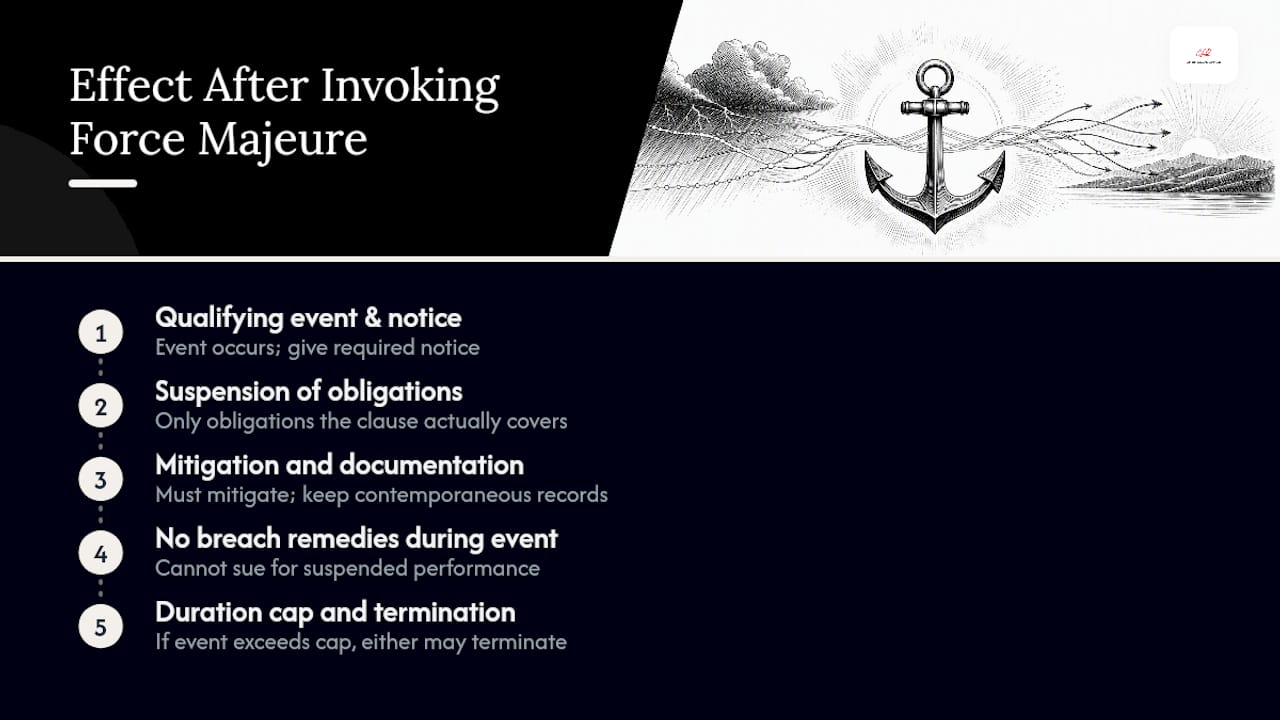
Remedies get complicated when only part of an obligation is affected. Say a supplier can deliver half the contracted volume during a shortage. A poorly drafted clause might suspend the entire delivery obligation, letting the supplier off the hook for the portion it could have fulfilled. A well-drafted one specifies that force majeure excuses only the portion actually affected by the qualifying event, and that supplier must still deliver what it reasonably can.
There is also a documentation consequence that catches people off guard. Once you invoke the clause, you are effectively announcing that a dispute is possible, and the other side will scrutinize your notice, your mitigation efforts, and your timeline. Sloppy internal records at the moment of invocation can undercut a legitimate claim months later when the matter actually goes to negotiation or litigation.
Negotiating Force Majeure Clauses Across Jurisdictions
The state or country whose law governs your contract changes what a force majeure clause can and cannot do, which is why the governing-law provision deserves as much attention as the force majeure language itself. Within the United States, courts generally treat force majeure as purely contractual, but interpretation habits differ enough between states that a clause negotiated under New York law can produce a different outcome than the identical clause under Texas or California law.
Cross-border deals raise the stakes further. Comparative research on international contract law shows that many civil-law jurisdictions build force majeure directly into their statutes, sometimes overriding what the parties wrote, while common-law countries stick to contract text, according to the Fordham International Law Journal analysis of the doctrine across systems. That means a force majeure clause that works perfectly in a U.S. supply agreement might interact unpredictably with a counterparty’s home jurisdiction if a dispute lands there instead.
Two habits reduce that risk. First, always pair your force majeure clause with a clear governing-law and venue provision, so you know in advance whose interpretive habits will apply. Second, if you are dealing with international counterparties, ask local counsel in their jurisdiction whether a statutory force majeure rule could override or supplement your contract language. Skipping that question is how companies discover, mid-dispute, that the clause they negotiated in English does not mean what they thought it meant somewhere else.
Adapting Force Majeure Clauses for Different Contract Types
A force majeure clause written for a construction contract will not fit a SaaS agreement, and treating them as interchangeable is one of the more common drafting mistakes we see. The event list, the notice requirements, and even the definition of “performance” need to shift with the type of deal.
For services and consulting agreements, the focus should be on labor availability and access issues, government shutdowns, travel restrictions, facility closures, rather than physical-goods language that doesn’t apply. For technology and software contracts, relief typically centers on infrastructure failures, third-party hosting outages, and cyberattacks, while data-security and confidentiality duties usually stay intact regardless of the disruption, a distinction worth reviewing against your technology-sector obligations. For manufacturing and distribution contracts, supply-chain specificity matters most: naming raw-material shortages, shipping-carrier disruptions, and customs delays separately, rather than lumping them under one vague “supply chain” term.
Professional services agreements, including legal, accounting, and consulting relationships, benefit from clauses that address regulatory changes and government action distinctly from natural disasters, since those two categories trigger very different obligations and are relevant to how professional-services engagements get structured. The common thread across every industry: generic language saves time during drafting and costs you during a dispute. Specificity up front is cheaper than a fight later.
The Real Problem With Most Force Majeure Advice
Most of what gets written about force majeure treats it like a legal curiosity, something to understand in the abstract rather than a tool you actually have to operate under pressure. That framing misses the point. The clause you need is the one that works at 11 p.m. when your ops manager is trying to figure out whether a supplier’s factory fire actually triggers relief, and whether the notice email needs to go out today or can wait until Monday.
The conventional advice, add a broad catch-all and move on, is exactly backward. Broad language feels safe and produces the opposite result: courts narrow it anyway, and you are left arguing about intent instead of relying on words you actually wrote. Specificity is what protects you, not breadth.
If you take one thing from this, prioritize the operational layer over the perfect clause. A mediocre clause with a disciplined notice process and mitigation log will outperform a beautifully drafted clause nobody remembers to invoke correctly. Draft carefully, then build the muscle memory to use what you drafted.
— Amy Natasha Osteen
How Chief Legal Office Helps You Get Force Majeure Right
Most founders do not need a lecture on contract theory. They need someone who has drafted these clauses before, negotiated them against a supplier’s counsel at 9 p.m. before a deadline, and knows which fights are worth having. That is what a fractional in-house legal department gives you that a one-off contract review cannot: continuity.
A fractional in-house legal department builds your force majeure language into the broader contract review process, drafts the mitigation playbooks your operations team actually uses when something breaks, and helps document the response in real time so you are not reconstructing a timeline from memory six months later during a dispute. Clients may see faster contract turnaround because someone senior already knows their risk profile, better-negotiated protections from consistent legal support, and a documented mitigation record that reduces litigation exposure if a disruption ever escalates.
If your company is outgrowing ad-hoc contract reviews and needs a legal function that actually owns this work, start with Chief Legal Office’s fractional general counsel services to see how the model fits your stage of growth.
Sources
Force majeure | Wex | US Law | LII / Legal Information Institute
Force Majeure Clause Guide: Cases, State Law, Drafting & Negotiation (2026) | ReviewMyContract
From Coronation to Coronavirus (Fordham International Law Journal)
Negotiation and drafting issues surrounding force majeure provisions (Holland & Knight)
FAQ
What Is an Example of a Force Majeure Clause?
A basic example: “Neither party is liable for delay caused by events beyond its reasonable control, including fire, flood, war, or government action, provided the affected party gives prompt written notice and uses reasonable efforts to mitigate the delay.”
What Are the Three Elements of a Force Majeure Claim?
Generally, a valid claim needs an event that qualifies under the contract’s language, causation between that event and the failure to perform, and compliance with the contract’s notice and mitigation requirements.
What Are Force Majeure Clauses?
They are contract provisions that suspend or excuse specific performance obligations when an extraordinary, listed, or described event beyond a party’s control prevents that performance, as defined by Cornell’s Legal Information Institute.
What Is Force Majeure in Simple Terms?
It is a contract term that says, “if something extraordinary and outside our control happens, like the ones we listed, we won’t be blamed for not delivering on time.” It only works if the event, notice, and causation all line up with what the contract actually says.
Does a Force Majeure Clause Excuse Payment Obligations Too?
Usually not, unless the clause specifically says so. Most well-drafted clauses exclude payment for work or goods already delivered from any suspension, precisely to prevent one side from using the disruption to avoid paying earned amounts.
Recommended
The lawyerly fine print: This article is for general information, not legal advice…