Founders: What a GC Sees First in an Indemnification Clause
An indemnification clause makes one party pay another party’s covered losses, damages, or defense costs when a specified claim happens. The single most important drafting rule: narrow the trigger, cap the exposure, and match the promise to what your insurance actually covers. Everything else in this article is detail. That’s the whole ballgame.
TL;DR:
Indemnity clauses should be narrowly drafted with proportional trigger language and capped at a level that aligns with available insurance coverage.
The choice between one-way and mutual indemnity depends on the parties’ control over the risk and the direction of potential claims, with broad triggers increasing exposure.
Clear control over defense and explicit settlement approval rights are essential to prevent unexpected cash flow demands and unapproved settlements.
Always verify that the indemnity coverage matches actual insurance policies, including endorsement requirements, to avoid uncollectible promises.
For recurring or high-risk contracts, a company-wide indemnity management approach and standard clauses protect against aggregated exposure and claims.
Chief Legal OfficeMake Indemnity Risk Easier to ManageChief Legal Office provides senior legal leadership and a dedicated team to organize contracts, manage risk, and support growing technology companies.Learn about Chief Legal Office
Table of Contents
What Is an Indemnity Clause, Exactly?
One-Way vs. Mutual Indemnification, and What Actually Triggers It
Duty to Defend vs. Duty to Indemnify: Why Timing Changes Everything
Your Drafting Checklist and Ready-to-Adapt Sample Clauses
Red Flags That Should Stop a Negotiation Cold
When Indemnity Risk Needs a Real Owner, Not Just a Reviewer
How Chief Legal Office Handles Indemnity Risk for You
Sources
FAQ
What Is an Indemnity Clause, Exactly?
Here’s the plain-English version. An indemnification clause is a promise that one party (the indemnitor) will cover specified losses suffered by the other party (the indemnitee). It’s a private risk-shifting agreement, and it’s one of the most negotiated provisions in any commercial contract because it decides who writes the check when something goes wrong.
The legal definition of indemnify, according to Cornell’s Legal Information Institute, is compensating someone for losses they’ve incurred or will incur. Simple enough. The complexity shows up in the details: what counts as a “loss,” who controls the process when a claim lands, and whether there’s a ceiling on the payout.
A few terms you’ll see in almost every version of this language:
Indemnitor: the party making the promise to cover losses.
Indemnitee: the party protected by that promise.
Trigger: the event or condition that activates the obligation (a lawsuit, a breach, a data leak).
Covered losses: the specific categories of damages included, like legal fees, settlements, judgments, or fines.
Hold harmless: a related phrase that usually means the indemnitor won’t hold the indemnitee liable, often paired with indemnify, but not always identical to it.
That last point trips people up constantly. Indemnity vs. hold harmless sounds like a distinction without a difference, and in many contracts it functions that way. But some courts treat “hold harmless” as barring the indemnitee from suing the indemnitor, while “indemnify” is the affirmative payment obligation. If your contract uses both, know that a court may read them as doing separate jobs.
One more caveat before you assume any indemnity clause you write will hold up: enforceability has limits. Some states restrict or void indemnities that try to cover a party’s own negligence, particularly in construction contracts. Texas, for instance, has specific statutory rules on this. Governing law matters here more than most people assume.
One-Way vs. Mutual Indemnification, and What Actually Triggers It
The first question in any negotiation is whether the clause is a one-way street or a two-way one. One-way indemnity means only one party bears the obligation, typical when a vendor sells a product or service and the customer wants protection against defect or infringement claims. Mutual indemnification means both sides promise to cover the other’s losses arising from their own conduct, common in agreements where the risk genuinely runs both directions, like joint ventures or services agreements with data exchange.
Founders often assume mutual indemnity is automatically “fairer.” It isn’t always. If one party controls the product, the code, or the physical premises, a mutual clause can quietly shift risk back onto the party least equipped to manage it. Read what each side is actually promising, not just whether the label says “mutual.”
Then there’s trigger language, which decides how far the obligation reaches:
Broad form: covers claims “arising out of or related to” the contract, even if the indemnitee shares some fault. This is the most exposed version and the one you should push back on hardest.
Intermediate form: covers claims except to the extent caused by the indemnitee’s own negligence.
Limited form: covers only claims “to the extent caused by” the indemnitor’s specific acts or omissions.
The phrase “arising out of” is expansive and plaintiff-friendly. “To the extent caused by” is precise and proportional. That’s not a stylistic choice, it’s a liability allocation decision hiding in four words. Also worth flagging: many well-drafted clauses limit indemnity to third-party claims only, meaning disputes between the two contracting parties directly (a breach of contract claim, say) get resolved under the contract’s regular damages provisions instead of the indemnity. Mixing the two creates duplicate remedies and messy math later.
Duty to Defend vs. Duty to Indemnify: Why Timing Changes Everything
These two obligations get treated as synonyms constantly, and that’s a mistake that costs real money. Duty to indemnify means reimbursement after the fact, once losses are determined. Duty to defend means the indemnitor pays legal fees as they’re incurred, often from the moment a claim is filed, regardless of how the case eventually resolves.
That timing gap matters enormously in practice. A defense obligation can bankrupt cash flow during a multi-year lawsuit even if the indemnitor ultimately wins on the merits. If your contract says “defend,” you’re signing up for immediate cash outlay, not a reimbursement promise you settle up later.
Defense control is the other half of this. Whoever controls the defense picks the lawyers, sets the strategy, and decides whether to settle. Three practical options show up in real contracts:
The indemnitor assumes full control of the defense, subject to the indemnitee’s approval of counsel.
The parties share control (co-counsel or joint decision-making on major strategic moves).
The indemnitee retains control but the indemnitor pays, often with a requirement that settlements need the indemnitor’s consent if the indemnitor is footing the bill.
Pro Tip: Never let a contract stay silent on settlement consent. Silence usually gets read as giving the party controlling the defense full authority to settle, even on terms the other side would hate.
Your Drafting Checklist and Ready-to-Adapt Sample Clauses
Before you sign anything, run the indemnity language through this checklist. It’s the same list a general counsel runs through in the first five minutes of reviewing a deal.
Does the trigger use narrow, proportional language (“to the extent caused by”) rather than broad catch-alls (“arising out of or related to”)?
Is there a liability cap, and is it tied to something rational, like contract value or available insurance limits?
Are indemnitee negligence, willful misconduct, and fraud carved out of what the indemnitor has to cover?
Does the clause require prompt written notice of any claim, with a defined timeframe?
Is defense control clearly assigned, including who picks counsel and who approves settlement?
Does the indemnity match what your insurance policies actually cover, and does it require insurer endorsements where a gap exists?
That last point deserves emphasis because it’s the one people skip. A promise to indemnify for data breach claims means nothing if your cyber policy has a $1 million limit and you’re negotiating a $10 million exposure. Tying caps to available insurance, and requiring the other party to name you as an additional insured where appropriate, is one of the more overlooked moves in commercial contracts, as Thomson Reuters notes in its overview of how indemnities allocate risk for third-party claims.
Here are four short sample clauses you can adapt. These aren’t meant to be copy-pasted wholesale into a live contract, but they show the structural building blocks, similar to the variations institutional legal offices like the University of Texas System publish for their own contracting teams.
Use case | Sample language |
|---|---|
Mutual, limited-form indemnity | “Each party shall indemnify the other for third-party claims to the extent arising from its own negligence, breach, or willful misconduct.” |
One-way IP indemnity (vendor to customer) | “Vendor shall indemnify Customer against third-party claims alleging that the Product infringes a valid U.S. patent or copyright.” |
Duty-to-defend with settlement consent | “Indemnitor shall defend Indemnitee against covered claims and shall not settle any claim without Indemnitee’s prior written consent.” |
Capped indemnity tied to insurance | “Indemnitor’s aggregate liability under this Section shall not exceed the greater of $1,000,000 or the limits of Indemnitor’s applicable insurance.” |
Red Flags That Should Stop a Negotiation Cold
Some clauses are drafted to look standard and function as landmines. Watch for these patterns before you sign.
Unlimited, no-fault indemnity. No cap, no carve-out, triggered by any claim “arising out of” the agreement, regardless of who was actually at fault. This is the clause that turns a $50,000 services contract into an eight-figure exposure.
Being asked to indemnify the other party’s own negligence. If you’re the indemnitor and the language doesn’t exclude claims caused by the indemnitee’s misconduct, you’re insuring behavior you can’t control.
No notice requirement or no settlement control. Without prompt notice provisions, an indemnitor can get blindsided by a claim that’s already been mishandled for months. Without settlement consent rights, someone else can agree to pay on your behalf.
A mismatch with insurance. If the contract promises indemnity levels your policy doesn’t cover, and there’s no endorsement requirement, you’ve made a promise your insurer won’t back up.
The fix in each case is the same: propose specific caps, add negligence and fraud carve-outs, insert notice and settlement provisions with real deadlines, and require certificates of insurance or endorsements that actually match the promised coverage. One founder-focused breakdown of these tactics from Coto Waddington makes the same point: resist uncapped exposure and check the timing of when defense costs actually get funded, not just whether they’re covered eventually. And always check governing law before you finalize anything. Some industries and states have statutory limits on what an indemnity can validly cover, particularly around a party’s own negligence, so a clause that looks fine on paper may be partly unenforceable in your jurisdiction, per Nolo’s overview of common indemnification drafting traps.
When Indemnity Risk Needs a Real Owner, Not Just a Reviewer
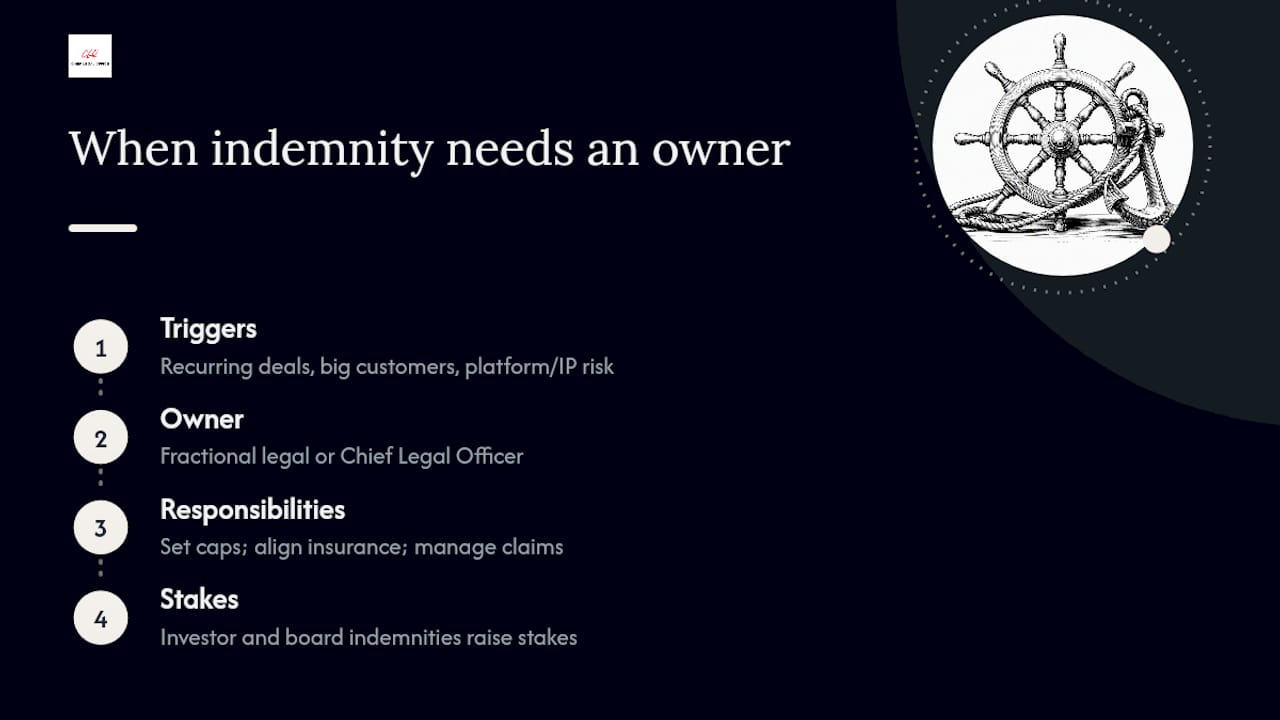
Most companies treat indemnification as a one-off negotiation. That works until it doesn’t. Once you’re signing recurring supplier agreements, dealing with a large customer that has its own indemnity playbook, or carrying platform and IP risk that shows up in every deal, indemnity stops being a contract clause and starts being a company-wide exposure that needs a standard, not a one-time review.
That’s usually the moment a fractional legal department earns its keep. Someone needs to set the caps your company will accept across every contract, make sure your insurance actually lines up with what you’re promising, and manage the claim when it eventually lands, because it will. Investor and board indemnities raise the stakes further. Chief Legal Office builds that muscle for companies that aren’t ready for a full-time General Counsel but have outgrown ad hoc contract review.
— Amy Natasha Osteen
How Chief Legal Office Handles Indemnity Risk for You
Most companies don’t need a law firm to review one contract. They need someone who owns the standard across every contract, checks it against their actual insurance, and knows how to fight when a claim shows up. That’s the gap between hiring counsel for a single negotiation and having a legal department that treats indemnity as an ongoing risk to manage, not a box to check.
An initial engagement typically starts with a review of your current indemnity language across your top contracts, a recommended clause set matched to your actual risk and coverage, and a short playbook your team can use in future negotiations without escalating every deal to outside counsel. If you’re a founder-led company signing bigger contracts than your legal setup was built for, that’s exactly the gap this closes. Take a look at fractional General Counsel services and see what an initial review would look like for your contracts.
Sources
This article is general information, not a substitute for advice from a qualified lawyer. Consult a qualified legal professional about your own circumstances before acting on anything here.
FAQ
Do Indemnity Clauses Hold Up in Court?
Generally yes, courts routinely enforce indemnification clauses because they’re a standard risk-allocation tool in contract law. Enforceability can be limited by state law, particularly when a clause tries to make one party indemnify another for that other party’s own negligence, so governing law and specific carve-outs matter.
Should I Agree to an Indemnification Clause?
It depends on the trigger language, whether there’s a cap, and whether the obligation matches your insurance coverage. A narrow, capped clause tied to your actual policy limits is reasonable; an uncapped, broad-form clause covering the other party’s negligence is a red flag worth negotiating hard against.
What Is the Best Example of Indemnity?
A common example is a vendor agreeing to indemnify a customer against third-party claims that the vendor’s product infringes a patent or copyright, since the vendor controls the product and is best positioned to bear that risk. Insurance policies work the same way: the insurer indemnifies the policyholder for covered losses.
Is Indemnification Legally Binding?
Yes, once both parties sign a contract containing an indemnification clause, it’s a binding contractual obligation like any other term. Binding doesn’t always mean fully enforceable in every scenario, since some provisions can conflict with state public policy, which is why matching the clause to your jurisdiction and insurance matters before you rely on it.
Recommended
The lawyerly fine print: This article is for general information, not legal advice…