Founders: Sign an IP Assignment Agreement Now Before Fundraising
An IP assignment agreement transfers legal ownership of specific intellectual property from a person to the company. It is not a license, and it is not an NDA. If you have not signed a present-tense assignment covering your company’s patents, code, and other IP, sign one now, and tell investors about any gap before they find it. This guide gives you the checklist and the language that actually holds up.
TL;DR:
Signing a present-tense IP assignment agreement is critical to establish immediate ownership of patents, code, and trademarks before fundraising or acquisition.
The agreement must include clear scope, specific IP identification, a prior-inventions schedule, and obligations for future cooperation to withstand legal and investor scrutiny.
Recording assignments with the USPTO or relevant authorities solidifies ownership and protects against future disputes or challenge risks.
Most ownership issues arise from vague language, missing signatures, or unmonitored IP assets, highlighting the importance of ongoing IP recordkeeping.
Cross-border assignments require tailored jurisdictional clauses and legal advice to address enforceability, moral rights, and tax implications.
Table of Contents
What an IP Assignment Agreement Actually Does
When You Actually Need One (Spoiler: Probably Now)
The Clauses That Actually Matter in an IP Assignment
How to Execute an IP Assignment: A Practical Checklist
Due Diligence and Recordation: What Actually Perfects Title
Where Founders Get This Wrong
Filling Out the Template Without Shooting Yourself in the Foot
Tax Implications of IP Assignments
Jurisdictional Considerations and Enforceability
Keeping Track of What You Already Own
When Multiple Parties or Joint Ownership Are Involved
When to Bring in Chief Legal Office
Get Your Chain of Title Fixed Before Someone Else Finds the Gap
Sources
What an IP Assignment Agreement Actually Does
An assignment moves title. Once it is signed, the company owns the invention, the code, or the trademark, the same way it owns its office chairs. A license does the opposite: it grants permission to use something someone else still owns. An NDA does something different entirely. It just keeps information confidential and never touches ownership. Founders mix these up constantly, and the confusion becomes expensive fast.
IP assignment agreements typically cover:
Patents and patentable inventions
Copyrighted works (code, content, designs)
Trademarks and brand assets
Trade secrets and proprietary processes
The wording matters more than most founders assume. “I hereby assign” transfers ownership the moment ink hits paper. “I agree to assign” is a promise to do something later, and later sometimes never comes. Under 17 U.S.C. § 201(a), copyright vests automatically in the human author, not the company, unless a written assignment moves it. That single statutory fact is why so many startups discover, usually during diligence, that the company doesn’t actually own the app it has been selling for two years.
When You Actually Need One (Spoiler: Probably Now)
Most founders think they’ll get to this “later.” Later is how companies end up scrambling during a term sheet negotiation. Here’s when the need is real, not hypothetical:
Pre-formation work. Code written before incorporation belongs to whoever wrote it, not the company that doesn’t exist yet. You need a retroactive assignment the moment the entity forms.
Employees. Work-for-hire doctrine covers some employee output automatically, but patents are a different animal. Inventors must personally assign patent rights, employment alone does not do it.
Contractors. Freelancers and agencies default to owning their own work unless a signed assignment says otherwise, and it should be signed before work starts, not after.
Fundraising and M&A. Investors and acquirers run title checks. A missing signature here can delay or kill a deal, according to Ironclad’s diligence guidance.
The Clauses That Actually Matter in an IP Assignment
Most template disputes come down to five clause categories. Skip one, and you’ve built a document that looks fine until someone challenges it.
Present-tense assignment language. “Assignor hereby assigns” beats “Assignor agrees to assign” every time. Courts and investors both treat future-tense language as a red flag.
Precise scope and identification. List the actual IP, patents by application number, code by repository, trademarks by mark and class. Vague catch-alls invite arguments later.
Prior-inventions schedule. An exhibit listing what the assignor is not assigning (personal projects predating the company) protects both sides and avoids messy overreach claims.
Warranties, indemnities, and consideration. The assignor should confirm they have the right to assign, and the agreement should state what they’re getting in return, salary, equity, or a specific payment.
Further assurances and power of attorney. This obligates the assignor to help with future filings, and grants the company authority to act if that person becomes unreachable.
Effective date, governing law, dispute resolution. Boring but load-bearing. Get the date right, especially for retroactive assignments.
A real-world example: a publicly filed SEC exhibit shows exactly this structure in practice, present-tense grant, defined IP, and a further-assurances clause obligating ongoing cooperation.
Pro Tip: Never let a founder or employee sign an assignment without also completing the prior-inventions schedule. An assignment with a blank schedule looks complete but leaves your company’s biggest asset argument, “we own everything relevant,” undefended.
How to Execute an IP Assignment: A Practical Checklist
This is the sequence I’d walk a founder through on a Tuesday afternoon call, no fluff, just the steps.
Inventory the assets. List every patent, codebase, design, and trade secret in an exhibit. If you can’t name it, you can’t assign it.
Ask the uncomfortable questions. Did a co-founder write core code at a previous employer using their equipment? Is there a co-inventor who never signed anything? Surface this before a buyer does.
Draft with present-tense language. Use “hereby assigns,” attach the prior-inventions schedule, and tie the agreement to specific consideration, equity grants are the most common structure for founders.
Sign, notarize if needed, and record. For patents and trademarks, recording the assignment with the USPTO provides public notice and helps establish priority in a dispute.
Update records and notify stakeholders. Cap table, IP register, and board minutes should all reflect the transfer.
Founder resources like Stripe’s guidance on assigning IP recommend this exact sequence: identify, diligence, draft, sign, record. Skipping the diligence step is the most common shortcut, and the most expensive one, because it’s the step that catches co-inventor gaps before an acquirer does.
Due Diligence and Recordation: What Actually Perfects Title
Signing the document is necessary but not sufficient. Two more things determine whether that signature holds up under pressure.
USPTO recordation. Recording a patent or trademark assignment gives the world notice of who owns it, and it matters enormously in priority disputes where two parties claim the same rights.
Copyright’s vesting rule. Because 17 U.S.C. § 201(a) vests copyright in the human creator by default, a company that never got a signed assignment technically doesn’t own the code its own engineers wrote. This surprises almost every founder the first time they hear it.
Encumbrance checks. Look for prior licenses granted by a founder, unresolved co-inventor claims, or an old employer’s IP assignment clause that might already claim the work.
Chain-of-title cures. If you find a gap, a retroactive assignment can clean it up for most commercial purposes, though it typically cannot manufacture standing for a lawsuit that predates the fix.
Notarization isn’t always legally required, but it’s cheap insurance, especially for documents headed toward a diligence binder.
Where Founders Get This Wrong
“Assignor agrees to assign” is one of the most common drafting traps in founder paperwork. Courts have repeatedly treated that phrase as a promise to do something in the future, not a present transfer, which means the company’s ownership claim can collapse exactly when it matters most, mid-diligence or mid-litigation.
Pre-formation code is the other recurring problem. A retroactive assignment can fix ownership for business purposes, but it does not reach back in time to give the company standing to sue over infringement that happened before the assignment existed, according to Stripe’s founder guidance. Pair every assignment with a prior-inventions schedule and tie it to real consideration, usually the same equity grant that’s already vesting.
— Amy Natasha Osteen
Filling Out the Template Without Shooting Yourself in the Foot
Templates are a fine starting point, MaRS and other startup resources publish reasonable ones, but three fields sink more deals than any clause you’ll actually argue about: the asset exhibit, the effective date, and the signature block. Leave any of them blank or vague, and you’ve built a document that looks finished but isn’t.
Negotiate consideration and scope early with contractors, before work starts, not after. Red flags that need a second set of eyes: missing co-inventor signatures, a prior-inventions schedule that just says “none” with no detail, or a license grant with no end date buried in the same document.
Tax Implications of IP Assignments
An IP assignment can trigger tax consequences depending on how it’s structured, and this is where founders often assume “it’s just paperwork” when the IRS disagrees. If a founder assigns IP to the company in exchange for equity, that exchange can be treated as a taxable event, valued at the fair market value of the IP transferred, unless the transaction qualifies for tax-deferred treatment under provisions like Section 351 for corporate contributions in exchange for stock.
Royalty-bearing assignments raise a separate issue: if the assignment includes ongoing payments rather than a lump sum, the IRS may treat it more like a license for tax purposes regardless of what the document calls itself, which changes how the assignor reports the income. Capital gains treatment versus ordinary income treatment also depends on whether the assignor created the IP as their trade or business, self-employment income, versus a personal capital asset.
Cross-border assignments add another layer. If a founder or contractor lives outside the country where the company is incorporated, the assignment can trigger withholding tax obligations or transfer pricing scrutiny, especially between related entities.
None of this means every assignment needs a tax opinion. It means founders should not assume an assignment tied to equity is automatically tax-free, and should flag equity-for-IP structures to an accountant before signing, not after the K-1s go out. The legal transfer and the tax treatment are two separate questions, and treating them as one is how founders end up with a surprise tax bill attached to a document they thought was purely legal housekeeping.
Jurisdictional Considerations and Enforceability
An assignment signed in one state or country doesn’t automatically behave the same way everywhere the company operates, and this catches founders who assume “a contract is a contract.”
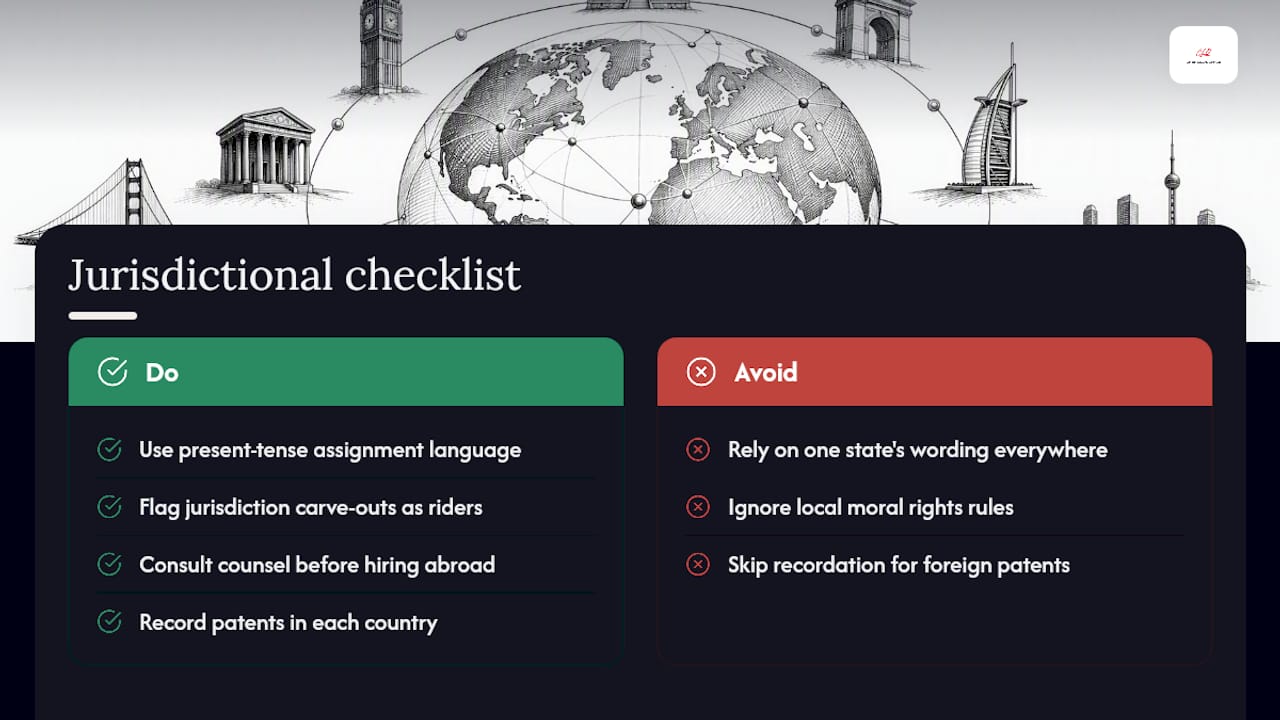
Governing law clauses matter because states differ on how they treat IP assignment provisions in employment agreements. California, for example, restricts how broadly an employer can claim ownership of an employee’s inventions through Labor Code Section 2870, carving out inventions developed entirely on the employee’s own time without company resources. An assignment clause that ignores this carve-out isn’t automatically void, but it can be unenforceable against the excluded category of inventions.
Internationally, the picture gets more complicated. Some countries, several in the EU among them, have moral rights doctrines that persist even after a copyright assignment, meaning the creator retains certain rights (attribution, integrity of the work) that a standard U.S.-style assignment doesn’t address. Patent assignment recordation requirements also vary by country: what perfects title with the USPTO doesn’t automatically perfect title with the European Patent Office or a national patent office elsewhere.
The practical fix isn’t drafting fifty versions of the same agreement. It’s building a base assignment with strong, present-tense language and broad enforceability, then flagging jurisdiction-specific carve-outs (like California’s inventor protections) as riders or amendments where they apply. If your company has contractors or employees outside the country of incorporation, that’s a specific conversation worth having with counsel before, not after, the agreement is signed.
Keeping Track of What You Already Own
Signing the assignment is the beginning of ownership, not the end of the work. IP that sits unmonitored tends to develop gaps: a trademark that lapses because no one tracked the renewal deadline, a patent assignment that never got recorded, a codebase that absorbed a new contractor’s work without a fresh assignment covering it.
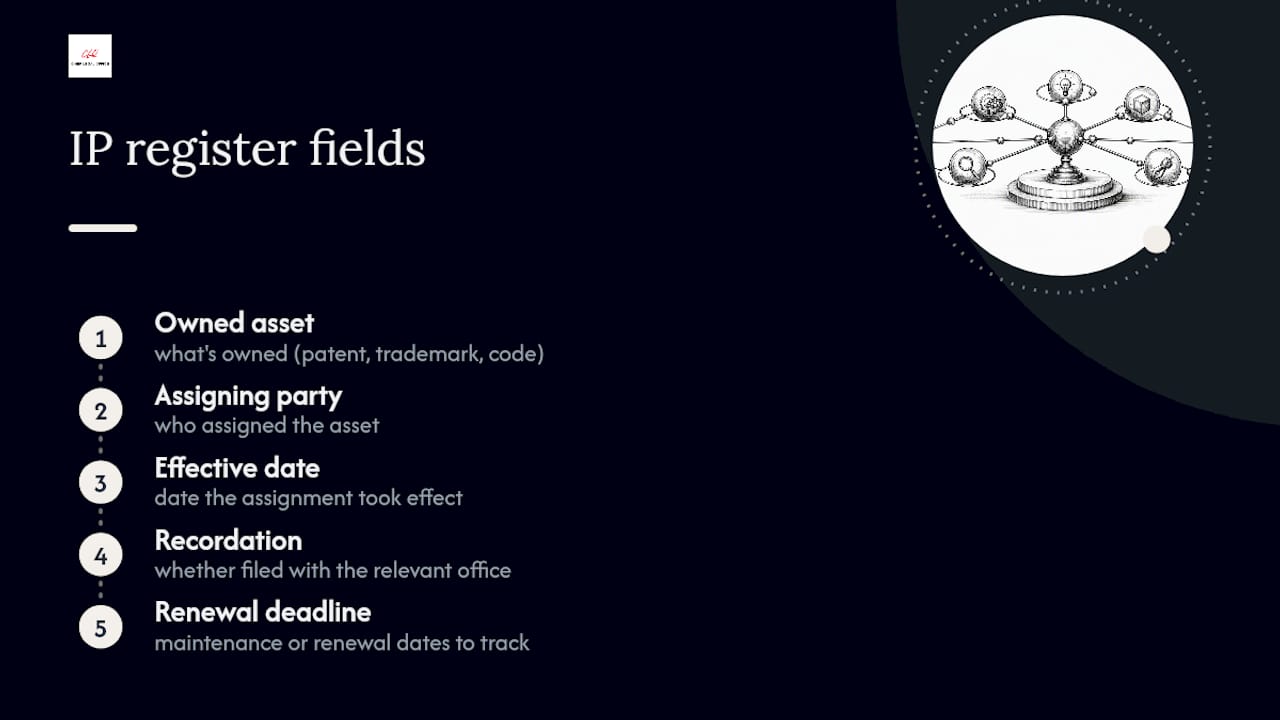
A basic IP register solves most of this. It should track what’s owned, who assigned it, the effective date, whether it’s recorded with the relevant office, and renewal or maintenance deadlines. This sounds obvious until you talk to a Series B company that discovers, mid-diligence, that three trademarks lapsed two years ago because nobody owned the calendar.
Post-assignment monitoring also means catching new gaps as the company grows. Every new hire, every new contractor, every new AI tool used to generate code or content creates a fresh question: does the existing PIIA (proprietary information and inventions assignment agreement) actually cover this? Companies that treat IP assignment as a one-time formation task, rather than an ongoing operational habit, are the ones that show up to due diligence with a folder of half-signed documents and hope nobody looks too closely.
When Multiple Parties or Joint Ownership Are Involved
Joint ownership sounds collaborative and tends to be a mess. When two or more people (co-founders, co-inventors, a company and an outside collaborator) jointly create IP without a clear assignment structure, each joint owner in most patent contexts can use or license the invention without the others’ consent, and without accounting to them for profits, unless a written agreement says otherwise.
That default rule surprises almost everyone who hears it. It means a departed co-founder who jointly invented something with the company can, absent an assignment, keep using or licensing that IP on their own, even after they leave. The fix is a single agreement, signed by every contributing party, that assigns all rights to the company rather than leaving joint ownership sitting between individuals.
Multi-party situations get more complex with external collaborators: joint ventures, university research partnerships, or co-development deals with another company. These usually need a separate ownership allocation clause spelling out who owns what, who can license to third parties, and how revenue or licensing income gets split. A generic single-page assignment template rarely covers this adequately, this is one of the clearer signals that a founder needs a real conversation with counsel rather than a fill-in-the-blank form.
When to Bring in Chief Legal Office
A clean template works fine for a single founder assigning clearly defined pre-formation work with no other parties involved. Once you’ve got multiple co-inventors, a tangled prior-employer relationship, or a fundraise on the horizon, you need someone who can spot the gap before an investor does. That’s the point where embedded legal support, not another form, is the right call.
Get Your Chain of Title Fixed Before Someone Else Finds the Gap
Most founders don’t discover an IP ownership gap until a term sheet or acquisition offer forces the question, and by then it’s a fire drill instead of a fix. Reviews and drafts PIIAs, executes retroactive assignments where they’re still legally useful, records patent and trademark assignments with the USPTO, and builds the diligence package before a buyer or investor asks for it.
This isn’t a document mill. It’s a fractional in-house legal department built specifically for technology companies that need someone who actually owns the outcome, not just a lawyer who answers the question you happened to ask. If your company’s IP ownership hasn’t been reviewed since formation, or you’re heading into a raise and haven’t checked your chain of title, that’s the conversation worth having now. Reach out through the fractional general counsel services page to talk through where your gaps might be.
Sources
17 U.S.C. § 201 — Copyright ownership; transfer and termination
Exhibit: Intellectual Property Assignment Agreement — SEC filing
What Every Legal Team Needs in an IP Assignment Contract — Ironclad
Recommended
The lawyerly fine print: This article is for general information, not legal advice…