Six to Eight Weeks to a Usable Legal Design Pilot for In House Teams
Legal design is the practice of applying human-centered design methods, the same ones product teams use to build usable apps, to legal documents, services, and systems. The goal is simple: make law something people can actually understand and act on, not just something lawyers can defend. It works, and there’s evidence to prove it, but only when teams treat it as a real process rather than a font change.
TL;DR:
Focusing on user research and iterative testing is more impactful than aesthetics or font choices in legal design projects.
Small, targeted pilots on one form or process can generate measurable improvements in comprehension, completion rates, and satisfaction within six to eight weeks.
Accessibility features like color contrast and keyboard navigation must be integrated at every stage to avoid excluding the intended audience.
Most legal design successes come from documenting and replicating methods, with formal evidence of improved understanding, but long-term outcome data remains limited.
A fractional legal team can implement legal design principles by auditing and redesigning existing documents and processes without needing a dedicated design department.
Table of Contents
What Legal Design Actually Means (And Why It’s Not Just “Plain Language”)
The Core Methods: Empathy, Prototyping, and Testing Before You Ship
Where Legal Design Shows Up in Real Projects
Does Legal Design Actually Work? The Evidence So Far
How to Run a Small Legal Design Pilot in Six to Eight Weeks
Why Most Legal Design Projects Stall Before They Finish
The Toolkits and Labs Worth Studying
Applying Legal Design Inside a Growing Company
What the Data Actually Supports, and What It Doesn’t
Getting Help Implementing Legal Design Without Hiring a Design Team
Sources
What Legal Design Actually Means (And Why It’s Not Just “Plain Language”)
Most people hear “legal design” and picture a contract with fewer semicolons and a friendlier typeface. That’s not wrong, exactly. It’s just incomplete, and the confusion costs organizations real money when they hire a graphic designer instead of running an actual design process.
The plain-language movement started this conversation decades ago, pushing lawyers to write “shall” instead of “shall not fail to.” That mattered. But plain language only fixes the words. Legal design fixes the whole experience, from how someone finds the form to whether they understand what happens after they submit it.
Stanford’s Legal Design Lab, led by Margaret Hagan, gave the field its clearest institutional home and its sharpest definition: applying human-centered design to legal problems and documents to make legal systems more usable. That framing matters because it borrows directly from product design. You research real users, you prototype, you test, you throw out what doesn’t work. Law firms don’t usually operate that way. Product teams do, and that’s the whole point.
Here’s how legal design differs from its neighboring disciplines:
Plain language simplifies vocabulary and sentence structure but doesn’t touch the surrounding process or interface.
UX design focuses on digital interfaces and rarely grapples with the substance of legal obligations underneath them.
Legal design combines both, plus service design, information design, and behavioral research, applied specifically to legal content and legal systems.
Legal innovation is a broader umbrella that includes legal design alongside technology adoption, pricing models, and delivery structures.
Why does any of this matter beyond academic tidiness? Because access to justice is, at its core, a usability problem. Millions of people who qualify for legal help never get it, not because the help doesn’t exist, but because the forms, websites, and processes standing between them and that help are unreadable or intimidating. Legal design treats that as a solvable engineering problem instead of an unfortunate fact of life. The OECD’s toolkit for people-centered legal services makes the same case at a policy level: services built around what people actually need, in language they actually understand, produce better outcomes and reach populations that traditional legal services miss entirely.
The Core Methods: Empathy, Prototyping, and Testing Before You Ship
Legal design borrows its process almost wholesale from product design, and that’s a feature, not a shortcut. The sequence looks like this:
Research. Talk to the actual people who will use the document, form, or service. Not lawyers. Not the general counsel. The tenant filling out the eviction response, the small business owner trying to understand a vendor contract.
Synthesize. Take those interviews and turn them into patterns. Where did people get confused? Where did they give up? Journey maps and empathy maps are the standard tools here, laying out each step a user takes and the emotional friction at every point.
Ideate. Generate multiple possible fixes before committing to one. This is where teams usually cheat, jumping straight from “the form is confusing” to “let’s redesign the form” without considering that the real fix might be eliminating three unnecessary questions.
Prototype. Build a low-fidelity version, paper sketches, a clickable wireframe, anything cheap enough to throw away.
Test and iterate. Put the prototype in front of real users and watch what breaks. Then fix it and test again.
LSNTAP’s practical guide lays out this exact rhythm for legal aid organizations: recruit people with lived experience of the problem, run quick interviews, synthesize findings into a journey map, and test prototypes iteratively rather than shipping a finished product on the first try. That guide’s core insight, and it’s one legal teams resist more than any other, is that shifting from an expert-centric mindset to genuinely valuing lived experience over lawyer intuition is the single hardest cultural change a legal design project requires.
Accessibility has to be part of every stage, not a final polish pass. That means checking color contrast against Web Content Accessibility Guidelines (WCAG) standards, writing alt text for any diagram or icon, making sure a screen reader can navigate a form’s structure, and testing with keyboard-only navigation. Skip this at the prototype stage and you’ll ship something that excludes the exact population legal design claims to serve.
Pro Tip: Run your first round of usability testing with five users, not fifty. Jakob Nielsen’s research on usability testing has long shown that five users surface the vast majority of usability problems in a given design; the value of a sixth interview drops fast. Save the bigger sample for validating your fix, not finding the problem.
One caveat worth sitting with: legal design is not cosmetic. Practitioners at Law By Design describe it as a rigorous, data-driven process of discovery and testing that has to align with actual user behavior and organizational goals, not a rebrand exercise dressed up in nicer visuals.
Where Legal Design Shows Up in Real Projects
Legal design isn’t theoretical. It shows up in specific, replicable project types, and looking at a few makes the abstract methodology concrete.
Court forms and visual guides. Court systems across the country have redesigned intake and response forms using plain language and visual layout, cutting the reading level and reorganizing information around the sequence a person actually needs, not the sequence a statute lists it in. Stanford’s Legal Design Lab has documented dozens of these projects, from small claims guides to eviction response forms.
Layered and annotated contracts. Instead of a single dense wall of legal text, layered contracts put a one-page summary on top, with icons or callout boxes flagging the terms that matter most (payment terms, cancellation rights, liability caps), and the full legal language underneath for anyone who wants it.
Guided interviews and triage tools. Legal aid organizations have built self-help tools that ask a user plain questions (“Did you receive a notice in the mail?”) and route them to the right next step, rather than handing them a blank form and a statute number. These triage flows do the cognitive work of “which form do I even need” that used to require calling a lawyer.
Online dispute resolution prototypes. Small claims and consumer dispute platforms have experimented with structured, guided negotiation flows that walk both parties through an issue step by step, reducing the need for either side to understand procedural law before they can participate.
A few things make these projects worth studying instead of just admiring:
They’re documented publicly, with methodology and sometimes raw before/after materials, which means they’re replicable rather than proprietary.
Academic labs like Stanford’s treat them as research, publishing what worked and what didn’t, including the failures.
Most started as narrow pilots, one form, one flow, before anyone attempted a system-wide redesign.
That last point is the one growing organizations should pay attention to. You don’t need a mandate to redesign your entire client intake process. You need one form, one journey, and a willingness to test it.
Does Legal Design Actually Work? The Evidence So Far
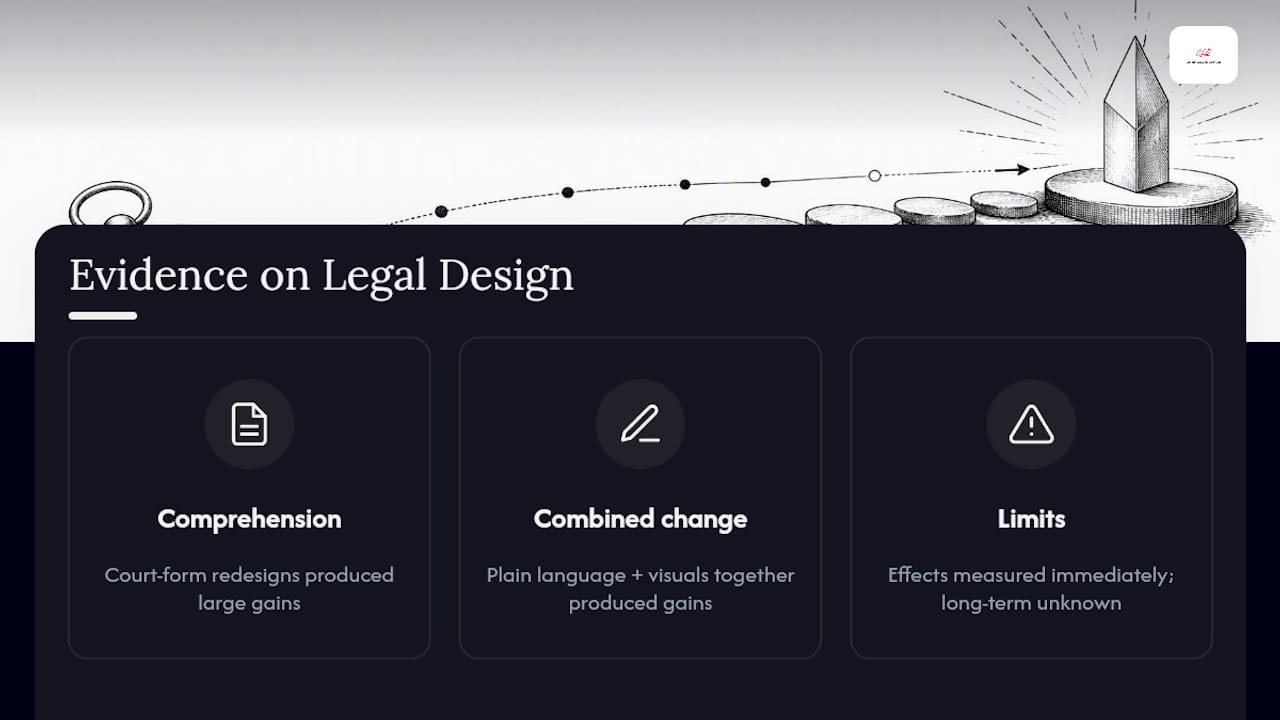
The comprehension gains from legal design work are large enough that they’re hard to dismiss as anecdote. A California court forms study documented in Margaret Hagan’s briefing on user-centered legal design found that redesigning a proof of service form using plain language and visual layout moved correct identification of the form’s purpose from a low percentage to a substantially higher percentage among test users.
That’s not a marginal improvement. That’s the difference between most people misunderstanding a legal document and most people getting it right.
The gain came from plain-language rewrites combined with visual redesign, not either one alone, which tracks with the field’s core argument that words and layout have to change together.
At the policy level, the OECD’s people-centered justice framework makes a broader recommendation: legal and justice services designed around actual user needs, built on real user research rather than institutional assumptions, tend to produce better outcomes and reach underserved populations more effectively than services designed from the provider’s side outward.
Where the evidence gets thinner is longevity. Most published studies measure comprehension immediately after a redesign, not whether that comprehension holds up six months later, or whether it actually changes case outcomes, settlement rates, or court appearance rates over time. Form redesigns have a solid evidence base. Whole-system redesigns and their downstream effects on justice outcomes do not, yet, and any organization citing legal design as a magic fix for systemic access problems is overselling what the current research supports.
How to Run a Small Legal Design Pilot in Six to Eight Weeks
You don’t need a design department to try this. You need a narrow scope, real users, and the discipline to test before you ship. Here’s a realistic timeline for a small team.
Pick one thing, and make it small. A single form, a single onboarding email, a single step in a client journey. Write a one-page brief: what’s broken, who it affects, and how you’ll know if you fixed it. Resist the urge to redesign “the whole intake process.” That’s a program, not a pilot.
Recruit real users and talk to them. Six to eight interviews with people who’ve actually used the document or gone through the process is enough to surface the major pain points. Ask open questions: “Walk me through what you did when you got this.” Don’t lead with “was this confusing?”
Map the journey. Lay out every step your users took, from first contact to completion, and mark where they hesitated, backtracked, or gave up. This is usually where the real problem reveals itself, and it’s often earlier in the process than the document you originally thought was the culprit.
Build a cheap prototype. Paper sketches, a mocked-up PDF, a basic clickthrough. Nothing that took more than a day to make.
Test it twice. Run the prototype past five to eight new users, fix what breaks, then test again with a fresh group. Two rounds catches problems your first fix introduced.
Measure four things. Comprehension (can they explain what the document asks of them), completion rate (did they finish it), time-to-complete, and satisfaction. A short cohort comparison, old version versus new version, tells you more than a survey ever will.
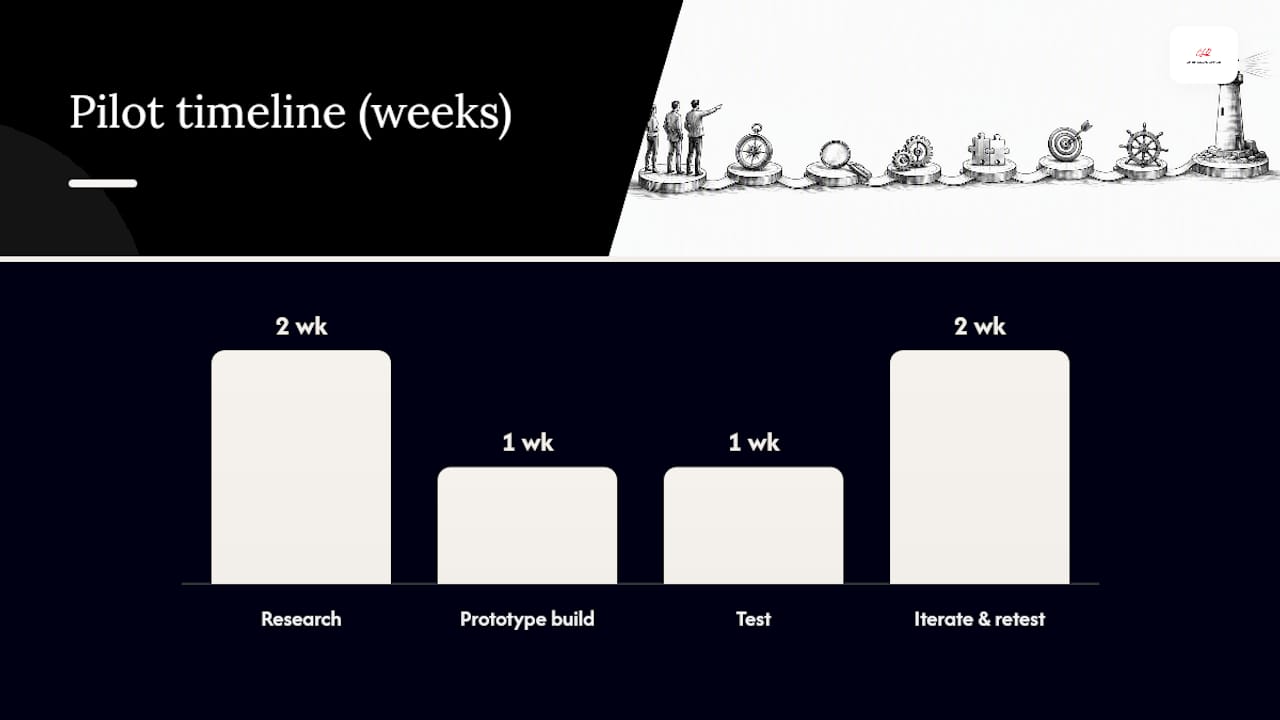
A realistic timeline for this whole cycle runs about six to eight weeks: weeks one and two for research, week three to synthesize and build the prototype, week four to test, weeks five and six to iterate and retest, and the final stretch to measure results and write up what you learned.
Pro Tip: *Track your drop-off points, not just your final completion rate.
Why Most Legal Design Projects Stall Before They Finish
The methodology is straightforward. Getting an organization to actually follow it is where most projects die.
Lawyer-centric drafting habits are hard to break. Attorneys are trained to write for other attorneys and for judges, not for the person actually reading the document, and that instinct resists redesign even when everyone agrees the current version is confusing.
Risk aversion masquerades as caution. “We can’t change that language, what if it gets challenged” often means “we haven’t checked whether the language is even legally required,” and that distinction rarely gets tested before a project stalls.
Accessibility gets bolted on at the end, or skipped. Visuals without alt text and forms that don’t work with keyboard navigation defeat the entire purpose of a people-centered redesign, and this is one of the most common oversights in otherwise well-intentioned projects.
Aesthetic polish gets mistaken for tested usability. A form can look clean and modern and still confuse users just as badly as the version it replaced, if nobody actually tested it with real people.
Evaluation gets rushed. Short pilots, tiny sample sizes, and no tracking beyond launch week make it impossible to tell whether a fix actually worked or just felt better in the room.
The Toolkits and Labs Worth Studying
You don’t have to build a legal design practice from scratch. A handful of organizations have already done the hard work of documenting methods and publishing templates.
Stanford’s Legal Design Lab publishes project case studies, course materials, and prototypes covering court forms, self-help tools, and access-to-justice interventions.
LSNTAP’s practical guide gives legal aid teams a step-by-step method for user research, journey mapping, and iterative testing.
The Legal Design Journal publishes case studies and research at the intersection of law and design, useful once you want to go deeper than introductory guides.
The OECD’s toolkit chapter frames the policy case and gives government and institutional teams a delivery framework.
If you’re choosing a partner to scale beyond a pilot, look for one who can point to documented before/after results, not just a portfolio of nice-looking PDFs.
Applying Legal Design Inside a Growing Company
Most companies encounter legal design without ever calling it that. It shows up as “why does our vendor contract take four email threads to explain” or “why do half our new hires never finish onboarding paperwork correctly.” That’s a legal design problem wearing a business-friction costume.
A fractional in-house legal department is a natural place to run these fixes, because the team is already inside the business, already looking at the same contracts and processes on repeat. At Chief Legal Office, that shows up in practical ways: layering a dense vendor agreement so the business terms sit on top and the boilerplate sits underneath, redesigning an intake process so requests get routed correctly instead of stalling in someone’s inbox, or mapping a governance approval flow so the board and the leadership team aren’t stuck decoding it during a fundraise. Our leadership team has spent careers running legal departments from the inside, which means these fixes get treated as operational work, not a special project that needs its own budget line.
What the Data Actually Supports, and What It Doesn’t
Here’s my honest read on the evidence: the comprehension gains are real and well documented, particularly for forms and written communication.
What’s overrated is the idea that legal design is primarily a design problem. It’s a research problem wearing design’s clothes. The organizations that succeed spend most of their time talking to users and mapping where things break, not picking fonts. The ones that fail skip straight to the redesign and call it done after one look-and-feel pass.
My advice for anyone starting out: pick something small enough to finish in eight weeks, involve users you don’t already agree with, and measure completion rate before you measure how good the new version looks. The visuals matter last, not first. If your organization can’t tolerate finding out its current process fails, legal design will surface that failure faster than any audit would, and that’s the actual value of doing it right.
— Amy Natasha Osteen
Getting Help Implementing Legal Design Without Hiring a Design Team
Running a legal design pilot well takes research discipline and someone senior enough to push back on “that’s just how we’ve always drafted it.” Most growing companies don’t have that person sitting idle, waiting for a redesign project. Chief Legal Office is built to be that person, and the team behind them, without asking you to hire a full design department or a full internal legal team.
A fractional in-house legal department engagement typically starts by auditing the contracts, forms, and processes your team touches most often, the ones generating the most confused emails and the slowest turnaround. From there, a senior attorney backed by paralegals and legal administrators can layer your key agreements, streamline an intake flow, or rebuild a governance process so it actually gets used instead of ignored. If you’re a technology company scaling fast, the same team can apply these methods to your product and platform agreements as easily as your internal operations.
The next step is simple: visit Chief Legal Office’s fractional General Counsel page and start a conversation about a focused pilot engagement, one process, one set of documents, before committing to anything larger.
Sources
Recommended
The lawyerly fine print: This article is for general information, not legal advice…