Founders: Fix 4 High Risk Clauses in Your Master Service Agreement
A master service agreement is a standing contract that sets the legal framework for all future work between two parties. Sign one when you expect repeated projects with the same vendor or client, because it lets you negotiate risk once and run every future project on a short statement of work. Skip it for a single, one-off engagement where there is no “future work” to protect.
TL;DR:
MSAs are most valuable when managing recurring vendors, multi-phase projects, or complying with enterprise procurement requirements to ensure risk and liability are consistent across all work.
Key clauses to focus on include mutual liability caps, carefully scoped indemnity obligations, precise IP ownership terms, and an order-of-precedence clause to prevent silent overrides that could increase exposure.
When drafting or negotiating an MSA, prioritize mutual protections and clear termination rights, while keeping operational changes limited to SOWs that specify scope and pricing without altering core risk provisions.
Regularly review and manage your MSA program by tracking active SOWs, verifying insurance coverage, and updating liability caps as the relationship grows to effectively control ongoing legal and financial risk.
For one-time, low-cost projects, a standalone service contract is usually more efficient, whereas MSAs suit long-term relationships with frequent, ongoing work.
Chief Legal Officechieflegaloffice.comKeep Your MSA Program MovingChief Legal Office provides senior legal leadership and a dedicated team to organize agreements, manage priorities, and support growing technology companies.Explore Chief Legal Office
Table of Contents
What Does an MSA Do, and When Should You Use One?
What Clauses Does an MSA Need, and How Do You Draft Them?
MSA vs. Statement of Work: What Goes Where?
Where Should You Spend Your Negotiation Leverage on an MSA?
What Should Be on Your Pre-Sign Checklist?
Bilateral vs. Unilateral MSAs: What’s the Real Difference?
Which Industries Rely Most on MSAs?
Is a Master Service Agreement Legally Enforceable Everywhere?
How Do You Manage Risk Across an MSA Relationship?
What Are the Most Common MSA Mistakes?
What Role Does an MSA Play in Long-Term Vendor Management?
What Should Founders Actually Prioritize With MSAs?
Who Manages Your MSA Program When You Don’t Have Time To?
Where to Read More on Master Service Agreements
Sources
FAQ
What Does an MSA Do, and When Should You Use One?
Think of a master service agreement as the constitution and every statement of work as a piece of legislation passed under it. The MSA sets the rules that don’t change project to project: who owns intellectual property, who pays for what goes wrong, how disputes get resolved, how either side can walk away. The SOW handles the stuff that changes every time: what’s being built, when it’s due, what it costs.
This two-tier structure exists because negotiating a full contract from scratch every time you kick off a new project is a waste of everyone’s billable hours. Thomson Reuters describes the MSA as a standing legal framework that speeds up future negotiations precisely because the hard parts, liability, indemnity, IP, are already locked in. Once that framework exists, a new SOW can be two pages instead of twenty.
I’ve watched founders resist this at first. “We already have a contract with this vendor,” they say, pointing to the agreement from the first project. But that agreement was written for one project. When project two shows up, either you’re renegotiating the whole thing again or you’re bolting new terms onto an old document that was never built to flex. Neither is a good use of anyone’s time.
Here’s where an MSA earns its keep in practice:
Recurring vendor relationships. A marketing agency doing quarterly campaigns, a software vendor running ongoing development sprints, a staffing firm placing contractors month after month.
Multi-phase projects with uncertain scope. You know you’ll need three to six SOWs over the next two years, but you can’t specify all of them today.
Enterprise procurement requirements. Larger customers often require an MSA before they’ll even open a purchase order, regardless of deal size.
Fast-moving teams that can’t wait on legal every time. Once the MSA is signed, ops or sales can issue a new SOW without looping in counsel for every clause.
The efficiency gain is real, but it isn’t the only benefit. An MSA also creates consistent risk allocation across a whole relationship instead of letting each SOW quietly renegotiate liability caps or indemnity language. Without that consistency, you end up with five contracts covering the same vendor relationship, each with slightly different limitation-of-liability language, and nobody notices until something goes wrong and three lawyers are arguing about which version controls.
When should you skip the MSA entirely? If you’re hiring a contractor for a single deliverable with no expectation of future work, a standalone service contract template covering that one engagement is faster and cheaper. Building a full MSA for a $5,000 one-time project is like drafting a prenup for a first date. The overhead isn’t worth it unless you actually expect a second project.
What Clauses Does an MSA Need, and How Do You Draft Them?
This is the section worth bookmarking. Every clause below shows up in nearly every MSA you’ll encounter, and each one has a wrong version that will cost you money later.
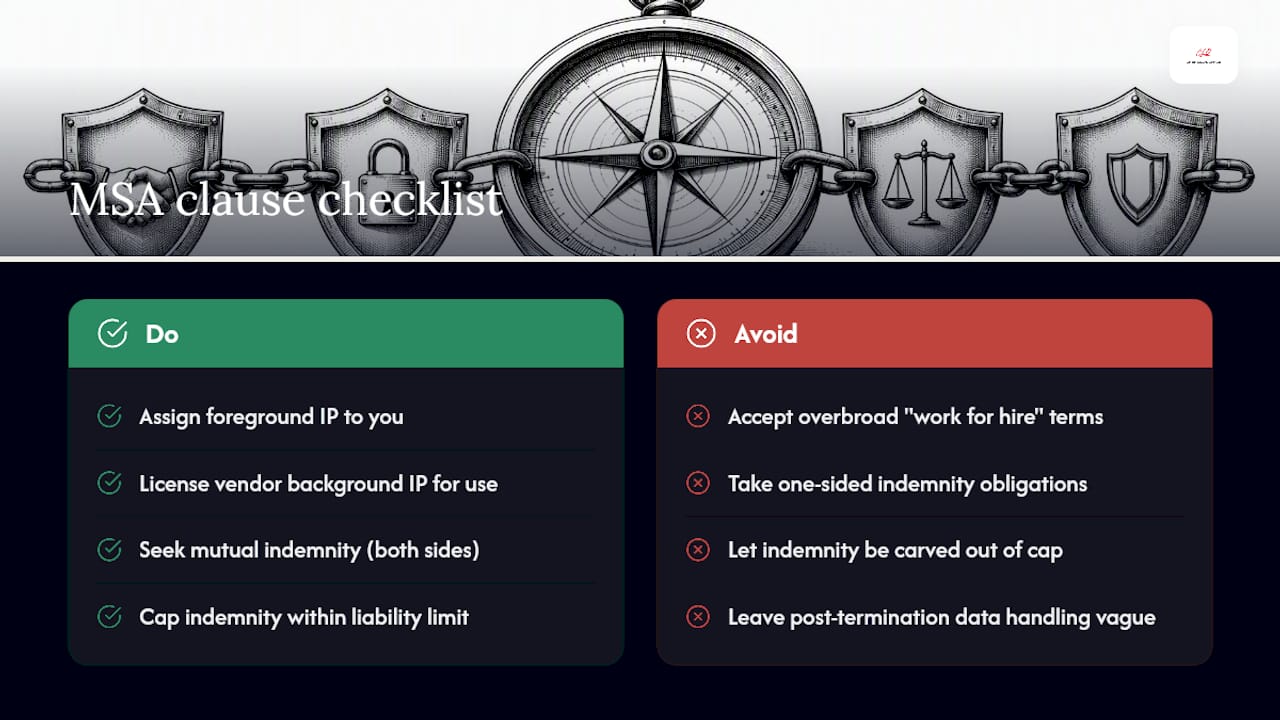
Intellectual property. The core question is background IP versus foreground IP. Background IP is what each party brings to the table, existing code, proprietary methods, pre-existing content. Foreground IP is what gets created during the engagement. Vendors should keep their background IP and license it to you for use with the deliverable. What you’re actually negotiating is who owns the foreground IP, and whether it’s an assignment (you own it outright) or a license (you can use it, but the vendor retains rights).
Watch for overbroad “work for hire” language that tries to sweep the vendor’s pre-existing tools and methodologies into your ownership. That’s not a fair trade, and most vendors will fight it if you don’t catch it first. A cleaner approach: assign foreground IP created specifically for you, license background IP broadly enough that you can actually use the deliverable, and say nothing about tools the vendor uses across all its clients.
Indemnity. This clause determines who pays if a third party sues over the work. Mutual indemnity, where each side indemnifies the other for its own breaches, is the fair default. One-sided indemnity, where you’re on the hook for the vendor’s mistakes too, is a red flag. Common carve-outs include IP infringement claims, breach of confidentiality, and gross negligence or willful misconduct, which typically aren’t subject to the liability cap at all.
The indemnity clause and the limitation of liability clause are not separate conversations. If indemnity obligations aren’t capped or are carved out of your liability limit entirely, you’ve effectively signed an agreement with unlimited exposure no matter what the liability section says.
Limitation of liability. Most MSAs cap damages at a multiple of fees paid, often linked to the fees under the applicable SOW. That’s a reasonable starting point for most service relationships. Watch for exceptions written into the cap: confidentiality breaches, IP claims, and indemnity obligations are frequently carved out and left uncapped. Practical negotiation guidance from JD Woods Law identifies limitation of liability, indemnification, and IP ownership as the three provisions that drive the most financial exposure in an MSA, which is exactly why they deserve the most attention during redlines.
Confidentiality and data protection. Beyond the standard mutual non-disclosure language, include a notice provision required under the Defend Trade Secrets Act if trade secrets are involved, and specify what happens to confidential information at termination: return it, destroy it, or certify destruction. Survival matters here. Confidentiality obligations should outlive the agreement itself, typically by several years, sometimes indefinitely for trade secrets.
Service levels and SLAs. A service level agreement defines measurable performance standards, uptime percentages, response times, resolution windows, and the remedies for missing them. The critical drafting question is whether the SLA remedy (service credits, usually) is your exclusive remedy for a performance failure, or whether you retain the right to pursue other damages too. Vendors push for exclusive remedy language because it caps their exposure to a predictable credit schedule. You want to preserve the right to terminate for repeated, chronic SLA failures even if you’ve been accepting service credits along the way.
Insurance. Require proof of coverage, not just a promise of it. Standard categories include commercial general liability, professional liability or errors and omissions, cyber liability if data is involved, and workers’ compensation. Ask to be named as an additional insured on the general liability policy and require a certificate of insurance before work starts, with notice if coverage lapses.
Payment and invoicing. Net 30 is standard; net 45 or 60 favors the paying party. Build in a disputed invoice process, ideally requiring the paying party to pay undisputed amounts while formally disputing specific line items, rather than withholding the entire invoice. Include suspension rights: the vendor’s right to pause work on nonpayment, and your right to suspend payment obligations if the vendor is in material breach.
Termination, survival, and amendment. Cover termination for convenience (either party walks with notice, typically over a notice period), termination for cause (immediate, for material breach), and what survives termination (confidentiality, IP ownership, payment obligations for work already performed, indemnity). Amendment procedures should require written agreement signed by both parties, not a casual email exchange.
Order of precedence. This is the clause that decides what happens when the MSA and a SOW say different things about the same issue. More on this in the next section, because getting it wrong is one of the most common and expensive drafting mistakes in the entire document.
Pro Tip: Before you sign anything, run a search for the phrase “notwithstanding anything to the contrary” across the whole document. That phrase is almost always attached to an override clause, and overrides are where the real risk hides. If you find five of them scattered across the MSA and the SOW, you need to map out exactly which clause wins before you sign, not after a dispute forces the question.
MSA vs. Statement of Work: What Goes Where?
The MSA and the SOW aren’t competing documents. They’re two layers of the same relationship, and confusing what belongs in each is one of the most common sources of disputes.
The MSA carries the framework: liability caps, indemnity, IP ownership defaults, confidentiality, termination rights, dispute resolution, governing law. These terms should barely ever change once negotiated, because renegotiating them every time a new project starts defeats the purpose of having an MSA at all.
The SOW carries the specifics:
Scope of work. What exactly is being delivered, in enough detail that both sides can agree later whether it was actually delivered.
Deliverables and milestones. Concrete outputs with dates attached, not vague descriptions of ongoing effort.
Acceptance criteria. Objective standards for what counts as “done,” plus a defined testing window and a deemed-acceptance fallback if the client goes silent instead of formally accepting or rejecting.
Price and payment schedule. Fixed fee, time and materials, or milestone-based, tied to the specific deliverables in that SOW.
Assumptions and dependencies. What the vendor is relying on the client to provide, access, data, approvals, and by when.
The order-of-precedence clause decides what happens when these two documents conflict. There are three common patterns. MSA-controls means the MSA’s terms win on any conflict, and the SOW can only add detail, never override core terms. This is the safest default for the party trying to protect its risk framework. SOW-controls means the SOW can override the MSA on any point, which sounds flexible but is genuinely dangerous, because it means a project manager signing a SOW under deadline pressure can unknowingly waive a liability cap or indemnity protection negotiated months earlier. Hybrid precedence lets the SOW override on operational matters like scope and pricing, while explicitly stating that risk-allocation clauses, liability, indemnity, IP ownership, cannot be modified by a SOW without an explicit, conspicuous amendment referencing the specific MSA section being changed.
Chaindoc’s contract handbook recommends the hybrid pattern as the practical default for U.S. commercial relationships, and that recommendation lines up with how these disputes actually play out. The projects and pricing change constantly. The risk architecture shouldn’t.
Change orders deserve their own process, separate from a full SOW amendment. A clean change order procedure requires written approval from both sides, states the specific change in scope, price, or timeline, and references the original SOW it modifies. Verbal scope changes agreed to in a status call are the single most common source of “we never agreed to that” disputes, because nobody wrote anything down.
Where Should You Spend Your Negotiation Leverage on an MSA?
You will not get everything you want in an MSA negotiation, and trying to fix every clause equally is how you burn goodwill on issues that don’t actually matter much. Negotiation here is triage. JD Woods Law’s guidance on this is blunt: limitation of liability, indemnification, IP ownership, and order-of-precedence account for most of the financial exposure in a typical MSA. Everything else is comparatively low stakes.
Priority one: the liability cap. This single number determines your maximum exposure if the relationship goes wrong. Push for a cap tied to fees paid, typically 12 months’ worth, rather than a flat dollar figure that won’t scale if the relationship grows. Push equally hard for mutuality: whatever cap applies to you should apply to the other side too. A one-sided cap, where the vendor’s liability is capped but yours isn’t, is not a negotiating oversight. It’s usually intentional, and it’s worth fighting.
Priority two: indemnification scope. Uncapped indemnity obligations are the most dangerous clause in the entire document, because they can swallow the liability cap whole. If indemnity for IP infringement or confidentiality breach isn’t subject to any cap, ask why. A reasonable middle ground is a super-cap, a higher liability ceiling that applies specifically to indemnity claims, rather than truly unlimited exposure.
Priority three: IP rights. Get specific about what’s being assigned versus licensed, and resist any clause that sweeps a vendor’s general tools, frameworks, or pre-existing methods into your ownership just because they were used on your project.
Priority four: termination rights. Make sure you can exit for convenience with reasonable notice, not just for cause. “For cause” termination usually requires proving material breach, which can turn into its own dispute if the relationship is already souring.
Here’s what tactical give-and-take actually looks like in practice:
Trade a higher liability cap for mutual application. If the vendor wants a higher cap, that’s more palatable if the same cap protects you too.
Accept narrower carve-outs in exchange for a super-cap on indemnity. A capped indemnity exposure beats an uncapped one every time, even if the cap is higher than you’d like.
Negotiate transition assistance and data escrow instead of fighting termination-for-convenience notice periods to the last day. What actually matters when a vendor relationship ends isn’t the notice period, it’s whether you can get your data and a smooth handoff on the way out.
Push back hard on any SOW clause that claims to override MSA risk terms unless it explicitly references the specific section it’s changing. Silent overrides are the mechanism by which a rushed project manager accidentally waives a protection legal spent weeks negotiating.
Pro Tip: If a vendor’s redline pushes back on every single point you raise with equal resistance, that’s often a negotiating tactic designed to wear you down on the issues that actually matter. Watch for a vendor who happily concedes five minor points and digs in hard on the liability cap. That pattern tells you exactly where the real risk sits from their side too.
One more thing worth knowing before you dig into a redline: smaller law firm guidance suggests that lawyer review of an MSA governing significant revenue or a repeated engagement usually results in targeted edits to five to ten specific provisions, not a wholesale rewrite. That’s useful context if you’re worried that bringing in counsel means blowing up the timeline. It rarely does, if the review is scoped correctly.
What Should Be on Your Pre-Sign Checklist?
Before anyone signs, run through a short list. This isn’t a substitute for full legal review on a high-stakes deal, but it catches the mistakes that show up most often.
Confirm the liability cap is mutual and tied to fees paid, and check what’s carved out of it.
Confirm indemnity obligations are either capped, subject to a super-cap, or narrowly scoped to specific, named risks.
Confirm foreground IP ownership matches your expectations, and that background IP definitions aren’t broad enough to swallow your own materials.
Confirm the order-of-precedence clause protects risk-allocation terms from silent SOW overrides.
Confirm termination rights include termination for convenience, not just for cause, with a workable notice period.
Confirm confidentiality survival terms and data return/destruction obligations at termination.
For sample language, a few short prompts you can adapt:
IP assignment: “Vendor hereby assigns to Client all right, title, and interest in and to the Foreground IP created specifically for Client under an applicable SOW, excluding any Vendor Background IP, which Vendor licenses to Client on a non-exclusive, perpetual basis solely for use with the Deliverables.”
Liability cap: “Except for breaches of confidentiality, IP infringement claims, or indemnification obligations under Section [X], each party’s aggregate liability under this Agreement shall not exceed the fees paid or payable under the applicable SOW during the twelve (12) months preceding the claim.”
Indemnity: “Each party shall indemnify, defend, and hold harmless the other party from third-party claims arising from its breach of this Agreement, negligence, or willful misconduct, subject to the limitations in Section [X].”
Termination: “Either party may terminate this Agreement or any SOW for convenience upon sixty (60) days’ written notice. Either party may terminate immediately for material breach not cured within thirty (30) days of written notice.”
Order of precedence: “In the event of a conflict between this Agreement and any SOW, this Agreement shall control, except that a SOW may modify the scope, price, and timeline of services, provided that no SOW may modify Sections [liability, indemnity, IP] without an explicit amendment referencing this Agreement by section number.”
If you want to see this language at full scale in a real commercial context, SEC exhibit EX-10.2 reproduces the complete master service agreement between Intelenet Global Services and Apria Healthcare, filed in May 2009. Reading a filed exhibit like this shows you how these clauses actually get drafted in a live commercial deal, not just how a template presents them. Pay attention to how the liability and indemnity sections cross-reference each other, and how termination and survival interact. That’s the part templates tend to oversimplify.
Bilateral vs. Unilateral MSAs: What’s the Real Difference?
A bilateral MSA imposes obligations on both parties, mutual indemnity, mutual confidentiality, mutual liability caps. A unilateral MSA imposes most of the meaningful obligations on one side only, typically the vendor, while the client retains broad rights and minimal duties.
Most commercial MSAs between roughly equal negotiating parties should be bilateral. If your indemnity clause only protects the vendor and your confidentiality clause only binds you, someone drafted this from a template that favored the other side, or you’re dealing with a vendor who genuinely won’t move off a one-sided position.
Unilateral structures aren’t automatically unfair. A large enterprise client with significant negotiating leverage over a small vendor may reasonably push for terms that skew in its favor, and vendors sometimes accept this in exchange for the volume or prestige of the relationship. The problem is when a party doesn’t realize the agreement is unilateral because the asymmetry is buried in definitions and carve-outs rather than stated plainly.
The practical test: read the confidentiality clause, the indemnity clause, and the liability cap, and ask whether the same standard applies if the roles were reversed. If your obligations are stricter, broader, or less protected than the other party’s on the same issue, you’re looking at a unilateral agreement wearing bilateral language. That’s worth flagging in redlines even if you ultimately accept the asymmetry, because at least then it’s a conscious business decision instead of an oversight.
Which Industries Rely Most on MSAs?
MSAs show up wherever a client expects an ongoing relationship with repeated, discrete pieces of work rather than one continuous project. Technology and software companies use them constantly, one MSA governing a development vendor across dozens of feature sprints and integration projects over several years.
Staffing and consulting firms rely on MSAs to place contractors and consultants across multiple assignments without renegotiating liability and IP terms every time someone new starts. Marketing and creative agencies use them for clients running recurring campaigns, one MSA, a new SOW every quarter for the next creative push.
Manufacturing and supply chain relationships use MSAs to govern ongoing purchase orders and services from a single supplier over years, particularly where volume, specifications, or delivery schedules shift regularly but the underlying legal terms shouldn’t. Healthcare organizations use them with recurring vendors, medical billing services, IT support, equipment maintenance, where HIPAA-related confidentiality and data handling terms need to be locked in once and referenced across many engagements.
Private equity firms and their portfolio companies frequently standardize MSAs across multiple vendor relationships to keep risk allocation consistent as the portfolio scales. Nonprofits with recurring grant-funded projects or ongoing professional services relationships use the same structure to avoid renegotiating baseline terms every funding cycle. In every one of these cases, the common thread isn’t the industry. It’s the expectation of repeated work with the same counterparty.
Is a Master Service Agreement Legally Enforceable Everywhere?
An MSA is enforceable under standard U.S. contract law principles: offer, acceptance, consideration, and mutual assent, the same requirements as any other commercial contract. What makes enforceability tricky in practice isn’t whether the MSA itself is valid. It’s jurisdiction and governing law when the parties operate in different states or countries.
Every MSA should include a governing law clause specifying which state’s law controls interpretation, and a venue or forum-selection clause specifying where disputes get resolved, in court, or through arbitration. Mismatched or missing clauses here create real problems: if the MSA is silent on governing law and a dispute arises between a California vendor and a Texas client, you’re litigating over which law applies before you even get to litigate the actual dispute.
Arbitration clauses are common in MSAs specifically because they offer more predictable timelines and confidentiality than open court litigation, both of which matter in an ongoing commercial relationship where the parties may need to keep working together, or at least keep the dispute out of the press. If arbitration is included, specify the administering body, the American Arbitration Association is standard for domestic U.S. disputes, the location, and whether the arbitration decision is binding.
One enforceability trap worth knowing: a beautifully drafted MSA doesn’t help you if the person who signed it didn’t have authority to bind their company. Confirm signature authority, especially with larger organizations where procurement, legal, and business teams may all touch the deal before it’s actually executed by someone empowered to sign.
How Do You Manage Risk Across an MSA Relationship?
Risk management under an MSA isn’t a one-time drafting exercise. It’s an ongoing discipline, because the risk profile of the relationship changes as the volume and nature of the work under it changes.
Start with the liability cap and revisit it periodically against actual exposure. A cap that made sense when the relationship was worth $50,000 a year looks thin once it scales to $2 million a year across multiple SOWs. Renegotiating the cap as volume grows is a normal, healthy conversation, not a sign of distrust.
Insurance verification should happen at signing and then annually, not just once. Certificates of insurance expire, coverage lapses, and a vendor who was adequately insured at signing may not be two years later. Build a calendar reminder into whoever owns vendor management, because this is exactly the kind of administrative task that falls through the cracks without a system.
Track every SOW issued under the MSA in one place. This sounds obvious, but plenty of companies lose track of how many active SOWs exist under a given MSA, which makes it nearly impossible to assess aggregate exposure to a single vendor. If you’re not tracking cumulative fees paid, you can’t verify whether your liability cap calculation is even accurate.
Finally, treat the data security and confidentiality provisions as living obligations, not paperwork. If the nature of the data shared under the relationship changes, say, a vendor that started with marketing support now touches customer PII, the confidentiality and data protection terms negotiated at signing may no longer match the actual risk.
What Are the Most Common MSA Mistakes?
The single most expensive mistake is letting a SOW silently override MSA risk terms without anyone noticing. A project manager under deadline pressure signs a SOW with a clause buried in the fine print that modifies the liability cap or indemnity language, and nobody flags it because SOWs are treated as operational paperwork, not legal documents. The fix is procedural: require legal sign-off on any SOW language that touches risk allocation, even briefly, before it’s signed.
The second most common failure, according to practitioner commentary on MSA and SOW negotiation, is weak acceptance criteria in the SOW. Vague deliverable descriptions like “provide marketing support” create endless disputes over whether the work was actually completed, which stalls payment and damages the relationship. Objective, testable acceptance criteria with a defined review window solve this before it becomes a fight.
A third pitfall: signing the MSA and then forgetting it exists. Companies negotiate hard on the framework and then let every subsequent SOW get issued by whoever happens to be running the project, with zero reference back to what the MSA actually says. Two years later nobody remembers the liability cap, and a dispute forces someone to dig through old files to figure out what was actually agreed.
The last one is subtler: treating the MSA as a one-time legal cost instead of ongoing infrastructure. Contracts drift out of date as business relationships evolve, and an MSA that isn’t revisited every year or two stops reflecting the actual risk of the relationship it governs.
What Role Does an MSA Play in Long-Term Vendor Management?
An MSA is the backbone of any vendor relationship expected to last years, not months. It’s what lets a procurement team, an ops lead, or a project manager issue a new SOW in an afternoon instead of routing a fresh contract through legal every single time.
That speed only holds up if the MSA is treated as the stable core it’s meant to be. A practitioner-level framing worth internalizing is this: the MSA should change rarely, and SOWs should change often and stay short and operational. When that discipline breaks down, when people start amending the MSA every few months to accommodate one project’s quirks, the whole point of having a two-tier structure evaporates.
For vendor relationships that span multiple years and multiple teams within your own organization, the MSA also functions as institutional memory. When the person who negotiated it leaves the company, the next person managing that vendor relationship needs the MSA to still say clearly who owns what, who’s liable for what, and how to get out of the deal if it stops working. A well-maintained MSA program, one where someone owns tracking active SOWs, insurance certificates, and upcoming renewal or termination windows, is what separates a vendor relationship that scales cleanly from one that quietly accumulates risk nobody’s watching.
What Should Founders Actually Prioritize With MSAs?
Most guidance on this topic treats an MSA like a legal formality: get the template, fill in the blanks, sign it, move on. That’s backwards. The research and the pattern of real disputes both point the same direction: an MSA is risk architecture, and the handful of clauses that actually drive financial exposure, liability cap, indemnity, IP ownership, order of precedence, deserve nearly all of your attention, while the rest of the document deserves comparatively little.
The conventional advice oversells the danger of every clause equally, which trains founders to either ignore the whole document or agonize over all of it. Neither works. Triage works. Fix the four or five provisions that carry real dollar risk, and let the operational language flow without a fight.
What gets underestimated is the SOW side of the equation. Companies obsess over MSA liability language and then let project teams issue SOWs with vague scope and no acceptance criteria, which is where most real disputes actually originate. An airtight MSA paired with sloppy SOWs still leaves you exposed. Prioritize both halves, or the framework you fought hard to negotiate won’t protect you when it matters.
— Amy Natasha Osteen
Who Manages Your MSA Program When You Don’t Have Time To?
Most founders don’t lose sleep over the MSA itself. They lose sleep over the fact that nobody at the company is actually watching it, tracking which SOWs are active, whether insurance certificates are current, or whether the last three SOWs quietly modified terms legal spent weeks negotiating. There are fractional in-house legal departments that treat your MSA program as ongoing infrastructure, not a one-time drafting project.
Clients may work with a dedicated team led by a senior in-house attorney, often a former General Counsel, backed by attorneys and paralegals who handle recurring work such as reviewing new SOWs against existing MSAs, flagging silent overrides before they get signed, tracking renewal and termination windows, and maintaining a consistent contract risk framework across vendor relationships. Such a structure can result in faster turnaround on routine contract review and a consistent risk framework across vendor and client agreements, without the need to hire a full internal legal department prematurely.
If your company is signing repeated SOWs under aging MSAs nobody’s reviewed in years, or you’re negotiating your first real MSA and want senior judgment without a full-time hire, start with Chief Legal Office’s fractional General Counsel services to see what ongoing contract ownership actually looks like.
Where to Read More on Master Service Agreements
For readers who want to go straight to primary sources rather than secondhand summaries, a few documents are worth your time. SEC exhibit EX-10.2 reproduces a complete, real-world MSA between two commercial parties, useful for seeing full clause language and how liability, indemnity, and termination sections cross-reference each other in practice. Thomson Reuters’ MSA explainer covers the fundamentals of what an MSA does and why it speeds up recurring negotiations. Chaindoc’s U.S. contract handbook walks through the MSA and SOW two-tier structure and precedence patterns in more technical detail than most blog content. The American Bar Association’s practice guidance offers a practitioner’s view on drafting norms across the legal profession. Reading the primary text, not just a summary of it, is the fastest way to confirm whether a clause you’re reviewing actually matches market standard.
Sources
FAQ
What Is the Purpose of a Master Service Agreement?
An MSA sets the baseline legal terms, liability, indemnity, IP ownership, confidentiality, and termination rights, that govern an entire ongoing relationship, so future projects only need a short SOW instead of a full renegotiation each time.
What Is the Difference Between an MSA and an SLA?
An MSA is the overarching legal framework for the relationship, while a service level agreement is a specific performance standard, uptime, response time, resolution windows, that’s usually included as a schedule or exhibit within the MSA or a SOW.
Can an MSA Be Terminated?
Yes. Most MSAs include termination for convenience with a notice period, commonly 30 days, and termination for cause allowing immediate exit after an uncured material breach; confidentiality and payment obligations typically survive termination.
How Much Does an MSA Agreement Cost?
Cost varies widely depending on complexity and whether you draft from a template or negotiate custom terms; a lawyer review for a material or recurring relationship typically results in targeted edits to five to ten specific provisions rather than a full rewrite. Chief Legal Office’s current pricing for fractional legal support is listed directly on its site.
What Is the Difference Between an MSA and a Statement of Work?
The MSA governs the ongoing legal relationship, liability, IP, termination, while the SOW covers the specifics of a single project: scope, deliverables, acceptance criteria, and price, and the two documents work together under an agreed order of precedence.
Recommended
The lawyerly fine print: This article is for general information, not legal advice…