Only 1 Win in 25 Years: Material Adverse Effect Clauses for Deal Teams
A material adverse effect clause gives a buyer the right to walk away from a signed deal if something catastrophic happens to the target company before closing. In practice, that right is much narrower than most founders assume: Delaware courts have let a buyer terminate on this basis only once in the last quarter century. Treat the clause as protection against genuine disaster, not a hedge against buyer’s remorse.
TL;DR:
Delaware courts rarely find in favor of buyer MAE claims, requiring harm to threaten long-term earnings over years, not just immediate results.
Carve-outs in MAE clauses, like natural disasters or economic shifts, usually protect sellers, while disproportional impact must show the target was hurt more than peers.
Successful MAE lawsuits demand extensive, costly evidence of durational significance and comparator data, making such claims nearly impossible to win.
Broad systemic shocks during macro events like pandemics are typically absorbed by carve-outs, shifting dispute focus to ordinary-course or closing conditions.
Negotiators should focus more on precisely drafting “ordinary course” and closing conditions, as these are more often decisive in deal disputes than MAE clauses.
Chief Legal OfficeKeep Deal Risk Moving ForwardChief Legal Office provides senior legal leadership and a dedicated team to help technology companies manage complex transactions and legal work.Explore Chief Legal Office
Table of Contents
What an MAE clause actually says
How Delaware courts read these clauses in practice
Carve-outs and the disproportionate-impact test in practice
Drafting checklist for buyers and sellers
An operational playbook for managing MAE risk before closing
Where MAE clauses came from
How other jurisdictions treat the same clause
Where MAE language shows up beyond M&A
MAE versus MAC: is there really a difference
Why proving an MAE in court is so hard
What happens to MAE clauses when the economy breaks
Why the MAE clause gets more attention than it deserves
How Chief Legal Office handles MAE risk from signing to closing
Sources
FAQ
What an MAE clause actually says
Every material adverse effect clause has the same skeleton, even when the drafting looks different from deal to deal. It sits inside the representations and warranties section, usually tied to a closing condition, and it has three moving parts.
First comes the affirmative grant: language stating that no event has occurred, and none is expected, that would have a “material adverse effect” on the target’s business, financial condition, or results of operations. That is the buyer’s leverage.
Second comes the carve-out list, the exceptions that pull certain events back out of the definition even if they hurt the business. Common carve-outs include:
General economic or financial market conditions
Industry-wide changes affecting all competitors
Acts of war, terrorism, or natural disaster
Changes in law or in generally accepted accounting principles
The announcement or pendency of the transaction itself
Third comes the disproportionate-impact exception, a clawback that says: even if an event falls inside a carve-out, it still counts against the seller if the target was hit harder than its peers. A typical SEC exhibit definition excludes pandemics and industry-wide downturns by name, then adds that the exclusion does not apply “to the extent such effects have a disproportionate impact on the Company relative to other participants in the industries in which the Company operates.” That single sentence is where most MAE fights actually happen.
How Delaware courts read these clauses in practice
Delaware’s Court of Chancery, which decides the overwhelming majority of contested MAE disputes because so many companies are incorporated there, has built a body of law that is remarkably buyer-unfriendly. The foundational cases, IBP v. Tyson and later Hexion v. Huntsman, established that an MAE must have “durational significance,” meaning the harm has to threaten the company’s earnings power over a period of years, not just disappoint one bad quarter. A scholarly review of the doctrine describes this as looking at the target “from the perspective of a reasonable acquirer viewing the target over the long term.”
Over the past 25 years, Delaware courts have almost never found in favor of a buyer’s MAE claim, with successful rulings being exceptional, in Akorn v. Fresenius. That result mattered because Akorn’s decline was not a market blip. Regulatory violations, collapsing earnings, and data integrity failures compounded over multiple quarters, giving Fresenius the kind of durational evidence courts almost never see.
Post-2020 cases refined the picture further. Pandemic-era disputes like Snow Phipps generally found that COVID-19 fell inside broad carve-outs, while AB Stable shifted the fight toward a different provision entirely: the ordinary-course covenant. When assessing an MAE claim:
The party asserting the MAE, typically the buyer, carries the burden of proof.
Comparative data against peer companies is critical in disproportionate-impact analysis.
Temporary declines generally do not meet the threshold for durational significance.
Carve-outs and the disproportionate-impact test in practice
Carve-outs exist because sellers refuse to bear the risk of events they cannot control. A downturn in the broader economy, a change in tax law, a war overseas: none of that is the seller’s fault, so none of it should let the buyer escape a deal it agreed to. The Harvard Corporate Governance analysis of pandemic-era carve-outs makes an important point here: a carve-out does not need to name “pandemic” specifically to cover one. Broader language, like “natural disasters” or “changes in general economic conditions,” can do the same work.
The disproportionate-impact exception is the pressure valve. It asks a comparative question: did this event hurt the target meaningfully more than it hurt similar companies in the same industry? Two quick scenarios show how this plays out:
A recession hits every company in the target’s sector roughly the same way. Revenue is down 15% across the board. The carve-out applies cleanly and no MAE exists, because there is no disproportionate impact to point to.
The same recession hits the target’s revenue by 40% while direct competitors drop only 10 to 15%. That gap is the evidence a buyer needs to argue the carve-out should not apply, and it is exactly the kind of comparator analysis courts expect to see.
Drafting checklist for buyers and sellers
Whichever side of the table you sit on, the MAE definition is not the place to get lazy. A few sentences of boilerplate here can decide whether a deal closes or blows up eighteen months later in litigation.
If you represent the buyer, push for:
A narrower carve-out list, especially trimming seller-favorable categories like “changes in law” or “general market conditions” where they are broader than they need to be
A tighter disproportionate-impact threshold that does not require proof of an extreme gap
Explicit language tying the MAE definition to the closing condition and the ordinary-course covenant, so the three provisions cannot be read against each other
If you represent the seller, push for:
Broad, relational carve-outs that capture systemic risk categories in full
A clear, specific definition of “ordinary course of business” so the buyer cannot later claim an MAE through the back door of a covenant breach
Carve-out carve-backs written narrowly enough that the buyer cannot stretch disproportionate impact into a routine underperformance claim
Three lines worth adapting into your own drafts:
Affirmative grant: “No event has occurred that has had or would reasonably be expected to have a material adverse effect on the business, assets, or results of operations of the Company, taken as a whole.”
Carve-out: “Provided, however, that none of the following shall constitute a Material Adverse Effect: changes in general economic or financial market conditions, or in the industries in which the Company operates.”
Disproportionate-impact clawback: “Except to the extent such changes disproportionately affect the Company relative to other participants in the industries in which it operates.”
Pro Tip: Ask for board minutes and monthly financials to be preserved from signing through closing. If a dispute arises, that record is what proves or defeats a disproportionate-impact claim.
An operational playbook for managing MAE risk before closing
Doctrine only matters if someone is watching the business between signing and closing, and that gap is usually where MAE risk actually gets created or defused. An embedded legal team’s job during that window is less about litigation theory and more about disciplined tracking.
Practical steps that reduce exposure on either side of a deal:
Set a reporting cadence with the executive team so financial and operational surprises surface within days, not at the next board meeting.
Build a covenant dashboard that flags anything that could look like a departure from ordinary-course operations before it happens.
Keep disclosure schedules and diligence files current in real time rather than reconstructed after a dispute starts.
Maintain a short, factual record of industry conditions so a disproportionate-impact argument can be made or rebutted with real comparator data.
A strong legal support model is built for this kind of continuous oversight, with leadership by experienced attorneys backed by a team handling recurring diligence and reporting work rather than leaving one lawyer to juggle it alone between deal calls.
Where MAE clauses came from
The material adverse effect clause did not arrive with a single landmark deal. It grew out of decades of financing practice, where lenders needed a way to reassess a borrower’s creditworthiness if something fundamental changed before funds were disbursed. Loan agreements used MAE-style language as a condition precedent and, separately, as an event of default long before the M&A market adopted the same structure for signing-to-closing gaps.
As public company mergers grew more complex through the 1980s and 1990s, and as the gap between signing and closing stretched from days to months, buyers wanted contractual protection against a target falling apart during that window. Courts had to give the phrase meaning, since “material adverse effect” says nothing on its own about how bad is bad enough. Delaware’s Court of Chancery filled that gap through case law rather than statute, and the durational significance test that emerged from IBP and Hexion became the standard other jurisdictions now reference.
Scholarly work on MAE clauses in finance transactions notes that the clause has always done more than one job: it screens deals before signing, gives lenders and buyers renegotiation leverage during due diligence, and functions as a governance mechanism that forces disclosure of bad news early. The M&A version borrowed that multifunctional design and layered on the carve-out architecture that dominates deals today.
How other jurisdictions treat the same clause
Delaware’s approach dominates the conversation because so many M&A targets are incorporated there, but the clause shows up in deals governed by other law, too, and the standards are not identical.
New York courts, which handle a substantial share of financing agreements and cross-border deals, generally apply a similar durational significance concept but with less developed case law directly on point. New York’s contract interpretation tends to lean more heavily on the plain text of the negotiated carve-outs, giving drafters even more reason to spell out exceptions explicitly rather than relying on judicial gap-filling.
English law takes a noticeably different posture. English courts read MAC and MAE clauses narrowly and are historically reluctant to find that a clause has been triggered, often demanding an even higher threshold of proof than Delaware requires before treating an event as material. The English approach also tends to focus more strictly on the literal wording of the clause rather than importing broader equitable reasoning about a company’s long-term prospects.
The practical lesson for anyone negotiating a cross-border transaction: never assume the governing law clause is a formality. An MAE definition drafted with Delaware precedent in mind may behave differently once a New York or English court is the one interpreting it, so the carve-out list and disproportionate-impact language need to be precise enough to stand on their own text, regardless of which court eventually reads them.
Where MAE language shows up beyond M&A
Most people encounter MAE clauses in the context of a merger agreement, but the concept travels well beyond acquisitions.
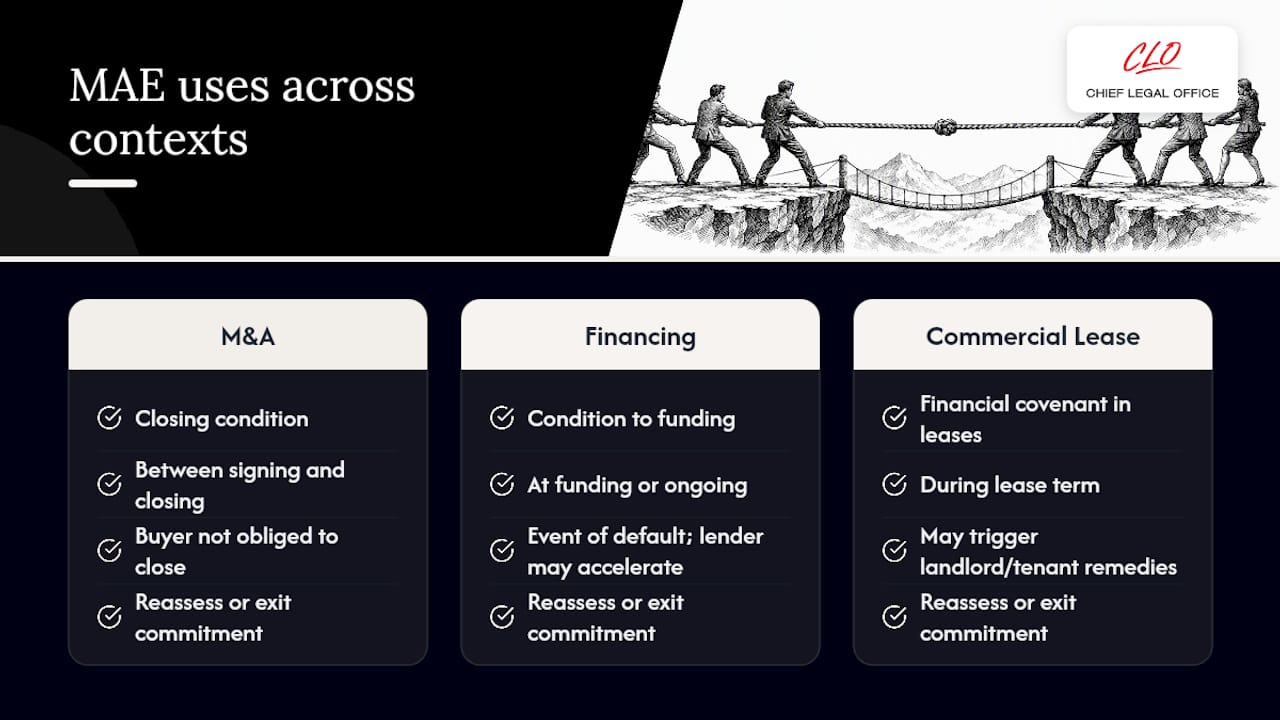
In M&A agreements, the clause typically functions as a closing condition. If an MAE occurs between signing and closing, the buyer is not obligated to complete the deal. This is the context behind nearly all the major Delaware cases.
In financing agreements, MAE language does double duty. It can appear as a condition to funding, similar to the M&A use case, but it also commonly shows up as an event of default in credit agreements, meaning a lender can accelerate a loan or refuse further draws if the borrower suffers a material adverse change in its financial condition. The scholarly finance analysis points out that this event-of-default version gives lenders a broad, ongoing monitoring tool rather than a one-time closing condition.
In commercial leases, MAE-style provisions are less standardized but occasionally appear in the context of landlord or tenant financial covenants, particularly in ground leases or leases tied to a larger financing structure, where a lender wants assurance that neither party’s financial condition will deteriorate materially during the lease term.
The common thread across all three contexts is the same: someone is trying to reserve the right to reassess or exit a commitment if the other side’s condition changes in a way that goes beyond ordinary business risk.
MAE versus MAC: is there really a difference
Material adverse effect and material adverse change get used almost interchangeably in practice, and for most purposes that is fine. Both phrases point to the same underlying idea: something significant enough happened to the target’s business that it changes the deal’s economics.
The distinction, where drafters bother to make one, is subtle. “Material adverse change” technically emphasizes a shift from a prior state, implying a comparison against how things stood at signing. “Material adverse effect” is framed more as a condition or consequence, focusing on the impact itself rather than the act of changing. In practice, courts and practitioners treat the two as functionally identical, and most modern agreements use “material adverse effect” as the defined term while occasionally referencing “change” informally in the same document.
The real takeaway for drafters is not to spend energy debating which phrase to use. It is to make sure whichever term you pick is defined precisely, with a full carve-out list and a disproportionate-impact exception, because the label does far less work than the definition attached to it.
Why proving an MAE in court is so hard
The rarity of successful MAE claims is not an accident of bad luck for buyers. It reflects a structural problem: the burden of proof is heavy, and the evidence required is expensive and slow to assemble.
A buyer has to show that the harm is durationally significant, meaning it will affect earnings power over a period of years, not just the current fiscal quarter. That requires financial projections, expert testimony, and often a multi-year lookback at the company’s performance trends, all of which invites the seller to introduce competing experts and competing narratives about what “normal” performance would have looked like anyway.
The disproportionate-impact fights add another layer of difficulty. A buyer needs credible comparator data showing that peer companies were not hit nearly as hard, and building that data set often means digging through competitors’ public filings, industry reports, and analyst commentary, none of which is designed for this exact purpose.
Timing works against buyers too. MAE litigation typically happens under enormous time pressure, right around a scheduled closing date, which is a terrible environment to build the kind of long-term earnings analysis Delaware’s durational significance test demands. Sellers, by contrast, often only need to point to a carve-out and argue the burden was never met. That asymmetry is a major reason buyer wins remain the exception rather than the rule.
What happens to MAE clauses when the economy breaks
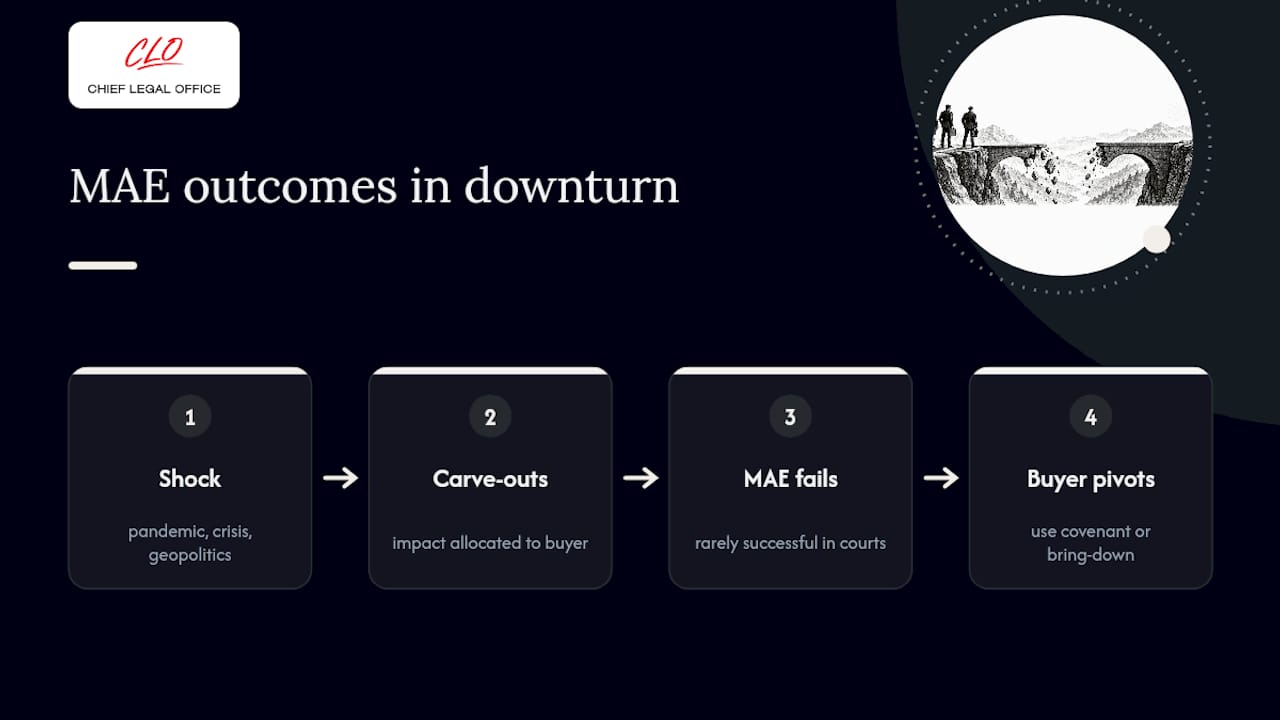
Every major macroeconomic shock, whether a financial crisis, a pandemic, or a sudden geopolitical event, becomes a live test of whether MAE clauses actually work the way drafters intended. The pattern that has emerged is fairly consistent: broad, systemic shocks tend to get absorbed by carve-outs rather than triggering a successful MAE claim.
During COVID-19, several buyers argued the pandemic itself, or the government responses to it, constituted an MAE. Courts largely disagreed. In Snow Phipps, the Delaware Court of Chancery found that pandemic-related effects fell within broadly drafted carve-outs, reinforcing that a systemic shock hitting an entire industry is exactly the kind of risk carve-outs are built to allocate to the buyer, not the seller.
That does not mean macro shocks are irrelevant to deal outcomes. They just tend to redirect the fight elsewhere. AB Stable is the clearest example: instead of winning on MAE, the buyer succeeded on an ordinary-course covenant argument, because the seller had made operational changes during the pandemic that arguably departed from how the business normally ran. A practitioner analysis of post-COVID drafting lessons puts it plainly: when carve-outs block the MAE path, buyers pivot to the ordinary-course covenant or the bring-down closing condition instead.
The lesson for anyone negotiating through the next downturn, whatever form it takes, is that MAE is only one piece of the risk allocation puzzle. The ordinary-course covenant deserves just as much drafting attention.
Why the MAE clause gets more attention than it deserves
Founders and even some experienced dealmakers spend a disproportionate amount of negotiating energy on the MAE definition, treating it as the linchpin of deal protection. The Delaware track record tells a different story. If a buyer’s real protection depends on a provision that has succeeded once in twenty five years, the MAE clause is not doing the heavy lifting most people assume it is.
The provisions that actually decide broken-deal disputes tend to be the ordinary-course covenant and the closing conditions tied to it, exactly what played out in AB Stable. Those provisions are more concrete, easier to prove, and far less dependent on a court accepting an aggressive theory about long-term earnings power.
That does not make the MAE clause pointless. It is still worth negotiating carefully, and the carve-out list still matters enormously to how much risk each side actually carries. But if you only have limited negotiating capital, spend more of it on defining “ordinary course of business” with precision and less on wordsmithing the MAE carve-outs to perfection. The clause you barely think about is usually the one that ends up deciding the case.
— Amy Natasha Osteen
How Chief Legal Office handles MAE risk from signing to closing
Getting an MAE definition right on paper is one thing. Managing the actual risk between signing and closing, while running a business, is another problem entirely, and it is the one most founders are not staffed to solve.
An embedded legal team builds a Client Success Team around your company, led by a senior in-house attorney experienced in running legal departments, backed by staff who track covenant compliance, keep disclosure schedules current, and flag operational changes that could lead to disputes. That continuous presence can make the difference between discovering a problem late and addressing it proactively.
If you are heading into a transaction, our Commercial Transactions team reviews and negotiates MAE language directly, and our Capital Raises and M&A practice runs the closing process end to end. Pricing starts with the Foundations plan at $1,000 per month. Get in touch to talk through a clause review or a pre-closing playbook for your next deal.
This article is general information, not a substitute for advice from a qualified lawyer. Consult a qualified legal professional about your own circumstances before acting on anything here.
Sources
FAQ
What is a material adverse change clause?
A material adverse change clause, often used interchangeably with material adverse effect, lets a party exit or renegotiate a deal if the other side’s business or financial condition worsens significantly before closing. Courts read the two terms as functionally the same, with the real substance sitting in the carve-out list and disproportionate-impact language rather than the choice of “change” versus “effect.”
What is the meaning of material adverse effect?
A material adverse effect is a harm to a company’s business, assets, or results of operations serious enough to threaten its long-term earnings power, not just a short-term dip. Delaware courts require this “durational significance” standard, which is why successful buyer claims are exceptionally rare.
What is considered a material adverse effect in a loan agreement?
In a loan agreement, an MAE typically functions as an event of default, letting a lender accelerate the loan or halt further funding if the borrower’s financial condition deteriorates materially. Unlike the one-time closing condition version used in M&A deals, this version can be invoked at any point during the life of the loan, giving lenders an ongoing monitoring tool rather than a single checkpoint.
What is an example of a force majeure clause?
A force majeure clause typically excuses a party from performing contractual obligations when events like natural disasters, war, or government action make performance impossible, distinct from an MAE clause, which is about a deal condition rather than an excuse from performance. The two provisions sometimes overlap in the events they cover, such as pandemics or acts of war, but they serve different contractual purposes and are usually drafted and negotiated separately.
The lawyerly fine print: This article is for general information, not legal advice…