

No-Shop Clause: What It Means and How to Negotiate It
A no-shop clause is a promise not to look for a better offer. Once you sign it, you, your officers, and your advisers generally cannot solicit other buyers or investors, negotiate with them, or hand them diligence information for a set period. In exchange, the buyer spends real money and time on the deal without worrying that you are using its bid as a coupon at someone else’s store.
Most founders first meet this clause in a letter of intent (LOI) that otherwise says “non-binding” on every page. That is the trap. The no-shop is often the one part that binds.
Chief Legal OfficeNegotiate Deal Terms With Legal ContextChief Legal Office provides senior legal leadership and a dedicated team to help technology companies manage complex commercial deals and ongoing legal work.Visit Chief Legal Office
TL;DR
A no-shop restricts the seller or target from soliciting, negotiating, or sharing diligence with competing bidders. It protects the buyer’s investment in the deal, per the ABA’s summary of no-shops.
In an LOI, the no-shop can be binding even when the rest of the deal is not, so negotiate it before you sign the LOI, not later.
Fight over five things: duration, what counts as a covered deal, who is bound, the exit for a superior offer, and the remedy if someone breaches.
A go-shop flips the model: you may actively solicit other bidders for a limited period after signing.
Table of Contents
What a no-shop clause actually does
Where you will meet one
The LOI problem: “non-binding” except for this
Five terms to negotiate before you sign
Termination fees and matching rights: the quiet part of the clause
Go-shop vs. no-shop vs. window-shop
Do boards have to run an auction?
A pre-signing checklist
Perspective: the clause is a business trade, not boilerplate
If you are heading into a deal
Common mistakes
FAQ
Sources
What a no-shop clause actually does
Picture a buyer who spends six weeks and six figures on lawyers, accountants, and travel. Then the seller takes that price, calls a competitor, and says “can you beat this?” The buyer paid for the seller’s leverage. The no-shop exists to stop that.
The core prohibited conduct, according to the ABA Business Law Today summary, has three parts:
Soliciting competing bids.
Discussing or negotiating with competing bidders.
Giving diligence access to anyone else.
The same logic shows up in venture financing, where a no-shop keeps a company from shopping a term sheet to other investors while the lead investor does its work. And it shows up in public company mergers, where the rules are more elaborate because the target’s board owes duties to stockholders.
A no-shop is almost never a flat ban. It comes with exceptions, and the exceptions are where the real negotiation happens.
Where you will meet one
Setting | Typical form | What to watch |
|---|---|---|
LOI or term sheet for a private sale | Short exclusivity paragraph, often binding | Duration, definition of covered deals, remedy |
Venture or growth round | Exclusivity while the lead completes diligence | Whether it covers only equity rounds or also debt, strategic deals, and partnerships |
Definitive merger or purchase agreement | Detailed covenant with exceptions | Fiduciary out, matching rights, termination fee |
Public company merger | Full deal-protection package | Superior proposal standard, fee size, stockholder vote timing |
The shorter the clause, the less likely a founder is to read it carefully. That is backward. A one-paragraph exclusivity clause in an LOI can do more damage than a ten-page covenant in a final agreement, because you signed it before you had any leverage in the process.
The LOI problem: “non-binding” except for this
Practitioners at Jenner & Block, in their 2024 drafting guidance on no-shop provisions, point out that no-shop language in a letter of intent can be binding even when the broader transaction is expressly nonbinding. They also flag four choices that tend to decide a later dispute: duration, scope, choice of law, and remedy.
That should change how you run the LOI stage. Many deal teams treat the LOI as a handshake and save the real lawyering for the purchase agreement. But the exclusivity clause is already in force while the purchase agreement is being drafted. If the deal drifts or the buyer starts asking for a lower price, you are still bound.
A clause that looks harmless during a fast transaction can later control who you may talk to, what you may share, and what the other side can recover when things go sideways. If you take one thing from this article: read the no-shop as if the deal will fall apart, because that is the scenario in which it matters.
Five terms to negotiate before you sign
1. Duration
The clause needs a clear start and a clear end. The Jenner & Block authors note that courts generally do not read contracts to create indefinite obligations, and that open-ended exclusivity is a common drafting failure. Do not rely on a court to rescue you. Put a date on it.
Then pick the right length. The period should realistically cover diligence, third-party approvals, and closing. Too short, and a seller can use one buyer as a stalking horse. Too long, and you suppress competition for months while the buyer holds an option on your company.
Market practice varies and depends on deal size and complexity, so treat any single number you see online with caution. Ask your counsel what is realistic for your deal type and what you would do if diligence stalls at day 30. Consider building in an automatic end if the buyer cuts its price or changes key terms.
2. What counts as a covered deal
This is where short clauses become very restrictive. If “acquisition proposal” is defined broadly, a conversation about a distribution partnership, a minority investment, or a license could breach the clause. Check whether the restriction covers only a sale of the company or also:
Equity or debt investments
Joint ventures and strategic partnerships
Licenses of core technology
Sales of individual assets or business lines
For a startup raising money, this matters constantly. You may need to keep talking to a bank, a customer who wants a strategic arrangement, or existing investors who want to participate. Carve those out by name.
3. Who is bound
Buyers often draft the clause to cover the company, its officers, directors, employees, and advisers. Your banker or outside counsel may then be in breach because of a call you did not know about. Make sure the representatives you are responsible for are the ones you can actually control, and be clear on what happens to conversations already underway when you sign. Do you have to terminate them? Notify the other party?
4. The exit for a better offer
This is the fiduciary out in the public company world, and an equivalent negotiation in private deals. The question is simple: if a materially better proposal arrives unprompted, can you listen, and can you take it?
In U.S. public M&A, the 2024 ABA Public Target Deal Points Study, as summarized in ACC materials, shows a fiduciary out for an unsolicited superior proposal, or one reasonably likely to become one, is nearly universal in the covered deals. It typically disappears once stockholders approve the transaction.
Private companies without a public stockholder base do not get this by default. If you want an out, you have to write it in.
5. The remedy
What happens if someone breaches? Damages, an injunction, a termination fee, or very little in practice? The Jenner & Block guidance treats remedy as one of the choices that decides whether a failed deal produces anything meaningful. For a seller, a clear, limited remedy is a feature. For a buyer, it is the whole point of the clause. Decide which side you are on and write accordingly.
Termination fees and matching rights: the quiet part of the clause
A no-shop can say you may accept a superior proposal and still make that nearly impossible. Two features do the work.
Matching rights. The buyer gets a window to match a competing offer before you can walk. A short clause can be highly restrictive if the buyer receives several days to match every time a new bid shows up, and again after each change.
Termination fees. If you leave for a better offer, you pay the original buyer. The same ACC materials report that 98.1% of public merger agreements provide for a fee payable to the original buyer when the target exercises a fiduciary termination right.
So a seller may technically be free to accept the superior offer, but the fee and the matching process can change whether a competing bidder bothers to make it. When you review a no-shop, read the fee, the matching mechanics, and the exception together. Practitioners treat these as a package, not a single sentence.
Go-shop vs. no-shop vs. window-shop
These three get mixed up, and the difference is practical.
Feature | No-shop | Window-shop | Go-shop |
|---|---|---|---|
Can you solicit other bidders after signing? | No | No | Yes, for a defined period |
Can you respond to an unsolicited offer? | Only through the negotiated exception | Yes, if it could reasonably lead to a superior proposal | Yes |
Typical use | Buyer wants maximum protection | Middle ground | Seller did not run a meaningful auction before signing |
The ABA summary describes typical go-shop periods as 30 to 60 days and notes that a topping bid originating in that period may trigger only part of the usual termination fee. Go-shops show up especially where the target did not run a real market check before signing.
If you are the seller and you have not tested the market, a go-shop is a way to prove to yourself, your board, and your stockholders that the price is fair. If you are the buyer, you will usually resist one, because it gives your competitor a window.
Do boards have to run an auction?
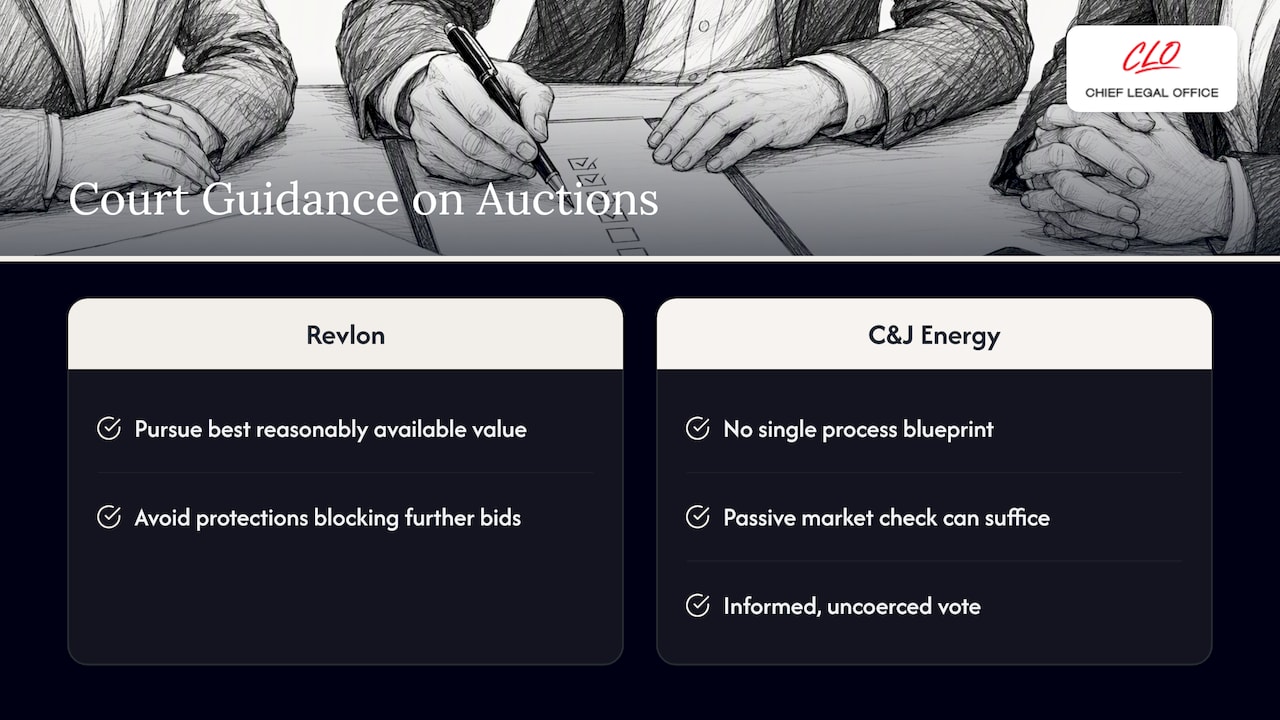
Not always. Courts have looked at the process, not at a single required format. In Revlon, the Delaware Supreme Court addressed a board’s duty to pursue the best value reasonably available, and it cautioned against deal protections that improperly foreclose further bidding. In C&J Energy Services, the court reversed an injunction and emphasized that directors have no single blueprint. An independent board may use a viable passive market check and give stockholders a fully informed, uncoerced vote rather than running an active auction every time.
The lesson for a deal team is balanced. A no-shop is not automatically invalid under Delaware law. But directors cannot use deal protections defensively or to entrench themselves and block a genuinely superior opportunity. If you sit on a board, document how you got comfortable with the process. If you are a buyer, do not assume a tight package will survive a challenge just because it is common.
That is Delaware law and public company context. Your state, your entity type, and your deal size will change the analysis, so have counsel confirm before you rely on any of it.
A pre-signing checklist
Before you sign any no-shop, confirm:
The exact start and end time (date and time zone, not “approximately 60 days”)
Whether it covers only a sale or also investments, joint ventures, licenses, asset sales, and strategic partnerships
Whether existing discussions must stop, and how
Which representatives are covered
The standard for any fiduciary out or superior proposal exception
Notice and response deadlines
Matching rights
Termination fees
The available remedy and the governing law
This list tracks the drafting issues identified in the Jenner & Block guidance. The right answer to each depends on your agreement and governing law.
Once the no-shop is settled, the next fights are usually elsewhere in the deal. Start your disclosure schedules at the LOI stage, and know how a material adverse effect clause will work if the buyer tries to walk. If your contracts have consent triggers on a sale, review your change of control clauses early, because they can affect timing and leverage. A buyer with a long exclusivity period and a seller scrambling on diligence is a bad combination.
Perspective: the clause is a business trade, not boilerplate
We see the no-shop as a pricing term disguised as a legal term. You are selling the buyer something valuable: time without competition. The question is what you get back. A higher price, a faster close, a firm financing commitment, a smaller closing condition list, a reverse termination fee if the buyer walks. If you give exclusivity and get nothing, you gave it away.
The companies that get hurt are usually not the ones who agreed to a no-shop. They are the ones who agreed to it in a rush, with nobody inside the company owning the legal function. The founder is closing a customer, the banker says the buyer wants a signature by Friday, and outside counsel is answering the question put in front of them without seeing the whole picture. No one asks: what happens on day 61?

That is why we build the legal function as a department rather than a single advisor. Our teams are led by senior U.S. in-house attorneys who have run legal departments, backed by attorneys, paralegals, and administrators. Executive questions, like how much exclusivity to give, go to senior leaders. The calendar, the diligence tracking, and the first pass at the clause go to the right person for the job. Nothing slips because everyone assumed someone else had it.
Our practical advice is short. Negotiate the no-shop at the LOI. Put a hard end date on it. Define the covered deals narrowly. Keep an out for a clearly better offer. Decide the remedy on purpose.
— Amy Natasha Osteen
If you are heading into a deal
If you are raising capital or selling, and you do not have a general counsel, the weeks before an LOI are the cheapest time to get legal leadership involved. Our Capital Raises and M&A work covers exactly this stage: reviewing the term sheet or LOI, flagging exclusivity and fee terms, and coordinating diligence. If the deal is one part of a larger need, our fractional in-house legal department takes on the whole legal function, and our published plans start at $1,000 per month for Foundations, with Embedded Access at $2,000 per month and Strategic Growth at $5,000 per month.
Common mistakes
Treating the LOI as nonbinding across the board. Read the section that says which provisions bind. Exclusivity is usually on the list.
Leaving the term open. Without an end date, you invite a dispute about how long you were actually bound.
Forgetting the side conversations. An old investor call, a partnership chat, or a banker’s courtesy outreach can look like a breach if the covered-deal definition is broad.
Ignoring the fee. A superior offer is only superior if it clears the termination fee and the match.
Skipping the buyer-side view. If you are the buyer, an exclusivity period too short lets the seller shop you around. Match the period to the diligence timeline, and use a clear diligence checklist to make the time count.
FAQ
What is a no-shop clause?
It is a provision, usually in an LOI, term sheet, or acquisition agreement, that restricts the seller or target from soliciting competing bids, negotiating with other bidders, or giving them diligence information. It protects the buyer’s investment in the deal. It usually comes with negotiated exceptions.
Is a no-shop clause legally binding?
Often yes, even in a letter of intent that calls the rest of the deal nonbinding. Drafting choices on duration, scope, governing law, and remedy then decide what a breach is worth. Have counsel read it before you sign.
What is the difference between a go-shop and a no-shop?
A no-shop bars active solicitation of other bidders. A go-shop permits it for a limited period after signing, which the ABA summary describes as typically 30 to 60 days. A reduced termination fee may apply to a bidder found in that window.
Can a no-shop stop me from accepting a better offer?
It can, unless it includes an exception. In public company deals, a fiduciary out for a superior proposal is nearly universal, though termination fees and matching rights still affect whether the better offer happens. In private deals, you only have the out you negotiate.
Sources
Recommended
12 Month Contact Based Non Solicitation Clauses for U.S. Employers
3 Ready Change of Control Clauses for Founders and In House Counsel
Only 1 Win in 25 Years: Material Adverse Effect Clauses for Deal Teams
The lawyerly fine print: This article is for general information, not legal advice…

