U.S. Nonprofit Boards: 5 Form 990 Policies That Prevent IRS Flags
Nonprofit board governance is the board’s legal and practical duty to steward mission, assets, and public trust on behalf of donors, beneficiaries, and the IRS. The single most important action any board can take is adopting a small set of written governance policies aligned with Form 990 and actually documenting how the board uses them. Everything else, from committee structure to compensation reviews, builds on that foundation.
TL;DR:
Adopting and documenting five key governance policies—conflict of interest, whistleblower, record retention, gift acceptance, and joint ventures—are essential for IRS compliance and transparency.
Boards should maintain clear minutes, conduct regular reviews of financials and Form 990 before filing, and implement formal procedures for conflicts and compensation to avoid regulatory scrutiny.
Ensuring board independence and balancing size with expertise reduces insider transaction risks and improves governance effectiveness.
Ongoing legal support for policy updates, minute review, and contract management helps maintain compliance beyond just annual efforts.
Regular routines like quarterly financial reviews, self-assessments, and policy audits prevent governance failures caused by treating oversight as a one-time task.
Chief Legal OfficeKeep Nonprofit Governance MovingChief Legal Office provides senior legal leadership and a dedicated team to help organize, manage, and support ongoing legal work.Learn about legal support
Table of Contents
What Nonprofit Board Governance Actually Means
The Five Governance Policies the IRS Actually Asks About
Building a Board Structure That Holds Up to Scrutiny
Fiduciary Oversight: Finance, Compensation, and Conflicts in Practice
Meetings, Minutes, and the Form 990 Review Nobody Wants to Skip
From Compliance to Real Stewardship
Red Flags That Draw IRS or Donor Attention
The Practical Legal Checklist for Ongoing Board Support
Why Governance Fails When It’s Treated as a Once-a-Year Task
How Chief Legal Office Supports Nonprofit Boards Year-Round
Sources
What Nonprofit Board Governance Actually Means
Governance and management are not the same job, and confusing them is where a lot of boards get into trouble. Management runs the organization day to day: hiring staff, paying vendors, delivering programs. Governance sets the direction, watches the money, and makes sure the organization stays legal. A board that spends its meetings debating which printer to buy is doing management’s job badly instead of governance’s job at all.
Every board member carries three legal duties, and they’re worth knowing by name because courts and regulators use these exact terms:
Duty of care means showing up prepared, reading the financials, and asking hard questions before voting. It doesn’t mean being an expert on everything, but it does mean paying attention.
Duty of loyalty means putting the organization’s interests ahead of your own. If your company wants to bid on the nonprofit’s printing contract, loyalty means disclosing that and stepping out of the vote.
Duty of obedience means following the mission stated in your governing documents and staying within the bounds of tax-exempt purpose. Drifting from mission without board approval and legal review is how organizations lose their exempt status.
BoardSource frames these three duties as the backbone of accountability, and that accountability runs in three directions at once: to the IRS, to state charity regulators, and to donors who gave money expecting it to be used as promised. This is exactly why board independence matters so much. A board stacked with the executive director’s relatives and business partners isn’t violating any specific rule by existing, but it raises every red flag regulators watch for.
The Five Governance Policies the IRS Actually Asks About
Form 990, Part VI doesn’t require these five policies by law, but it asks point blank whether your organization has them. Answering “no” repeatedly is the kind of thing that gets a return flagged for a closer look. According to the IRS’s own governance reporting guidance, the five policies are:
Conflict of interest policy requiring annual disclosure and a recusal process for interested transactions.
Whistleblower policy protecting staff or board members who report suspected misconduct without fear of retaliation.
Document retention and destruction policy setting how long financial, legal, and governance records get kept.
Gift acceptance policy governing how the organization evaluates and accepts non-cash or restricted donations.
Joint venture policy covering how the board oversees partnerships with for-profit entities to protect tax-exempt status.
Adopting these five policies is not a paperwork exercise you finish once. The IRS’s governance guidance for 501©(3) organizations makes clear the agency reviews governance structure, including these policies, both at the exemption application stage and every year through Form 990. It uses board composition and policy adoption as a proxy for how likely an organization is to have insider transactions or misused assets.
Statistic to know: Form 990, Part VI directly asks about all five of these policies, and the form is public. Any donor, journalist, or watchdog group can pull it and see exactly how your board answered.
Minimal policy elements matter more than polished language. A conflict of interest policy needs an annual disclosure form, a definition of what counts as a conflict, and a documented recusal procedure. A whistleblower policy needs a reporting channel and a non-retaliation clause. A document retention policy needs specific timeframes, not just “we keep things a while.” Template language from the National Council of Nonprofits is a solid starting point, but every policy should be tailored to your actual operations before the board adopts it.
Building a Board Structure That Holds Up to Scrutiny
Size is the first structural decision, and there’s no magic number. A five-person board can move fast but struggles to staff committees. A twenty-five-person board brings expertise and fundraising reach but can turn meetings into theater. Most well-run nonprofits have a voting board size that balances enough members for effective committee work without becoming too large to manage productive discussion.
Independence is the second decision, and it’s less about headcount and more about who’s in the room. The IRS guidance is blunt that boards dominated by employees, family members, or business associates of the founder carry more insider-transaction risk, even if nothing improper has actually happened. A board where the executive director’s spouse chairs the finance committee looks bad on paper even when every number is clean.
Committees are where governance gets real work done between full board meetings:
Audit or finance committee reviews financial statements, oversees the external audit or review, and reports findings to the full board.
Governance or nominating committee manages recruitment, board self-assessment, and orientation.
Executive committee handles time-sensitive decisions between meetings but should never become a shadow board that sidelines everyone else.
Every committee needs a written charter defining its authority, because “we’ve always just done it that way” is not a defense anyone wants to offer a regulator. Term limits and staggered terms round out the structure, keeping fresh perspective coming in while preventing an entire board from turning over in one year and losing institutional memory.
Fiduciary Oversight: Finance, Compensation, and Conflicts in Practice
Executive compensation is one of the fastest ways a board ends up in the news for the wrong reason. The fix is a documented process, not a gut check. Boards should pull contemporaneous comparability data (salary surveys for similar organizations by size and region), have the compensation committee document who reviewed what, and make sure any conflicted director recuses from the vote entirely. Write the rationale into the minutes and keep a compensation committee report on file. If a regulator ever asks whether pay was reasonable, that paper trail is the whole defense.
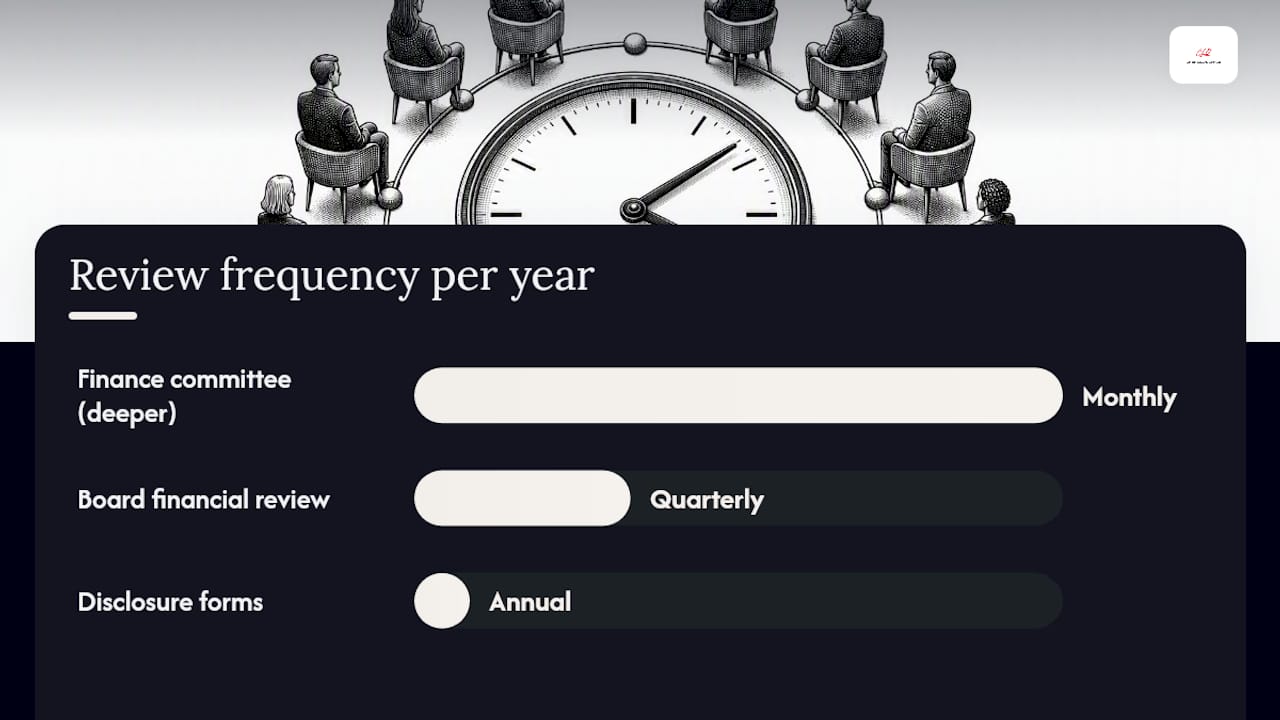
Finance oversight needs a rhythm, not a once-a-year scramble. Most boards review financials quarterly at minimum, with the finance committee going deeper monthly. Whether you need a full audit or a lighter financial review often comes down to budget size, state law thresholds, and whether major funders or lenders require an audit as a condition of funding.
Conflicts of interest need a paper trail too:
Annual disclosure forms for every board member, not just when a conflict comes up.
A recusal process written into the bylaws or policy, not improvised in the moment.
Minutes that specifically note the conflict, the recusal, and the vote count without the conflicted member.
Pro Tip: Don’t just note “conflict disclosed” in the minutes. Write who disclosed, what the conflict was, and that they left the room before the vote. Vague minutes protect no one, including the board member you’re trying to shield from suspicion.
Meetings, Minutes, and the Form 990 Review Nobody Wants to Skip
Good minutes aren’t a transcript. They’re a record that proves the board actually governed. Here’s how to run the process end to end:
Record attendance, decisions, and rationale. Note who was there, what was decided, and a brief reason for major decisions, along with any materials the board reviewed and any conflicts disclosed and managed.
Use written consent for time-sensitive matters. When a decision can’t wait for the next meeting, a written action signed by all voting members works, but document it the same day, not weeks later reconstructed from memory.
Assign Form 990 review before filing. The IRS’s Part VI instructions ask whether the organization provided a copy of the completed Form 990 to its governing body before filing. Answering yes only counts if it actually happened and someone documented that it happened.
Set a retention standard and stick to it. Contemporaneous documentation is one of the first things auditors and regulators ask for, so a retention policy that exists only on paper doesn’t help if minutes weren’t actually kept close to the meeting date.
Boards that treat minutes as an afterthought usually regret it the one time someone actually asks to see them.
From Compliance to Real Stewardship
Checking the Form 990 boxes gets you compliant. It doesn’t automatically make you a good board. That gap is where most of the practical value lives.
New board members should get a real orientation, not a folder dropped on their desk. A solid onboarding packet includes the bylaws, current policies, recent financials, board member job descriptions, and a plain-English summary of the three fiduciary duties. Pair that with an annual self-assessment where the board honestly rates its own meeting attendance, committee engagement, and fundraising participation. The National Council of Nonprofits treats this kind of self-assessment as a core practice, not an optional extra.
Recruitment deserves the same intentionality. Boards that recruit based on who they already know tend to end up with a room full of people who think alike and know the same donors. Building a skills matrix (finance, law, marketing, program expertise) alongside a real diversity strategy, one that reflects the communities the organization serves, tends to produce better decisions, not just better optics.
Pro Tip: If your board can’t find the skills or diversity it needs among voting members right now, an advisory council is a legitimate bridge. It brings in expertise and perspective without the fiduciary complications of a formal board seat, and it’s often an easier “yes” for busy professionals who want to help.
A governance calendar helps tie all of this together: orientation timing, self-assessment month, Form 990 review deadline, and policy review dates, all on one shared document so nothing depends on someone’s memory.
Red Flags That Draw IRS or Donor Attention
Certain patterns reliably attract scrutiny, and the good news is they’re all fixable once you see them:
Insider-dominated boards where family members or business partners hold most seats invite questions about self-dealing.
Missing or vague minutes suggest the board isn’t actually deliberating, just rubber-stamping decisions already made.
Weak conflict-of-interest handling, meaning no disclosure forms or recusals that never happen, undermines the whole point of the policy.
Compensation without comparability data looks arbitrary even when the number itself is fair.
The corrective steps are usually straightforward: add independent members, start disclosure forms this quarter, and go back and clean up minute-keeping going forward, even if you can’t fix the past. When a compensation dispute, a whistleblower complaint, or a joint venture structure gets complicated, that’s the moment to bring in legal counsel or an auditor rather than guessing your way through it.
The Practical Legal Checklist for Ongoing Board Support
Some governance work is a one-time project. Some of it needs a lawyer paying attention all year, not just when something breaks. Items that benefit from ongoing legal ownership rather than occasional outside counsel calls include:
Bylaws maintenance as the board and programs evolve.
The full policy lifecycle: drafting, board adoption, annual review, and updates when the law or the organization changes.
Executive compensation processes that need a documented, defensible structure every single year.
Joint venture and partnership agreements where tax-exempt status is genuinely at stake.
Contract review for vendors, funders, and program partners before signatures happen, not after.
A fractional in-house legal team fits naturally here because governance isn’t a single project with a clean end date. It’s a recurring routine: policy reviews, minute language checks, Form 990 pre-filing sign-off, and being available when a board chair calls with a question that can’t wait for the next scheduled meeting.
Why Governance Fails When It’s Treated as a Once-a-Year Task
Most governance problems I see aren’t caused by bad people. They’re caused by boards treating governance as something to handle in a rush before the Form 990 deadline instead of a routine woven into the calendar year. The conventional advice tells boards to “adopt policies,” full stop, as if a policy sitting in a binder does anything on its own.
It doesn’t. A conflict of interest policy nobody has signed since 2023 is worse than no policy at all, because it creates the appearance of governance without the substance. The boards that actually stay out of trouble are the ones that turn these obligations into boring, repeatable habits: quarterly finance reviews, annual disclosure forms, minutes drafted within 48 hours, not reconstructed from someone’s notes a month later.
That’s the real gap between what governance promises and what it delivers. If your board wants to close it, a governance health check is a good place to start.
— Amy Natasha Osteen
How Chief Legal Office Supports Nonprofit Boards Year-Round
Most nonprofits don’t need a full-time general counsel, but they do need someone who owns governance the way a staff attorney would, not the way an outside law firm bills by the hour for one-off questions. That’s the gap Chief Legal Office is built to fill: a dedicated Client Success Team led by a senior in-house attorney who learns your organization, not just your legal question of the week.
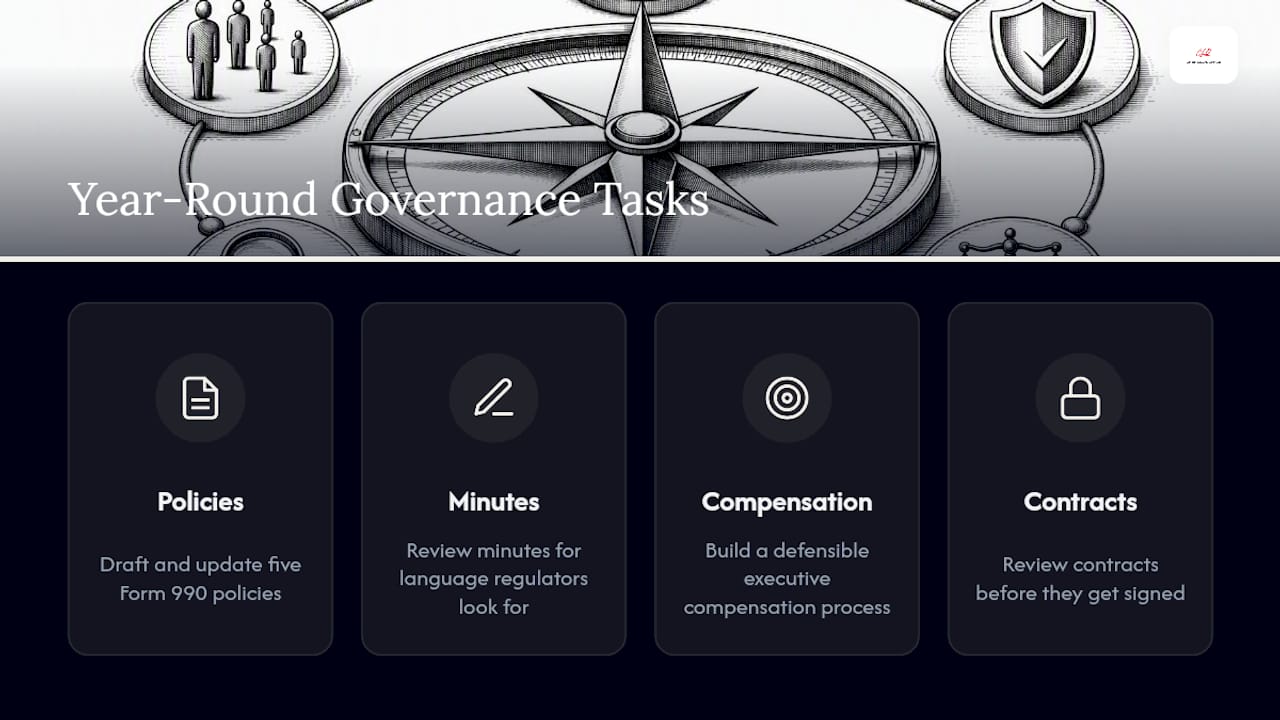
For nonprofit boards, that means real ownership of the recurring work: drafting and updating the five Form 990 policies, reviewing minutes for the language regulators actually look for, building a defensible executive compensation process, and reviewing contracts before they get signed instead of after something goes wrong. Chief Legal Office’s nonprofit and social enterprise practice works alongside your board and executive director as a standing legal function, not a lawyer you call once a year in a panic.
If your board is ready for governance support that shows up consistently rather than reactively, start with a conversation about fractional general counsel services built around exactly this kind of ongoing oversight.
Sources
For primary guidance, start with the IRS’s Form 990 Part VI governance overview and the IRS’s own governance check sheet for a self-assessment tool. BoardSource’s legal duties guide covers fiduciary basics, and the National Council of Nonprofits publishes sample policy templates ready for board adoption.
Exempt Organizations — Annual Reporting Requirements: Governance (Form 990, Part VI)
What are the legal duties of nonprofit board members? (BoardSource)
Good Governance Policies for Nonprofits (National Council of Nonprofits)
Recommended
The lawyerly fine print: This article is for general information, not legal advice…