
CLOs 90 Day Plan and Copy Ready Clauses for Outside Counsel Guidelines
Outside counsel guidelines are the enforceable rulebook that lets your legal department control billing, staffing, and data risk from outside firms, but only when they’re written in specific, measurable terms and wired into your engagement letters. The single most effective enforcement lever is pairing your guidelines with e-billing and LEDES-based automated review. Do that first, and the rest of your policy actually has teeth.
TL;DR:
Automated LEDES-based review and clear rate schedules are essential to enforce outside counsel billing guidelines effectively, preventing fee creep and invoice disputes.
Guidelines must be specific, measurable, and incorporated into engagement letters to be legally enforceable and prevent firms from ignoring unwritten or vague policies.
Strict staffing rules, pre-approval requirements, and consequences for unauthorized personnel help control overstaffing and reduce unnecessary legal costs.
Regular, automated invoice checks against set rules are necessary to detect violations, with dedicated personnel responsible for enforcement to ensure compliance.
Enforcement requires operational discipline, including automatic flagging and rejection of rule violations, not just well-written policies, to truly control outside counsel spend.
Chief Legal OfficeBring Structure to Outside CounselChief Legal Office helps companies set priorities, create repeatable processes, manage outside firms, and keep legal work organized.Explore Chief Legal Office
Table of Contents
What Are Outside Counsel Guidelines, Really?
Billing And Rate Rules That Actually Hold Up
Staffing Rules: Who Bills, Who Shows Up, Who Decides
How Should You Structure Budgets And Pre-Approval Thresholds?
What Counts As Reimbursable Versus Overhead?
Conflicts, Privilege, And Communication Protocols
Data Security, AI Use, And Technology Standards
Enforcement, Audit Rights, And Performance Metrics
Copy-Ready Clause Language You Can Use Today
Your First 90 Days: A Practical Rollout Plan
Where OCGs Go Wrong In Practice
The Editorial Take: Enforcement Beats Elegance Every Time
How Chief Legal Office Helps You Enforce What You’ve Already Written
Primary Sources And Templates Worth Reading
Sources
FAQ
What Are Outside Counsel Guidelines, Really?
Outside counsel guidelines, usually shortened to OCGs, are the written rules that tell outside law firms how to bill you, staff your matters, protect your data, and communicate with your team. They’re not a courtesy memo. When you incorporate them by reference into the engagement letter, they become part of the contract, which means a firm that ignores rate caps or block bills its invoices isn’t just being sloppy. It’s breaching a term it agreed to.
That distinction changes how you should think about drafting them. A lot of legal departments write OCGs the way they write employee handbooks: aspirational, vague, filed away, never opened again. That’s a mistake. If a rule can’t be checked by a machine or a paralegal in under thirty seconds, it won’t get enforced, and an unenforced rule is worse than no rule at all because it creates the illusion of control — see Contract Drafting & Disputes Attorneys in South Africa | Justibly for how precise contract guidelines help ensure enforceability.
The core modules every OCG needs
Think of your guidelines as a set of interchangeable modules rather than one long contract. Most well built OCGs separate administrative provisions from financial and operational ones specifically so you can update rates or expense rules without reopening every engagement letter on file.
Administrative front matter: scope of the policy, who at the firm and at your company are the named contacts, the effective date, and a signature or acknowledgment requirement.
Billing module: rate schedules, increments, prohibited fees, invoice format.
Staffing module: approved timekeepers, leverage ratios, meeting caps.
Budget module: matter estimates, pre-approval thresholds, accrual reporting.
Data and technology module: security standards, AI usage rules, retention requirements.
Conflicts and privilege module: disclosure duties, waiver procedures, communication protocols.
Map each module to an internal owner. Legal ops usually owns billing and budgets. IT or security should sign off on the data module. Whoever runs vendor relationships should own staffing. When one person is accountable for one module, updates happen instead of stalling in committee.
Billing And Rate Rules That Actually Hold Up
Vague billing language is where most OCGs quietly fail. “Reasonable rates” and “efficient staffing” sound fine in a policy but mean nothing to an accounts payable clerk reviewing an invoice. Guidelines that use specific numbers and clear triggers get enforced consistently across every firm on your panel; guidelines that use adjectives get argued about.
Start with a rate schedule tied to timekeeper level, not firm brand name. A partner rate cap, an associate rate cap, and a paralegal rate cap, each with a defined ceiling, gives you something concrete to check invoices against. For orientation, many mid-market companies cap partner rates in a band well below a firm’s standard rack rate and lock associate rates even tighter, since associate turnover is where fee creep tends to hide.
From there, lock down the mechanics:
Require billing in tenth-of-an-hour increments and explicitly prohibit block billing, where a single line item lumps together three unrelated tasks.
Mandate LEDES format invoices with UTBMS task and activity codes so every line item is machine-readable and comparable across firms.
Require specific data fields on every invoice: timekeeper name, level, task code, activity code, and a description that isn’t just “legal services rendered.”
Set a rate freeze period, typically twelve months, with a defined notice window (often 60 to 90 days) before any increase takes effect.
A note on enforcement: automated rule-based invoice review, checking every line against your rate caps, increment rules, and task codes at the moment of submission, catches errors a human reviewer skimming a 40-page invoice will miss. It also creates what one industry source calls a “sentinel effect”: firms that know every invoice gets checked the same way, every time, start self-correcting before they even submit.
Staffing Rules: Who Bills, Who Shows Up, Who Decides
Overstaffing is the quiet budget killer. A senior partner spending twenty minutes drafting a memo that gets billed at partner rate, when a fourth-year associate could have done it competently at half the cost, is the single most common leak in outside counsel spend. Staffing rules exist to close that gap before it opens.
Require pre-approval of the specific timekeepers assigned to your matters, by name, before they bill a single hour.
Restrict or exclude first-year associate billing entirely, since that work is essentially firm-funded training on your dime.
Cap the number of attorneys who can bill for attending the same meeting, call, or deposition (two is a common ceiling; anything past that needs written justification).
Require advance notice and your written approval before the firm substitutes personnel mid-matter.
Pro Tip: Put a specific consequence in writing for unauthorized staffing, such as automatic non-payment for any timekeeper not on your approved list. Vague language like “may result in adjustment” gives the firm room to negotiate after the fact. A hard rule doesn’t.
The American Bar Association’s Model Rule 1.5 requires that legal fees be reasonable, which gives you ethical backing, not just contractual backing, when you challenge overstaffed invoices. Staffing rules aren’t you being difficult. They’re you enforcing a standard the profession already agreed to.
How Should You Structure Budgets And Pre-Approval Thresholds?
Every matter above a defined dollar threshold should require a written budget before work begins, with the exact amount depending on the company’s size. Build the process in four steps.
Require an initial budget within 10 to 15 business days of matter opening, broken into phases (investigation, discovery, motion practice, trial, and so on) rather than one lump figure.
Set a pre-approval threshold for overruns, typically 10% of the approved phase budget, above which the firm needs your written sign-off before continuing to bill.
Require monthly accrual reporting so your finance team can forecast legal spend the same way it forecasts any other line item, instead of getting surprised by a big invoice in month four.
Use the budget history as leverage for alternative fee arrangements on recurring matter types. If a firm consistently comes in under a fixed estimate for routine work, that’s your opening to convert it to a flat fee.
Budgets that live only in email threads get forgotten. Budgets that live in your OCG, with defined submission timelines and overrun triggers, become part of how the relationship runs by default.
What Counts As Reimbursable Versus Overhead?
Most disputes over expenses come down to one unresolved question: is this cost part of running a law firm, or is it a cost of working on your matter? Your OCG should answer that question in advance., not invoice by invoice.
Treat Westlaw, Lexis, and other legal research subscriptions as firm overhead, not a reimbursable expense. The firm already pays for that access regardless of your matter.
Same logic for word processing, proofreading, and standard secretarial support. That’s the cost of doing business, not a pass-through cost.
Require pre-approval for airfare above coach or premium economy, and exclude billing for non-working travel time above a defined cap (many companies cap it at 50% of the travel hours).
Require original receipts for expenses exceeding a moderate dollar amount, and prohibit markups on subcontractor or third-party vendor charges.
Audit expense line items the same way you audit fees. A firm that pads travel time or bills for a document review platform it should already own is a firm worth a direct conversation, not just a rejected invoice.
Conflicts, Privilege, And Communication Protocols
Conflicts checks need to happen before engagement and stay active throughout the matter, not just at intake. Firms change lateral hires, merge, and pick up new clients constantly, and your OCG should require ongoing disclosure, not a one-time certification.
Model Rule 1.7 of the ABA’s Model Rules of Professional Conduct governs concurrent conflicts, and your guidelines should require matter-by-matter written consent rather than a blanket waiver buried in the original engagement letter. A blanket waiver signed three years ago tells you nothing about a conflict that emerged last month.
Require written disclosure of any new conflict within a reasonably prompt window after the firm becomes aware of it.
Mandate specific, matter-level consent for any waiver, not a general advance waiver.
Require privilege protocols: consistent email subject-line tagging, limited internal distribution lists, and maintained privilege logs.
Define an escalation path, naming who at the firm and who on your team resolves a conflict dispute, and by what date.
Data Security, AI Use, And Technology Standards
Your outside firms hold some of your most sensitive information, and most OCGs written before 2023 say almost nothing useful about how AI tools fit into that picture. That gap needs to close now.
Require encryption for data at rest and in transit, and specify a standard like FIPS 140-2 where the matter involves regulated or highly sensitive data.
Mandate multi-factor authentication and endpoint protection across any device or system touching your matter files.
Require disclosure before the firm uses generative AI tools on your matter, plus mandatory human review of any AI-drafted work product before it’s billed or delivered.
Prohibit the firm’s AI vendors from retaining your data for model training, and require written confirmation of that restriction.
Require return or certified destruction of all client data within a reasonable period after matter closure.
Pro Tip: Ask for a vendor security questionnaire or SOC 2 attestation up front, not after a breach. A firm that can’t produce one in a week probably isn’t handling your data the way its marketing page implies.
Verification matters as much as the written rule. Annual attestations, periodic penetration testing summaries, and a standard vendor security questionnaire give you documentation, not just a promise.
Enforcement, Audit Rights, And Performance Metrics
Here’s the uncomfortable truth about OCGs: most companies have them, and most companies don’t enforce them. Surveys consistently find high rates of written guidelines paired with low rates of systematic enforcement, which means the guideline exists on paper and does essentially nothing in practice. Enforcement, not drafting, is where most legal departments actually lose.
Fixing that comes down to three practical steps: detection, catching the violation; judgment, deciding whether it’s worth challenging; and resolution, actually getting the invoice adjusted. Skip any one of the three and the rule is decorative.
Reject or automatically flag any invoice that violates a defined rule, don’t wait for a manual review cycle to catch it.
Retain invoice documentation and supporting records for three to five years to support audits, disputes, or regulatory inquiries.
Build a simple scorecard per firm tracking rate compliance, staffing compliance, budget variance, and turnaround time on invoice corrections.
Reserve explicit audit rights in the engagement letter, including the right to request underlying time entries for any billed matter.
Rolling out enforcement all at once tends to backfire. Pick a small set of aggressively enforced rules, no block billing, LEDES format, staffing pre-approval, and pilot them with your two or three largest firms first. That creates behavioral change across your whole panel faster than trying to enforce every clause on day one.
Copy-Ready Clause Language You Can Use Today
You don’t need a law review article to write enforceable OCG language. You need specific numbers and clear triggers. Here’s language you can adapt directly:
Rate cap: “Outside Counsel shall not bill Client at a rate exceeding [$X] per hour for Partners, [$X] for Associates, and [$X] for Paralegals, without Client’s prior written approval.”
Billing increments: “All time shall be recorded in increments of one tenth (0.1) of an hour. Block billing of multiple tasks in a single time entry is prohibited.”
LEDES requirement: “All invoices shall be submitted in LEDES 1998B format (or successor format) with UTBMS task and activity codes.”
Staffing approval: “Outside Counsel shall not assign any timekeeper to Client Matters without prior written identification and approval by Client.”
AI disclosure: “Outside Counsel shall disclose any use of generative artificial intelligence tools in connection with Client Matters and shall not bill Client for AI-generated work product that has not undergone attorney review.”
Place billing and staffing clauses in the OCG itself, since those need updating more often. Keep the AI disclosure and data security requirements referenced in the engagement letter directly, since those carry the most contractual weight. Every version update should carry a date stamp and a signed acknowledgment from the firm’s engagement partner.
Your First 90 Days: A Practical Rollout Plan
Days 1 to 20: Draft or update your OCG using the modules above. Assign an internal owner to each module and get sign-off from finance, IT, and whoever manages outside firm relationships.
Days 20 to 45: Select two or three pilot firms, ideally your highest-spend relationships, and introduce the updated guidelines with a short explanation call, not just an email attachment.
Days 45 to 75: Enforce a small set of rules hard: no block billing, LEDES format, staffing pre-approval. Track every flagged invoice.
Days 75 to 90: Measure realized savings from rejected or adjusted invoices, then expand the same rules to your full panel.
Integrate your finance team early for accrual tracking and your IT team early for the data security module. Both will catch gaps in the draft that legal alone would miss.
Where OCGs Go Wrong In Practice
I’ve watched companies write beautiful, thorough outside counsel guidelines that accomplish nothing, because nobody built the enforcement mechanism behind them. The document sits in a shared drive. The firm bills however it always has. Nobody checks.
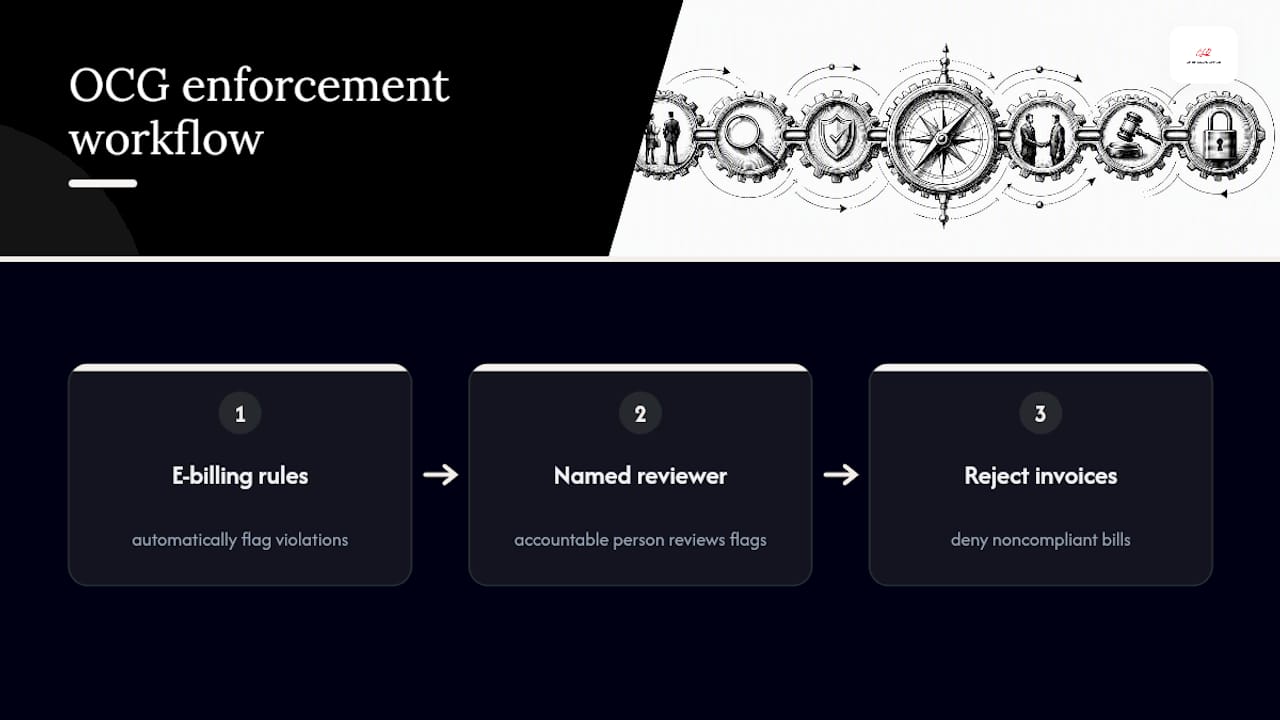
The fix isn’t a better-written policy. It’s operational: e-billing rules that flag violations automatically, a named person accountable for reviewing flags, and a habit of actually rejecting the invoices that break the rules you wrote. That’s the whole job. Most legal departments get the drafting right and the follow through wrong.
The Editorial Take: Enforcement Beats Elegance Every Time
Most of the OCG advice floating around treats the document itself as the achievement. Draft it well, get it signed, move on. That’s backwards. A guideline nobody enforces isn’t a risk control. It’s paperwork that makes everyone feel better while the same billing problems keep happening.
What actually works is unglamorous: specific numbers instead of adjectives, e-billing rules that check every invoice the same way every time, and a named person who’s accountable when a rule gets violated and nothing happens about it. If I had to pick one place to start, it wouldn’t be the perfect staffing clause or the most airtight AI disclosure language. It would be turning on automated LEDES checks against a real rate schedule, because that single change surfaces every other gap in your guidelines within one billing cycle.
The conventional advice treats OCGs as a legal drafting exercise. The reality is that they’re an operations problem wearing a legal document’s clothes. Fix the operations, and the document finally does what it was written to do.
— Amy Natasha Osteen
How Chief Legal Office Helps You Enforce What You’ve Already Written
If your outside counsel guidelines exist but nobody’s checking invoices against them, you don’t need a new policy. You need someone inside your company whose actual job is enforcement, not another external firm billing you to review other external firms’ bills.

A fractional in-house legal department manages your outside counsel relationships with awareness of your budget, risk tolerance, and matters, as they are embedded in your business rather than billing hourly to relearn it each quarter. Our Client Success Teams draft and update guidelines, set up e-billing and LEDES-based review, and handle the uncomfortable conversation when a firm needs an invoice adjusted. That’s the work that gets skipped when guidelines live in a drawer and nobody owns them.
This fits companies dealing with rapid growth, a growing outside counsel spend, or a legal function that’s outgrown “ask the CEO’s cousin who’s a lawyer” but isn’t ready for a full-time General Counsel hire. If that’s where you are, take a look at our fractional general counsel services and get a sense of what enforced, operationalized OCGs actually look like month to month.
Primary Sources And Templates Worth Reading
The ABA Model Rules of Professional Conduct remain the ethical foundation behind fee reasonableness and conflicts rules referenced throughout this article. For an example of institution-grade OCGs with strict conflicts and panel requirements, the New Jersey Office of Attorney General’s outside counsel guidance is publicly available and worth studying. For deeper structural and billing detail, see the sourced guides on OCG structure and rate caps, billing guideline enforcement, and keeping guidelines current.
Sources
The Complete Guide to Outside Counsel Guidelines | CounselAudit.ai
Outside counsel guidelines structure, rate caps, and staffing | LegalClarity
Legal Billing Guidelines: What to Include & How to Enforce Them | Onit
FAQ
What Is The 80/20 Rule For Lawyers?
In outside counsel management, it typically refers to the idea that a small set of clauses, rate caps, staffing limits, no block billing, and e-billing format, drive the majority of cost control and compliance outcomes, rather than every clause in a lengthy policy carrying equal weight.
What Are Typical Outside Counsel Guidelines At Large Institutional Clients?
Large institutional clients, including government agencies and major financial firms, generally require strict panel approval, diversity reporting (often referencing frameworks like the Mansfield Rule), detailed billing formats, and mandatory conflicts disclosure as a condition of engagement.
What Is Meant By Outside Counsel?
Outside counsel refers to attorneys or law firms engaged on a matter-by-matter or ongoing basis to provide legal services, as distinct from in-house counsel who work directly for the company as employees.
What Is The “Hot Potato Rule” In Legal Ethics?
The hot potato rule prevents a law firm from dropping an existing client to avoid a conflict of interest that would let it take on a new, often more lucrative, client; courts generally treat that kind of withdrawal as improper under conflicts rules like ABA Model Rule 1.7.
Do Outside Counsel Guidelines Actually Reduce Legal Spend?
They can, but only when paired with active enforcement. Guidelines that exist only on paper, without automated e-billing checks or a named person reviewing violations, tend to produce little measurable savings regardless of how detailed the written rules are.
Recommended
The lawyerly fine print: This article is for general information, not legal advice…