
For Legal Ops: 7 Part Outside Counsel Management, 30/90/180 Roadmap
Outside counsel management is the discipline of running your law firm relationships like a business function instead of a series of one-off fire drills. Done well, it makes external legal spend predictable, aligns firm behavior with your company’s actual priorities, and keeps quality high while costs stop surprising your CFO. The framework below covers the seven components that make up a real program, the tactics that make firms cooperate instead of resist, and a 30/90/180 roadmap to get moving this quarter.
TL;DR:
Prioritizing automated enforcement of billing guidelines and matter-level budget tracking can significantly improve legal spend predictability and forecasting accuracy.
Building a live, practical outside counsel guidelines manual and conducting annual panel audits helps prevent complacency and ensures consistent compliance.
Integrating outside counsel management into existing legal and financial workflows enables real-time visibility and eliminates data silos, enhancing governance.
Running regular, data-backed firm reviews and including positive feedback fosters collaboration and self-correction, leading to more effective outside counsel relationships.
Implementing a fractional legal team with dedicated roles for intake, vendor management, and enforcement provides continuous oversight without overloading internal staff.
Chief Legal OfficeBring Structure to Outside CounselChief Legal Office provides senior legal leadership and a dedicated team to organize legal work, manage outside firms, and keep priorities moving.Explore Chief Legal Office
Table of Contents
What Is Outside Counsel Management, and What Problem Does It Solve?
OCM Framework: Core Components Every Program Needs
Best Practices: Governance, Panels, Billing Guidelines, and Fee Design
Tooling and Automation That Make OCM Repeatable
Metrics and Reporting: The KPIs That Show Whether a Program Works
Your 30/90/180-Day Roadmap for Outside Counsel Management
A Practitioner’s View: Running OCM Through a Fractional In-House Team
Integration With Corporate Legal Department Workflows
Training and Change Management for Everyone Touching OCM
Compliance and Risk Management Considerations for Outside Counsel
Strategies for Better Collaboration Between In-House and Outside Counsel
Author Perspective: The Habit That Makes OCM Actually Stick
How Chief Legal Office Runs Outside Counsel Management for You
Sources
FAQ
What Is Outside Counsel Management, and What Problem Does It Solve?
Most legal departments do not have an outside counsel management problem so much as a visibility problem. You know the invoices are coming. You don’t know if the staffing plan matches what you approved, whether the rates crept up since last quarter, or if three different firms are billing you for research on the same open question.
Outside counsel management, or OCM, is the operational system that closes that gap. It covers how you select firms, set expectations, monitor spend, and evaluate results, so that legal work gets done by the right people at the right price without you having to personally audit every invoice.
The term overlaps with law firm panel management and legal vendor management, and you’ll see all three used somewhat interchangeably in legal ops circles. They point at the same underlying job: treating outside counsel as a managed relationship, not a blank check.
The urgency here is not theoretical. CLOC’s 2026 state of the industry report found that legal demand is outpacing both budget and staffing growth across corporate legal departments, which is forcing an operational shift toward centralized OCM practices. In plain English: the old model of “call the firm, get the bill, pay the bill” doesn’t survive this environment.
OCM Framework: Core Components Every Program Needs
A complete outside counsel program rests on seven interlocking pieces. Brightflag’s OCM framework lays these out as the practical model most legal ops leaders now build around, and it holds up well against what we see in practice.
Right-sourcing. Deciding whether a matter goes outside at all, or whether it belongs with in-house staff, a fractional team, or an alternative legal service provider.
Vendor management. Building your panel, setting rate cards, and deciding who gets your recurring work versus one-off matters.
Matter management. Tracking individual matters from intake through resolution, including scope, staffing, and status.
Budgeting and forecasting. Setting matter-level budgets up front and comparing actual spend against them in real time, not at year-end.
Billing guideline enforcement. Making sure invoices actually follow the rules you set, instead of trusting that they do.
Fee-arrangement strategy. Choosing when hourly billing makes sense and when a flat, capped, or phased fee serves you better.
Performance evaluation. Scoring firms on outcomes, responsiveness, and billing discipline, not just on who you like best.
The highest-leverage piece is the one most teams skip: front-end scoping and intake. If you don’t define the matter clearly and set a budget before work starts, every downstream control (billing guidelines, AFAs, scorecards) is fighting an uphill battle. These components compound. A firm that respects your billing guidelines and sits on your preferred panel is far easier to move onto a flat fee, and a flat fee makes performance evaluation simpler because you’re not arguing about hours.
Best Practices: Governance, Panels, Billing Guidelines, and Fee Design
Controlling spend without wrecking your firm relationships comes down to four moves, done consistently rather than occasionally.
Write outside counsel guidelines that function as a real operating manual. Spell out required clauses (rate caps, staffing approval, expense limits), submission rules (LEDES format, timekeeper codes, matter numbers), and an enforcement cadence, not a document that sits in a folder untouched for two years. The ACC’s guidance on OCG practices makes the point directly: guidelines only work if you treat them as living and train your own staff to apply them, because inadvertent waivers happen when nobody enforces the rules you wrote.
Build a preferred-provider panel, but audit it. Consolidating volume onto fewer firms gets you better rates and better institutional knowledge of your business. The risk is complacency, so build an exception workflow for matters that genuinely need a specialist outside the panel, and revisit panel membership annually instead of letting it calcify.
Push alternative fee arrangements where the work is repeatable. Flat fees work well for matters with predictable scope, contract reviews, standard employment matters, routine compliance filings. Capped or phased fees work better for litigation and complex transactions where scope shifts mid-stream. Pilot AFAs on a few matter types before rolling them out panel-wide.
Manage the relationship, not just the invoice. Assign a named internal contact for each panel firm, hold quarterly reviews, and bring cost data to those conversations instead of complaints. Law found that firms respond better to collaborative enforcement of billing guidelines than to adversarial pushback, and transparency tends to produce more durable rate discipline than threats do.
Pro Tip: Pilot your first AFA on the most repetitive matter type you send outside, not your riskiest one. You want clean comparison data before you negotiate anything more complex.
Tooling and Automation That Make OCM Repeatable
Manual invoice review does not scale past a handful of firms, and most legal ops leaders learn that the hard way around firm number six. The right platform handles four things well: invoice ingestion in LEDES format, automated OCG enforcement that flags violations before you approve payment, matter-level budget tracking, and accruals management so finance isn’t guessing at quarter-end liabilities.
AI adds real value on top of that baseline. Automated classification of invoice line items lets you benchmark rates across firms and matter types without reading every entry by hand. Anomaly detection catches the block-billed entry or the unapproved timekeeper before it becomes a pattern. Conversational queries over your spend data mean you can ask “what did we spend with this firm on IP matters last quarter” and get an answer in seconds instead of building a report.
Before you buy anything, check integration with your finance or ERP system, your matter management tool, and whatever reporting format your leadership actually wants to see. Rising demand against flat budgets and staffing, as CLOC’s 2026 data shows, is exactly why automated invoice review and OCG enforcement have moved from “nice to have” to baseline expectation for legal ops teams.
Prioritize automated OCG enforcement first. It has the fastest payback because it catches billing errors you’re currently paying for.
Add matter-level budget tracking next, since it feeds directly into your forecasting accuracy.
Save conversational AI querying for after your data hygiene is solid. Garbage in, garbage out still applies.
Metrics and Reporting: The KPIs That Show Whether a Program Works
You cannot manage what you don’t measure, and outside counsel management lives or dies on the quality of your reporting. A handful of KPIs tell you almost everything you need to know.
Budget variance. How far actual spend on a matter strayed from the approved estimate, tracked matter by matter, not just in aggregate.
Billing-guideline compliance rate. The percentage of invoices that pass review without a flag or a required edit.
Effective rate. What you actually pay per hour after discounts, write-offs, and AFA adjustments, which is often meaningfully different from the rate card.
Staffing mix. The ratio of partner to associate to paralegal hours on a matter, a strong early signal of overstaffing.
Matter cycle time. How long matters of a given type take from open to close, useful for spotting firms that drag out work.
AFA penetration. The share of total spend running through flat, capped, or phased fees instead of pure hourly billing.
Build these into a scorecard you actually bring to quarterly firm reviews, not a spreadsheet that only legal ops sees. Law.com’s coverage of legal spend management points to cross-functional visibility, finance and legal looking at the same numbers, as a key driver of more effective firm negotiations. There’s no universal benchmark for “good” AFA penetration or compliance rate, since it depends heavily on your industry and matter mix, but the direction should be obvious: rising AFA share, rising compliance rate, tightening budget variance, quarter over quarter.
Your 30/90/180-Day Roadmap for Outside Counsel Management
You don’t need a year to see results. You need thirty days to see the problem clearly.
Days 1 to 30: Get visibility. Pull every invoice from the last two quarters, triage your top 10 firms or matters by spend, and fix the obvious OCG errors (wrong rate, missing approval, block billing) you find immediately. Start a weekly or biweekly spend check-in, even if it’s just you and a spreadsheet.
Days 31 to 90: Pick your pilots. Select two or three firms for AFA negotiation on repeatable matter types, pilot an e-billing or OCG enforcement tool on a subset of invoices, and assign clear governance roles, who owns panel decisions, who approves exceptions, who runs the quarterly review.
Days 91 to 180: Scale what worked. Run formal firm scorecards using the KPIs above, automate the enforcement rules that proved themselves in the pilot, integrate your spend data with finance’s reporting, and calculate early ROI to justify expanding the program.
A Practitioner’s View: Running OCM Through a Fractional In-House Team
At Chief Legal Office, outside counsel management isn’t a side project bolted onto someone’s already-full plate. It’s owned end-to-end by a Client Success Team led by a senior in-house lawyer, backed by paralegals and specialists who handle intake, vendor governance, and enforcement as their actual job.
A senior in-house lead sets panel strategy and negotiates fee arrangements directly with firms.
Paralegals and administrators handle intake triage and OCG compliance review on every invoice.
Specialists get pulled in for matters that genuinely need them, keeping right-sourcing decisions sharp instead of defaulting outside every time.
That structure is what separates OCM as a real function from OCM as a spreadsheet someone updates when they remember.
Integration With Corporate Legal Department Workflows
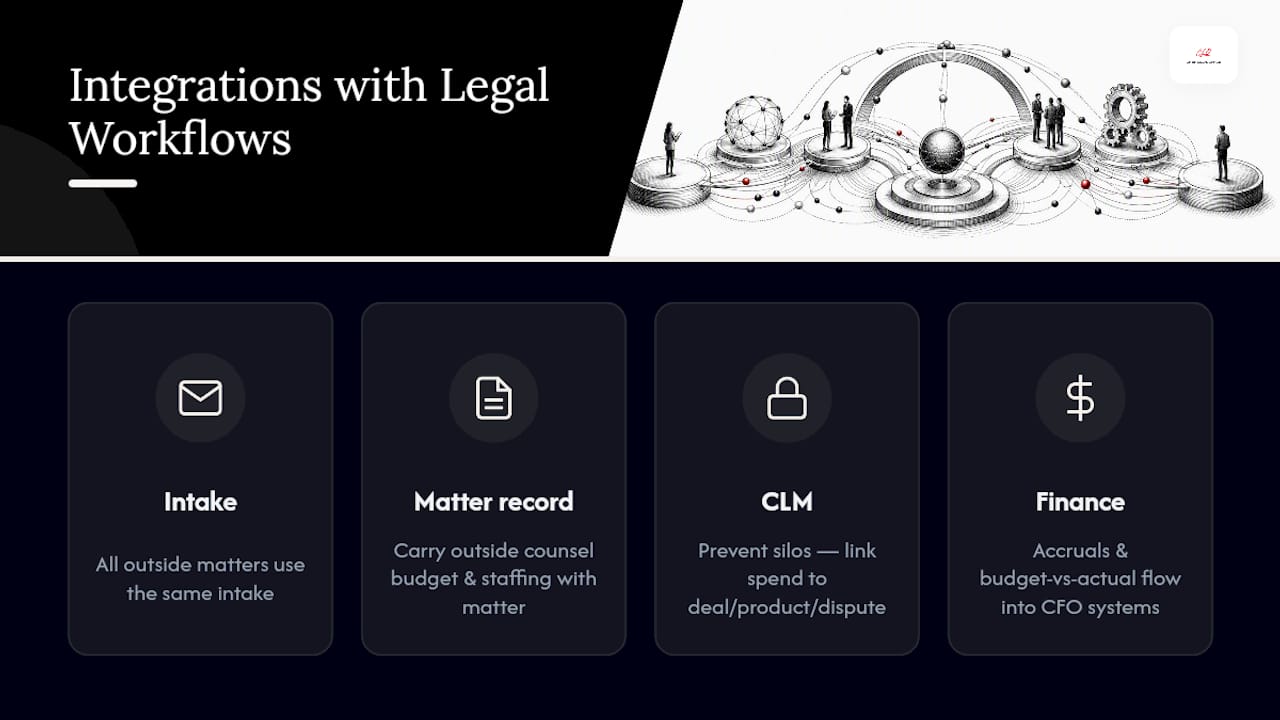
Outside counsel management doesn’t work as a standalone process. It has to plug into how your legal department already operates, or it becomes another system nobody updates.
Start with intake. Every matter that might go outside should pass through the same intake process you use for internal triage, so right-sourcing decisions get made consistently instead of ad hoc, depending on who happens to answer the phone. Matter management systems should carry the outside counsel budget and staffing plan alongside the internal record, not in a separate tracker that drifts out of sync within a month.
Contract lifecycle management matters here too. If your CLM system and your outside counsel spend data live in different silos, you lose the ability to connect legal spend to the business activity driving it, a specific deal, a specific product launch, a specific dispute. Finance integration matters just as much. Accruals and budget-to-actual reporting need to flow into the same financial systems your CFO already trusts, which is part of why cross-functional collaboration between finance and legal shows up repeatedly as a driver of stronger firm negotiations.
The goal is one source of truth for a matter: what it is, who’s working it, what it’s budgeted at, and what it’s actually costing, visible to legal, finance, and leadership without three separate exports and a reconciliation meeting.
Training and Change Management for Everyone Touching OCM
A billing guideline nobody reads is not a billing guideline. It’s a document. Getting outside counsel management to actually function requires training two very different audiences, and most programs only train one.
Internal stakeholders, in-house lawyers, paralegals, procurement, need to understand why the guidelines exist and how to apply them consistently, not just where to find the PDF. ACC’s guidance on OCG practices is blunt about this: internal staff must be trained on the guidelines directly, because a legal team that doesn’t enforce its own rules ends up waiving them by accident, invoice after invoice.
Outside counsel need onboarding too. When a new firm joins your panel, walk them through your submission rules, your approval workflow, and your escalation path before the first invoice arrives, not after you’ve rejected three of them. Set the expectation that guideline compliance is part of the relationship, not an obstacle to it.
Change management matters most when you’re rolling out something new, an e-billing platform, a revised AFA structure, a new scorecard. Give both audiences a heads-up before the change lands, explain the reasoning in a sentence or two, and give firms a grace period before you start enforcing a new rule strictly. Sudden, unexplained enforcement reads as arbitrary even when it’s perfectly reasonable, and it burns goodwill you’ll want later.
Compliance and Risk Management Considerations for Outside Counsel
Outside counsel relationships carry risk beyond the invoice. Conflicts of interest, data security, and regulatory exposure all travel with the work you send outside, and a mature OCM program accounts for all three.
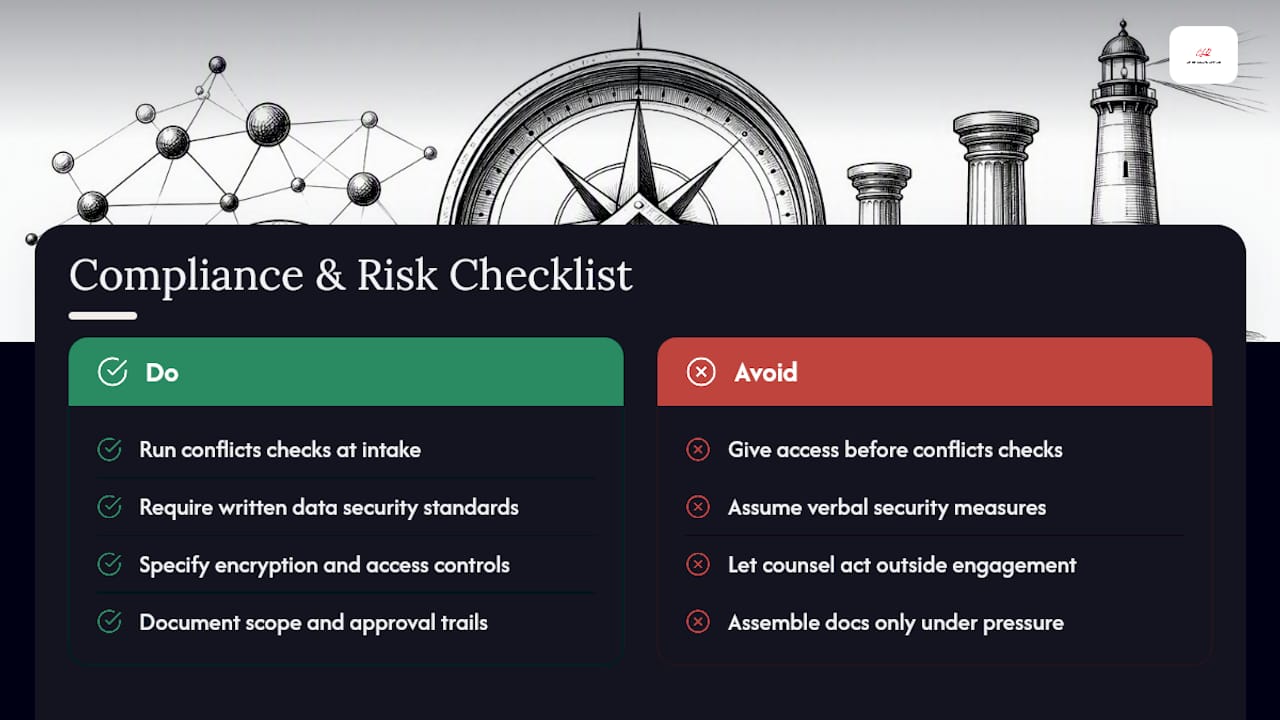
Conflicts checks should happen at intake, before a firm gets access to sensitive information, not after work is already underway. This matters more in industries with overlapping client bases, private equity and technology being two obvious examples, where the same firm might represent a counterparty on an adjacent deal.
Data security deserves its own line in your outside counsel guidelines. Firms handling sensitive contracts, personal data, or trade secrets should meet a defined security standard, encryption requirements, access controls, breach notification timelines, spelled out in writing rather than assumed. This is especially true for any matter touching AI governance or privacy compliance, where regulatory exposure compounds quickly if outside counsel mishandles data.
Regulatory risk cuts both ways. Outside counsel needs clear scope boundaries so they don’t inadvertently create compliance exposure by acting outside their engagement letter, and your internal team needs a documented approval trail showing who authorized what, in case a regulator or auditor asks later. Treat this documentation as part of your governance structure, not an afterthought you assemble under pressure.
Strategies for Better Collaboration Between In-House and Outside Counsel
The best OCM programs feel less like oversight and more like a working partnership, and that distinction shows up in how firms respond to your requests.
Share context, not just instructions. A firm that understands your business priorities, why a deal matters, what the board cares about, what keeps you up at night, staffs and bills differently than a firm that’s just executing a task list. Build that context-sharing into your intake process instead of treating it as optional color.
Regular, structured touchpoints beat ad hoc emails. Quarterly business reviews with your top panel firms, where you discuss upcoming matter volume, budget performance, and any friction points on both sides, tend to surface problems before they become invoice disputes. Bring data to those conversations. A firm that sees its own effective rate trend and staffing mix alongside peer benchmarks is far more likely to self-correct than one that just gets a terse email about an overrun.
Give feedback in both directions. Firms rarely hear what they’re doing well, only what went wrong, and that imbalance makes every conversation feel like a complaint session. Positive feedback on responsiveness or staffing discipline costs you nothing and makes the harder conversations land better when you need them.
Author Perspective: The Habit That Makes OCM Actually Stick
The programs that last treat outside counsel management as partnership, not policing. Firms that understand your priorities and see consistent, data-backed feedback tend to self-correct faster than firms that only hear from you when something’s wrong.
The single habit worth adopting this quarter: bring your scorecard data to every firm conversation, good news included. Regular, evidence-based check-ins do more to control spend than any guideline document sitting unread in a shared drive.
— Amy Natasha Osteen
How Chief Legal Office Runs Outside Counsel Management for You
If everything above sounds right but you don’t have the bandwidth to build it, that’s the actual problem Chief Legal Office solves. Chief Legal Office is a fractional in-house legal department, senior leadership and a full support team embedded in your business, rather than a solo lawyer trying to do intake, billing review, and firm negotiation between everything else on their plate.
That structure matters most when you’re past the point where a founder can manage outside counsel between meetings, but not yet ready to build a full internal department. A Client Success Team led by a former General Counsel can set your panel strategy, enforce your billing guidelines, and run your quarterly firm reviews, while paralegals and specialists handle the invoice-level work that eats hours you don’t have.
Plans start with Foundations at $1,000 per month, scaling up through Embedded Access and Strategic Growth as your outside counsel needs grow. Check the pricing page to see which tier fits where your legal function is today.
Sources
Outside Counsel Management: Best Practices and How to Choose the Right Platform | Brightflag
10 outside counsel guideline practices for strong operational relationships | ACC
FAQ
What is outside counsel management?
Outside counsel management is the operational system a legal department uses to select, monitor, and evaluate the law firms it hires, covering everything from billing guidelines to fee negotiation and performance scorecards. Its goal is predictable, business-aligned legal spend without sacrificing quality, as outlined in Brightflag’s framework.
How much does outside counsel cost?
Costs vary enormously by matter type, firm, and market, so there’s no single figure that applies across companies. What a mature OCM program controls is not the hourly rate itself but the variance around it, tracking budget-to-actual spend and pushing repeatable matters toward flat or capped fees to make costs predictable.
What is the “hot potato rule” in legal terms?
The hot potato rule is a conflicts-of-interest doctrine holding that a law firm generally cannot drop an existing client to avoid a conflict created by taking on a new, more lucrative client. It matters to outside counsel management mainly at intake, where conflicts checks should happen before a firm gets access to sensitive company information.
What is the definition of an outside counsel?
Outside counsel refers to lawyers or law firms a company hires on an engagement basis, rather than employing directly as in-house staff. Companies use outside counsel for specialized expertise, litigation, or matters that exceed internal capacity, while an in-house or fractional legal team, like the model Chief Legal Office runs, manages those relationships and the spend that comes with them.
Who should own outside counsel management inside a company?
Ownership typically sits with legal operations or a deputy general counsel, working alongside finance on budgeting and reporting. In companies without a dedicated legal ops function, this responsibility often falls to whoever leads the legal department, which is exactly the gap a fractional model like Chief Legal Office’s Fractional General Counsel service is built to fill.
Recommended
The lawyerly fine print: This article is for general information, not legal advice…