Privacy: 3 Dimensions and a Founder’s Checklist to Fix What Matters
Privacy is your ability to control who knows what about you and to keep reasonable seclusion over your body, your space, and your data. This article walks through the different types of privacy, why the law treats it as such a big deal, what actually threatens it day to day, and what to do about it. Along the way, you’ll see how organizations like the Federal Trade Commission and frameworks like the General Data Protection Regulation shape the rules, and how a company like Chief Legal Office helps founders operationalize the concept instead of just worrying about it.
TL;DR:
Privacy violations often stem from routine data collection and retention practices, not just high-profile hacks or breaches.
Data protection laws like the FTC rules, sectoral statutes, and GDPR have distinct scopes; confusion leads to compliance gaps.
Implementing basic security measures such as unique passwords, multifactor authentication, and regular setting reviews greatly reduces common privacy risks.
Companies should prioritize data minimization, real-time access controls, and operational privacy habits over complex user-facing privacy tools.
Privacy standards vary globally, requiring businesses to adopt the strictest applicable practices and ensure transparency and informed consent.
Table of Contents
What Is Privacy, Exactly? The Physical, Informational, and Digital Dimensions
Why Does Privacy Matter So Much?
Privacy vs. Data Protection: Are They the Same Thing?
What Laws Actually Protect Your Privacy?
What Are the Biggest Threats to Your Privacy Right Now?
Your Digital Privacy Checklist: What to Fix First
How Founders Can Operationalize Privacy Without a Legal Department
How Did Privacy Norms Actually Get Here?
Does Privacy Look Different at Work, on Social Media, or in Your Smart Home?
What Are the Hardest Ethical Debates in Privacy?
How Are AI and Big Data Changing the Privacy Conversation?
Why Do Privacy Expectations Differ So Much Around the World?
Why Do Consent and Transparency Matter So Much?
Where to Go Deeper on Privacy
Get Privacy Right Before It Becomes a Crisis
What Privacy Actually Requires, and What Gets Overrated
Sources
What Is Privacy, Exactly? The Physical, Informational, and Digital Dimensions
People use “privacy” to mean at least three different things, and mixing them up causes most of the confusion in this area.
Philosophers and legal scholars generally break the concept into three overlapping lenses, according to the Stanford Encyclopedia of Philosophy. The separation-based view treats privacy as physical seclusion: a closed door, a curtained window, a locked diary. The control-based view treats it as your right to decide who gets your information and what they do with it, regardless of physical distance. The power-based view looks at who holds leverage over you because they hold your data, which is really a question about imbalance more than secrecy.
Those three lenses map onto categories you deal with constantly:
Physical privacy is about your body and space. It covers everything from a fitting room curtain to a “do not disturb” sign, and it’s the oldest form of privacy law recognizes.
Informational privacy covers facts about you: medical history, income, relationship status, purchase history. This is where most modern law lives.
Digital privacy is informational privacy applied to devices, apps, and networks. It includes your passwords, your browsing habits, and the location data your phone quietly logs.
Metadata is the sneaky one. It’s not the content of your text message, it’s the fact that you texted your oncologist four times in one hour. Metadata often reveals more than the content itself, which is exactly why intelligence agencies and advertisers both chase it.
Here’s a distinction that trips people up: a locked diary is a physical privacy issue. A hacked cloud backup of that same diary is a digital privacy issue with an informational privacy harm attached. Same secret, different exposure, different legal remedy.
Why Does Privacy Matter So Much?
Privacy isn’t a luxury preference. It’s a load-bearing wall for autonomy, safety, and the ability to participate in public life without fear.
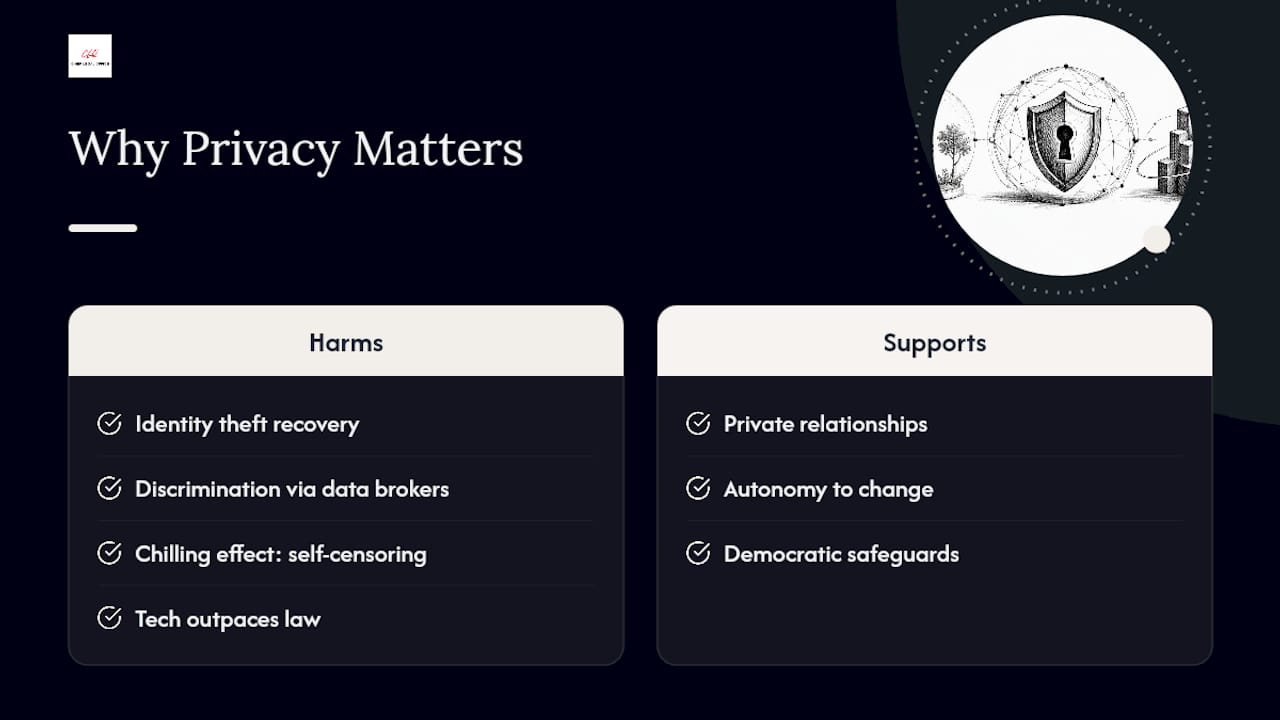
Start with the harms. Identity theft after a data breach can take months to unwind and wreck your credit in the meantime. Employers and insurers have used data brokers to make discriminatory decisions about job applicants and coverage. And surveillance, even the perceived kind, changes behavior. People self-censor political speech, avoid seeking medical care for stigmatized conditions, or stop attending protests when they believe they’re being watched. Researchers call this the “chilling effect,” and it’s not theoretical. It’s a documented reason authoritarian and democratic governments alike have to justify surveillance limits.
The bigger picture: The United Nations High Commissioner for Human Rights has warned that digital technologies are amplifying privacy risks faster than most legal systems can respond, and has called for stronger oversight, clearer legal frameworks, and real remedies when things go wrong.
On the flip side, privacy supports the good stuff too. It lets you form relationships, join associations, and hold opinions without every choice being cataloged and cross-referenced. Autonomy requires some room to make mistakes and change your mind without a permanent, searchable record. Democracies particularly depend on this: private ballots, private political donations below certain thresholds, and private legal counsel all exist because society decided some choices need a wall around them to function honestly.
Privacy vs. Data Protection: Are They the Same Thing?
No, and conflating them causes real confusion in boardrooms and courtrooms alike.
Data protection is the legal and procedural regime that governs how organizations collect, store, use, and share personal data. It’s rules based: consent requirements, breach notification deadlines, data retention limits. Privacy is the broader concept, and it includes things data protection law never touches, like your right to be left alone in your own home or to have a private conversation without a recording device nearby.
The Stanford Encyclopedia of Philosophy frames data protection as one operational answer to a much older privacy problem. They overlap heavily but aren’t interchangeable.
Some quick examples make the line clearer:
A neighbor peering into your backyard is a privacy-only issue. No data processing regime applies; this is a nuisance or trespass question.
A company quietly changing its data retention policy without telling users is a data-protection-only issue in the narrow sense, though it usually has privacy consequences too.
A health app selling your location and cycle-tracking data to advertisers is both: a data protection violation (improper processing, likely no valid consent) and a privacy violation (intimate personal information exposed to strangers).
If you remember one thing from this section, remember this: data protection law is the toolkit; privacy is the value the toolkit is supposed to protect. Confusing the two leads companies to think a cookie banner solves a privacy problem when it only checks a compliance box.
What Laws Actually Protect Your Privacy?
The regulatory picture in the United States is a patchwork, not a single statute, and that surprises a lot of people who expect one clean federal privacy law like Europe’s.
The Federal Trade Commission is the closest thing the U.S. has to a general privacy enforcer. It doesn’t operate under one comprehensive privacy statute. Instead, it uses its authority over “unfair or deceptive” business practices to go after companies that misrepresent their data practices or leave sensitive information exposed through sloppy security. Its own business guidance lays out a five-step operational framework that has become something close to an industry standard, even for companies the FTC never directly regulates.
Beyond the FTC, a few sectoral laws matter:
The Gramm-Leach-Bliley Act (GLBA) governs how financial institutions handle customer financial data.
The Fair Credit Reporting Act (FCRA) regulates consumer reporting agencies and how your credit history gets used and shared.
State breach-notification laws require companies to tell you, usually within a specific window, when your personal data has been exposed. Nearly every state has one, and the timelines and trigger definitions vary enough that a multi-state breach can turn into a compliance puzzle fast.
Then there’s the General Data Protection Regulation (GDPR), the European Union’s data protection law. It doesn’t apply to a purely domestic U.S. business with no EU users, but it reaches further than most founders assume. If your company has users in the EU, employees there, or even just markets to European customers, GDPR’s consent, data-minimization, and breach-notification rules likely apply to you regardless of where your servers sit.
Here’s the honest, unglamorous truth: none of this is designed to be intuitive. The rules differ by industry, by state, by whether you have a single EU user, and by what kind of data you’re touching. That’s precisely why “what’s the law here” is one of the most common questions we field from founders who assumed a single Google search would give them a clean answer. It usually doesn’t, and when the answer materially affects a fundraising round, an acquisition, or a regulator’s letter, that’s the moment to bring in counsel rather than guess. Our cross-border internal investigations work covers this exact tension for companies operating across jurisdictions.
What Are the Biggest Threats to Your Privacy Right Now?
Most privacy harm doesn’t come from a dramatic hack. It comes from quiet, routine, low-drama data collection that adds up.
Tracking and profiling. Cookies, browser fingerprinting, and ad-network trackers build a persistent profile of you across sites you never logged into. Fingerprinting is particularly hard to opt out of because it doesn’t rely on a cookie you can delete; it identifies your device by its unique combination of settings, fonts, and screen size.
Platform surveillance and metadata exploitation. Social platforms and messaging apps often collect far more metadata (who you talk to, when, how often) than message content, and that metadata is frequently the more revealing dataset.
Data breaches and social engineering. Attackers rarely need to “hack” anything technical when they can trick an employee into handing over credentials through a convincing phishing email.
IoT and smart-device risks. Smart speakers, doorbell cameras, and connected thermostats collect audio, video, and behavioral data continuously, often with weak default security and vague retention policies.
None of these require a criminal mastermind. They require an unpatched app, a reused password, and a company that decided data minimization was someone else’s problem.
Your Digital Privacy Checklist: What to Fix First
Not every privacy fix deserves equal urgency. Some changes take five minutes and close real gaps; others are marginal improvements with real friction attached. Here’s the order that actually matters.
Start with the basics that stop the most common attacks.
Use a unique password for every account, managed through a password manager rather than memory or a sticky note.
Turn on multifactor authentication everywhere it’s offered, especially email, banking, and any account tied to password resets for other services.
Keep your operating system, browser, and apps updated. Most exploited vulnerabilities were already patched months before the attack that used them.
Then tighten your settings.
Review privacy settings in your browser and major apps at least twice a year; defaults change more often than people expect.
Limit what you share on social media, particularly location tags, workplace details, and travel plans posted in real time.
Check the specific privacy controls a service offers, like Google’s privacy policy, which explains what data it collects and lets you export or delete much of it directly.
Consider privacy-enhancing tools, with eyes open about trade-offs.
End-to-end encrypted messaging apps protect message content so that even the platform operator can’t read it. Encryption, in plain terms, scrambles your data into unreadable code that only someone with the right key can unscramble, and it’s the backbone of everything from secure banking apps to private messaging. Tor, a free browser that routes your traffic through multiple relays to obscure your location and identity, offers a strong anonymity model for people who genuinely need it: journalists, activists, researchers handling sensitive sources. But it’s slower than a normal browser and overkill for everyday shopping. A VPN can mask your IP address from your internet provider and local network, but it shifts trust to the VPN provider instead, so pick one with a genuinely independent audit rather than a marketing promise. The Stanford Encyclopedia of Philosophy makes this point well: privacy tools always trade convenience for protection, and the right choice depends on what you’re actually defending against.
Clean up your account footprint.
Delete accounts you no longer use. An old forum account you forgot about is still a data breach waiting to happen.
Review app permissions on your phone regularly and revoke access to your camera, microphone, and location for apps that don’t need it.
Practice data minimization in your own habits: don’t fill out optional fields, don’t link accounts unnecessarily, don’t save a card number just to save thirty seconds at checkout.
Have a plan before you need it.
If you get a breach notification, freeze your credit, change the affected password immediately (and anywhere you reused it), and enable a fraud alert with the credit bureaus. Speed matters more than perfection here.
Pro Tip: Set a recurring calendar reminder every six months to audit your app permissions and delete unused accounts. Privacy maintenance dies the moment it stops being a habit and becomes a someday task.
How Founders Can Operationalize Privacy Without a Legal Department
Most founders don’t have a privacy problem because they’re careless. They have one because nobody owns it, and “everyone’s job” quietly becomes “no one’s job” the moment the company starts scaling.
The FTC’s guidance for businesses boils down to five plain-English steps, and they work whether you have five employees or five hundred:
Take stock. Know what personal data you actually collect and where it lives. Most companies are surprised by their own sprawl once they map it.
Scale down. Stop collecting data you don’t need. If a field on your signup form isn’t used for anything, delete the field, not just the plan to use it someday.
Lock it. Put real safeguards around what you keep: encryption, access controls, vendor contracts that actually say something.
Pitch it properly. Dispose of data securely when you no longer need it, rather than letting it sit in an old database nobody remembers exists.
Plan ahead. Have an incident response plan before you need one, with actual notification templates and a decision tree, not a vague promise to “handle it if it happens.”
This is where a fractional in-house legal department earns its keep. A solo advisor can tell you the rule; a team can help you build the recurring process: a data inventory that gets refreshed quarterly, a retention schedule with deletion actually automated instead of promised, role-based access so your intern doesn’t have the same database permissions as your CTO, and vendor contract clauses that put real obligations on the tools you rely on. That’s the difference between privacy as a policy document and privacy as an operational discipline someone actually runs.
Founders should be asking their engineers and vendors sharper questions than “are we GDPR compliant”: What data do we actually collect that we don’t use? Who has access to the production database, and why? What does our vendor do with our customers’ data if that vendor gets acquired? Do we have a tested incident response plan, or a document nobody has opened since it was written?
Governance matters here too. Boards increasingly expect a privacy and data-security update as a standing agenda item, not a once-a-year fire drill. Building that habit early, alongside solid AI governance practices as machine learning tools touch more customer data, is far cheaper than retrofitting it during due diligence. Our data security overview walks through how this framework gets built out in practice.
Pro Tip: When you’re evaluating a new vendor or software tool, ask to see their data retention and deletion policy before you ask about pricing. If they can’t answer clearly, that tells you something pricing never will.
How Did Privacy Norms Actually Get Here?
Privacy as a legal concept is younger than most people assume. The idea gained real momentum in the United States after an 1890 law review article argued for a “right to be let alone,” a response to intrusive newspaper photography of the era, which sounds almost quaint next to today’s data brokers.
For most of the 20th century, privacy law developed reactively, responding to wiretapping, then credit reporting, then computerized databases in the 1960s and 70s. Each wave of technology forced lawmakers to catch up after the fact rather than anticipate the next one. The pattern hasn’t changed. Social media forced a reckoning over what “public” even means when a comment to 200 friends can reach millions. Smartphones turned location data into something collected by default rather than by request. Each shift moved the boundary of what’s considered a reasonable expectation of privacy, usually only after enough harm had already occurred to force the conversation.
What’s different now is the pace. Earlier privacy law had years, sometimes decades, to adjust to new technology. Today’s regulators are trying to write rules for AI systems that outpace the legislative process by months, not years.
Does Privacy Look Different at Work, on Social Media, or in Your Smart Home?
Context changes what privacy even means, and treating it as one uniform standard leads to bad assumptions in all three settings.
At work, employees generally have far less privacy than they assume. Employers can typically monitor company email, network traffic, and devices issued for work use, often without much notice required depending on your state. The reasonable expectation of privacy shrinks considerably the moment you’re on employer-owned infrastructure.
On social media, privacy is largely a matter of settings you control, but platform defaults tend to favor visibility over restriction because engagement is the business model. A “friends only” post can still be screenshotted and redistributed well beyond your control, which is why the safest assumption is that anything posted could eventually become public.
With IoT devices, the risk is often invisible. A smart doorbell recording your porch also potentially records your neighbor’s, raising consent questions nobody agreed to. Many devices default to cloud storage with vague retention terms, meaning your voice commands or video footage may sit on a server indefinitely unless you dig into settings to change it.
What Are the Hardest Ethical Debates in Privacy?
Privacy debates rarely have a clean villain. Most involve two legitimate interests pulling in opposite directions.
Public safety versus individual liberty is the oldest tension: facial recognition can help find a missing child or a genuine criminal, and it can also enable mass surveillance of peaceful protesters. The technology doesn’t distinguish; the policy around it has to.
Personalization versus manipulation is the modern advertising dilemma. A recommendation engine that suggests a genuinely useful product feels helpful. The same technology used to exploit someone’s insecurities for engagement feels predatory. The line between the two is thinner than most platforms admit.
There’s also a harder question underneath all of this: does privacy protect the powerful more than the vulnerable? Wealthy people can afford lawyers, encrypted devices, and homes set back from public roads. People with less money often can’t opt out of data collection tied to public benefits, employment, or housing applications. That asymmetry is part of why privacy is increasingly framed as an equity issue, not just an individual preference.
How Are AI and Big Data Changing the Privacy Conversation?
Artificial intelligence didn’t invent privacy risk, but it scaled it in ways that break some of the old assumptions.
Traditional privacy law assumes data collected for one purpose stays roughly tied to that purpose. AI training models blur that line, since data scraped from public posts, forums, or old databases can end up embedded in a model’s outputs in ways almost impossible to trace or delete after the fact. That creates a genuine legal puzzle: how do you honor a deletion request when the data has already shaped a model’s weights?
Inference is the other shift. Big data analysis can now infer sensitive facts, pregnancy, sexual orientation, financial distress, from seemingly unrelated behavior, without you ever disclosing the fact directly. This means anonymized datasets are far less anonymous than they look. A handful of supposedly non-identifying data points, combined, can re-identify a specific person with unsettling accuracy.
Regulators are still catching up, which is exactly the gap the UN Human Rights Office report flagged: legal frameworks built for an earlier data era are straining against tools that didn’t exist when those frameworks were written.
Why Do Privacy Expectations Differ So Much Around the World?
Privacy isn’t a universal standard with local flavor text. It’s shaped fundamentally by culture, history, and political structure, and that shows up directly in the law.
The European Union treats privacy as a fundamental right, a legacy partly rooted in surveillance abuses under totalitarian regimes in the 20th century. That history is baked directly into how comprehensively GDPR regulates data processing. The United States, by contrast, treats privacy more as a consumer protection and sectoral issue, protected in pieces (health data here, financial data there) rather than as one overarching right. Other regions vary further still: some countries prioritize collective or family privacy over individual privacy, which changes how consent itself is understood and obtained.
For a company operating in multiple markets, this isn’t academic. A consent mechanism that satisfies U.S. expectations may fall short of GDPR’s stricter standard, and a data practice considered normal in one country may be legally or culturally unacceptable in another. Global products need privacy practices flexible enough to meet the strictest applicable standard, not the most convenient one.
Why Do Consent and Transparency Matter So Much?
Consent is the mechanism that’s supposed to make data collection legitimate, but it only works when it’s genuinely informed, and most consent mechanisms today fail that test quietly.
A 40-page privacy policy written in dense legal language technically discloses everything and functionally discloses nothing, because almost no one reads it. That gap between technical consent and real understanding is one of the most persistent criticisms of current privacy practice, and it’s why regulators increasingly push for plain-language disclosures and granular opt-ins rather than one giant “I agree” checkbox.
Transparency works alongside consent, not instead of it. A company can be transparent about collecting your location data and still be acting improperly if it never asked, or buried the disclosure in a place no reasonable person would look. Real transparency means telling people what’s collected, why, how long it’s kept, and who it’s shared with, in language a non-lawyer can actually parse on a phone screen in under a minute. Judged by that bar, most privacy policy examples in circulation today still fall short.
Where to Go Deeper on Privacy
A few sources are worth bookmarking if you want authority beyond this article.
The FTC’s business guidance is the single best starting point for understanding practical data-security expectations, written for businesses but genuinely readable by anyone. For a service-specific example of privacy controls in practice, Google’s privacy policy shows how a major platform documents what it collects and what you can export or delete. Readers who want the philosophical and legal foundations should read the Stanford Encyclopedia of Philosophy’s entry on IT privacy, and anyone interested in the global policy debate should read the UN Human Rights Office’s report on privacy in the digital age. If you work in a regulated sector like education, Assignify’s guide to student data privacy is a useful sector-specific example of applying these same principles to K through 12 environments.
Get Privacy Right Before It Becomes a Crisis
Most companies don’t think about privacy until a customer asks a hard question during a sales cycle, an investor asks during diligence, or a regulator asks after something has already gone wrong. By then, you’re playing defense instead of building a system.
Legal experts help founders and executives build the privacy and data-security infrastructure the FTC’s five principles describe: real data inventories, real retention schedules, real vendor controls, and an incident plan that actually works when tested instead of just sounding good on paper. If you’re a technology company trying to figure out where your privacy exposure actually lives, our fractional General Counsel services are built for exactly this kind of operational legal work, not just answering the occasional question when something breaks.
What Privacy Actually Requires, and What Gets Overrated
The conventional advice on privacy tends to obsess over consumer-facing tactics: clear a cookie, install a VPN, read a privacy policy nobody enjoys reading. Those steps help, but they’re not where the real exposure lives for most companies or most individuals.
The bigger risk is structural. Companies collect data they never needed, keep it long after any legitimate purpose expired, and discover both facts during a breach investigation rather than during a design conversation. Individuals face a similar version: chasing every privacy tool available instead of fixing the two or three habits, weak passwords, no multifactor authentication, oversharing on social platforms, that cause the vast majority of real harm.
If you take one thing from this article, prioritize data minimization over data protection theater. Collect less, keep it for less time, and build the boring institutional habits, an inventory, a retention schedule, an incident plan, before you need them under pressure. Privacy by design isn’t a compliance checkbox. It’s the discipline of not creating the risk in the first place.
— Amy Natasha Osteen
This article is general information, not a substitute for advice from a qualified lawyer. Consult a qualified legal professional about your own circumstances before acting on anything here.
Sources
Protecting Personal Information: A Guide for Business | Federal Trade Commission
Report of the United Nations High Commissioner for Human Rights on privacy in the digital age
Recommended
Remember the ALAMO: How Founders Can Turn Texas’ Privacy Crackdown into a Competitive Edge
The Privacy Conversation Grew Up. Here’s What that Means for Security.
The lawyerly fine print: This article is for general information, not legal advice…