Own Startup Privacy in 90 Days Without a Full Time GC
The smallest defensible privacy program a startup needs has four parts: a real data inventory, a privacy policy that matches what you actually do, signed data processing agreements with your critical vendors, and an incident response plan with named owners. Start with the inventory. Map your core data flows using the NIST Ready, Set, Go approach, and everything else gets easier.
TL;DR:
Start with a simple data inventory, privacy policy that reflects actual practices, and signed vendor agreements, focusing on core data flows and high-risk vendors.
Use the NIST Privacy Framework 1.1 sequential approach to identify, govern, and monitor data, aligning compliance with growth and enterprise diligence.
Assign clear ownership for privacy tasks with specific deadlines, prioritizing low-cost actions like policy updates, vendor triage, and MFA rollout in the first 30 days.
Opt for DIY when data is small, hire contractors for specific tasks, and bring in a fractional legal team for ongoing ownership as risk or deal flow increases.
Budget mostly on inventory, policies, and vendor agreements initially, reserving higher costs for complex audits or full-time hires once regulatory or deal requirements demand it.
Chief Legal OfficeOwn Privacy Without Hiring EarlyChief Legal Office provides senior legal leadership and a dedicated team to organize privacy work as your company grows.Explore Chief Legal Office
Table of Contents
1. Prioritized startup checklist: what to do in the next 30 to 90 days
2. How to use NIST Privacy Framework 1.1 to prioritize the work
3. The 30/60/90-day roadmap: owners, deliverables, and low-cost tools
4. Resourcing options: when to DIY, hire a contractor, or bring in a fractional legal department
5. Where to spend money first: realistic cost ranges for early-stage privacy work
6. A one-page checklist you can bring to your next meeting
7. Why treating privacy as strategy beats treating it as a checkbox
How Chief Legal Office helps startups own privacy without a premature hire
Sources
FAQ
1. Prioritized startup checklist: what to do in the next 30 to 90 days
Founders always ask me where to start, and my answer never changes: start with what you actually have, not what a compliance checklist says you should have. Many startups tend to over-invest in policy documents and under-invest in knowing what data lives where.
Here’s the order that actually works:
Map your core data flows: focus on what your product collects, where it goes, and who touches it, not a full enterprise audit.
Rewrite your privacy policy to describe your real processing, not a template copied from a competitor.
Triage your top ten vendors and get data processing agreements signed with the ones that touch personal data.
Turn on MFA, enforce least-privilege access, and confirm encryption at rest and in transit.
Write a short incident response plan naming who decides what during a breach.
Watch for the moments that make GDPR or CPRA suddenly urgent: an enterprise RFP, your first EU customer, meaningful California traffic, or sensitive data entering your product.
Pro Tip: Treat your data inventory as a business exercise led by product and legal, not a technical checklist handed to engineering.
2. How to use NIST Privacy Framework 1.1 to prioritize the work
The NIST Privacy Framework 1.1 gives you a sequence instead of a wish list, which matters when you have no dedicated privacy staff and a product roadmap that will not wait.
Ready (Identify-P): build your inventory, map data flows, flag legal triggers, and create a simple risk register.
Set (Govern-P): define a Target Profile of where you want to land, prioritize the gaps that matter most, and set baseline expectations for vendors and internal policy.
Go (implement and monitor): put controls in place, train the team that touches data, run a tabletop exercise, and revisit the profile as the product changes.
This sequence lines up with what GDPR and CPRA actually expect: know your data, govern it deliberately, then operate and monitor. It also happens to be what enterprise procurement teams and investors ask for in diligence, so the work you do for compliance doubles as work you do for growth.
3. The 30/60/90-day roadmap: owners, deliverables, and low-cost tools
Privacy work stalls when nobody owns it. Assign names, not departments.
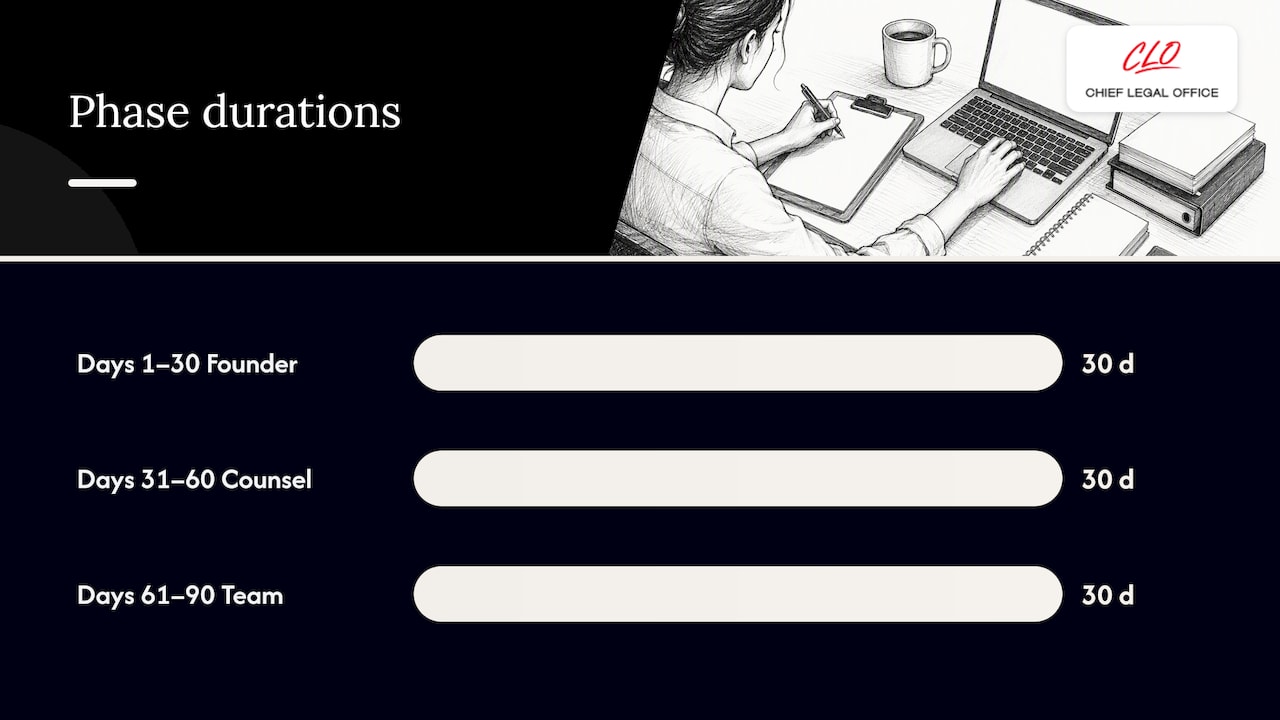
Days 1 to 30: the founder or product lead runs a scoped data inventory, drafts an updated privacy policy, triages vendors, and enables MFA across core systems.
Days 31 to 60: fractional counsel or the founder executes DPAs with top vendors, and engineering leads a simple risk assessment for any sensitive data flows using the NIST Identify-P approach.
Days 61 to 90: the team runs privacy training, sets a data retention schedule, builds a basic workflow for consumer data requests, and rehearses a breach response with a tabletop exercise.
A spreadsheet works fine for the inventory at this stage. A shared drive with version control works fine for policy drafts. You do not need enterprise privacy software to do the first ninety days right, you need clear ownership and a deadline.
Pro Tip: Put deadlines on the calendar for each of the three phases before you start, because privacy work without a deadline quietly becomes next quarter’s problem.
4. Resourcing options: when to DIY, hire a contractor, or bring in a fractional legal department
The honest answer depends on how fast your risk is growing, not how big your company is today.
DIY works when your data footprint is small, your vendors are few, and nobody outside the company is asking hard questions yet.
A contractor helps you clear a specific task, like drafting a policy or reviewing a DPA, but nobody owns the function between projects.
A fractional legal department gives you ongoing ownership: someone tracking your document library, managing DPA renewals, and ready to lead a breach response the day it happens, not after a scramble to find counsel.
The signals that you need recurring ownership rather than one-off help: enterprise RFPs asking about your privacy posture, cross-border data transfers, or any regulated data entering your product. Founders in treating legal as an operational function rather than a fire alarm tend to move faster through diligence, because the artifacts are already sitting in a folder waiting to be shared.
The FTC’s data breach guidance makes the point plainly: effective response depends on decision-makers being identified before the incident happens, not during it. That single fact explains why ownership matters more than any policy document.
5. Where to spend money first: realistic cost ranges for early-stage privacy work
Budget follows risk, not fear.
Low cost, high value: data inventory, policy rewrite, MFA rollout, and vendor triage mostly cost founder and engineering time.
Moderate cost: DPA drafting, a simple DPIA template, a tabletop breach exercise, and an external penetration test.
Higher cost, and only necessary later: a full-time General Counsel, large-scale audits, or a formal enterprise compliance program, which make sense once you have the headcount and the deal flow to justify them.
Spend first on whatever an active procurement deal or investor question is asking about. That is almost always the inventory and the vendor DPAs.
6. A one-page checklist you can bring to your next meeting
Print this and check items off as you go.
Data inventory spreadsheet completed: owner is product lead, target one week.
Privacy policy rewritten and published: owner is founder, target two weeks.
Top ten vendors triaged: owner is founder, target two weeks.
DPAs signed with critical vendors: owner is fractional counsel, target thirty days.
MFA enabled company-wide: owner is engineering lead, target one week.
Incident response plan drafted with named owners: owner is founder plus counsel, target thirty days.
Retention schedule documented: owner is product lead, target sixty days.
Tabletop breach exercise completed: owner is founder and counsel, target ninety days.
Action | Artifact to show |
|---|---|
Data inventory | Completed spreadsheet |
Privacy policy | Published policy URL |
Vendor DPAs | Signed agreements on file |
Incident response plan | Written plan document |
7. Why treating privacy as strategy beats treating it as a checkbox
Privacy work done early removes friction later. Deals slow down when a buyer asks for your data inventory and you have to build one on the spot instead of sending a link.
My biggest frustration watching founders is the instinct to copy an enterprise checklist wholesale. You do not need what a 500-person company needs. You need data minimization, a retention schedule, and named decision-makers. Get those three right before anything else.
— Amy Natasha Osteen
How Chief Legal Office helps startups own privacy without a premature hire
Most startups do not need a full-time General Counsel to get privacy right, they need someone who owns it continuously. Some legal service providers offer fractional in-house legal department support led by experienced General Counsel, providing ongoing management of document libraries, DPAs, and breach response leadership.
The Foundations plan starts engagement at $1,000 per month for companies establishing their first real legal function.
Embedded Access at $2,000 per month suits companies with more frequent contract and privacy work.
Strategic Growth at $5,000 per month fits companies facing enterprise deals, fundraising, or regulatory complexity.
If an enterprise RFP or an EU customer just landed on your desk, that is the signal to talk to us. Visit our AI Governance & Privacy page to see how we scope this work.
Sources
Keep these close: the NIST Privacy Framework, the FTC’s Start with Security guide, and the CPPA’s CCPA updates page.
FAQ
Does my small business need a privacy policy?
Yes, if you collect any personal information from customers, users, or website visitors, you need a privacy policy that accurately describes what you collect and why. A generic template copied from another company can create more legal exposure than having no policy at all, since it may describe practices you do not actually follow.
What triggers GDPR or CPRA obligations for a startup?
GDPR becomes relevant once you have EU customers or process EU residents’ data, while CPRA applies once you meet California’s revenue or data-volume thresholds, or process sensitive personal information. California’s rules now also add risk assessment and cybersecurity audit requirements for certain higher-risk processing activities.
What should I do first if my startup has a data breach?
Identify your decision-makers before anything else, since the FTC’s data breach guidance frames breach response as a management exercise requiring pre-assigned legal, forensic, and communications roles. Every U.S. state has its own breach notification law, so multi-jurisdiction planning matters even for small companies.
How much does it cost to start a privacy program?
The first phase, covering a data inventory, policy rewrite, and MFA rollout, costs mostly founder and engineering time rather than cash. Moderate costs appear later for DPA drafting, a simple risk assessment, and a tabletop breach exercise, while a full-time hire or large audit only becomes necessary once deal volume and regulatory exposure justify it.
Should a startup hire a full-time privacy lawyer?
Most early-stage companies do not need a full-time hire, they need continuous ownership of the function, which a fractional legal department like Chief Legal Office can provide at a fraction of the cost. The right time to consider a full-time General Counsel is when deal volume, headcount, and regulatory complexity make ongoing in-house leadership a daily need.
The lawyerly fine print: This article is for general information, not legal advice…