Founders and PE: Stop Tax Surprises From Rollover Equity Under ASC 805
Nothing clears a happy-hour circle faster than the words “so, about the tax structure.” Stay anyway. This one could be worth a lot of $$$.
Rollover equity is the portion of your sale proceeds you reinvest in the buyer’s new deal structure rather than taking it as cash at closing. It means the seller takes part of their payout as an ownership stake in the buyer’s new company instead of all cash, betting that stake will be worth more later. The core trade-off is refreshingly simple, even if nothing else about it is:
You give up certainty today for a minority stake that might pay off big or nothing.
Whether that trade is smart depends almost entirely on the tax structure, the valuation math, and the protections you negotiate into the term sheet before you sign anything. Yes, this involves tax. Stay with me. This is the good kind of tax content, the kind that keeps an extra seven figures in your pocket.
TL;DR:
Rollover equity is often based on a placeholder percentage in the letter of intent, which can significantly change as the deal progresses and valuations are finalized.
Fair value measurement under ASC 805 usually results in a lower valuation for the rollover stake than the headline purchase price, impacting tax and accounting treatment.
Proper structuring of the tax pathway, such as Section 721 or Section 351, is essential to ensure tax-deferred treatment and avoid unexpected taxable gains.
Founders should negotiate strong governance rights, anti-dilution protections, and clear reporting obligations in the term sheet before signing the deal.
Running detailed valuation models and confirming tax treatment with independent counsel before signing can prevent costly surprises post-closing.
How Does Rollover Equity Work in a PE Transaction?
The rollover percentage gets set surprisingly early, usually right in the letter of intent, before you’ve seen a purchase agreement or talked to tax counsel. That’s a problem, because the number in the LOI is often just a placeholder the sponsor’s associate typed in, and the definition of what it’s a percentage of (total consideration, equity value, your specific ownership stake) can shift the real dollar amount substantially.
Here’s what actually happens mechanically once the deal moves forward:
The buyer forms a new holding entity, usually an LLC taxed as a partnership. Some deals still use a C-corp structure, but that choice has major tax consequences you’ll read about below.
Instead of receiving 100% cash for your shares, you contribute a slice of your existing equity (or receive newly issued units in the holding company) in exchange for cash plus your rollover stake.
The holding company issues new units to you reflecting your ownership percentage, which now sits alongside the sponsor’s preferred equity and any management incentive pool.
Funds flow at closing accordingly: cash to you for the non-rolled portion, cap table entries for the rolled portion.
The valuation fights usually erupt around the gap between signing and closing, and between the stated deal price and what an accountant would call fair value. A sponsor may model your rollover at the same per-unit price they’re paying for the whole company, but that price bakes in preferred rights and control terms you as a minority common holder don’t get. That gap matters more than most founders realize until the accountants show up.
Advantages and Disadvantages of Rollover Equity for Sellers and Buyers
For the seller, a rollover is a bet on the sponsor’s ability to grow what you built. Sometimes it’s a great bet. Sometimes it’s a very polite way to lose money slowly. Here’s how to tell the difference.
Retained upside: If the sponsor executes and sells again in three to five years at a higher multiple, your rolled stake can be worth more than an equivalent amount of cash invested elsewhere.
Alignment signal: Sponsors like seeing founders roll equity because it tells them you believe in the growth story you just pitched them.
Possible tax deferral: Structured correctly, rolling equity can defer gain recognition on that portion of the sale.
Illiquidity risk: That stake is usually locked up for years with no market to sell into if you need cash.
Dilution exposure: Future financing rounds or add-on acquisitions can shrink your percentage if you didn’t negotiate anti-dilution protection.
Subordinate position: You’re typically behind the sponsor’s preferred return in the waterfall, meaning they get paid first.
A rollover makes sense when you trust the sponsor’s playbook and can afford to have that money locked up. It’s a bad idea when you need the liquidity, don’t believe in the growth plan, or can’t get basic governance rights written into the deal.
Why ASC 805 Makes the Rollover Numbers Harder Than They Look
Here’s what most founders never hear until their accountant delivers it, months after closing, with the enthusiasm of someone reading a phone book: the price the sponsor pays for the company and the fair value assigned to your rollover equity are not the same number under U.S. accounting rules. Treating them as identical feels harmless. It is not. It creates real, expensive problems.
ASC 805 requires that rollover equity in a business combination be measured at fair value as of the acquisition date, not at whatever price got negotiated in the term sheet. Because your rollover stake usually sits junior to the sponsor’s preferred equity, its fair value is almost always lower than the headline per-unit price the sponsor paid for the whole company. So, a stake you and the sponsor called $7.5 million in the term sheet might be booked at $5.8 million once a valuation specialist accounts for your subordinate position. Same stake, same day, roughly a quarter lower on paper.
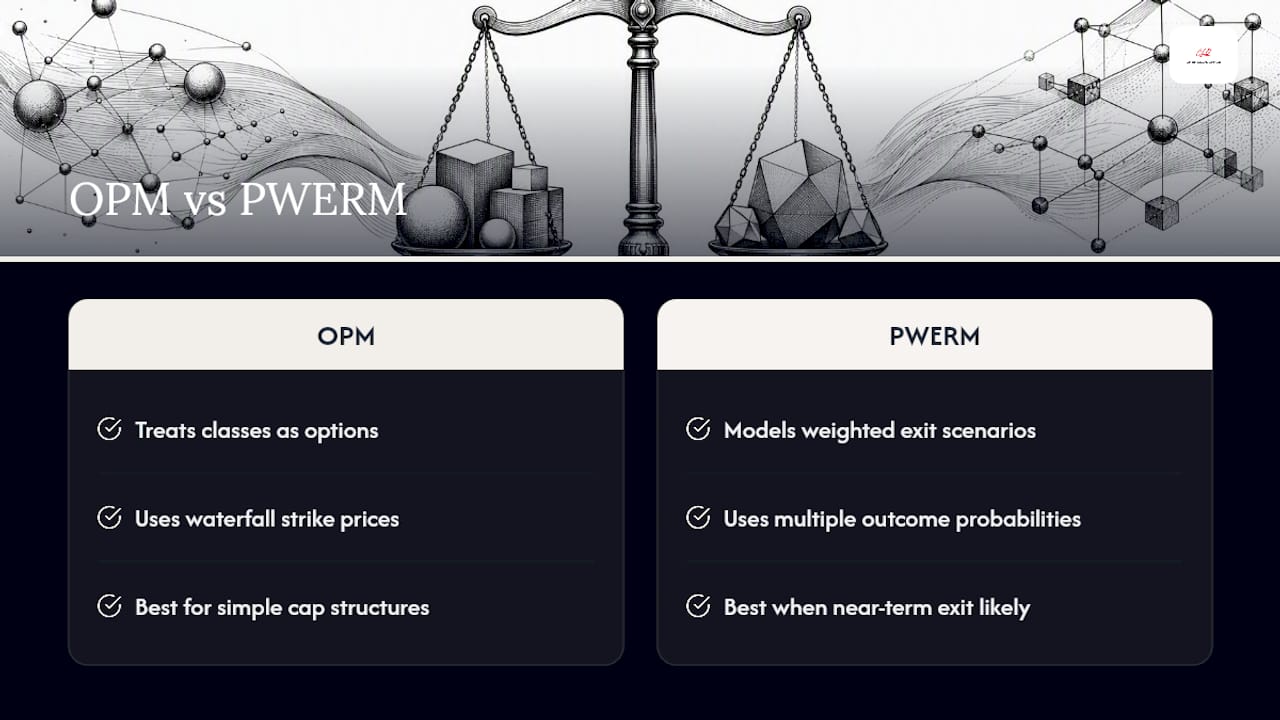
Valuation specialists typically use one of two models to figure out what that junior stake is actually worth. The Option Pricing Model (OPM) treats each class of equity like a call option with a different strike price based on the waterfall, which tends to fit companies with straightforward capital structures. The Probability-Weighted Expected Return Method (PWERM) models multiple future exit scenarios and weights them by likelihood, which works better when a near-term sale or recapitalization is realistic.
Booking your rollover at face value instead of running one of these analyses can distort goodwill and deferred tax calculations on the buyer’s books, and it can trigger audit questions down the line. Valuation teams recommend engaging this work at the term-sheet stage, not after the deal closes.
Pro Tip: Ask the buyer’s team directly whether they’ve run an OPM or PWERM analysis on your rollover tranche, and request a copy. If they haven’t, that’s your opening to insist on an independent valuation before you sign, or at minimum to flag it as an open item in the purchase agreement.
Does Rollover Equity Get Tax-Deferred Treatment?
Rolling equity does not automatically defer your tax bill. Whether it does depends on satisfying specific requirements under the Internal Revenue Code, and the entity structure you roll into determines which pathway even applies.
Section 721 governs contributions to a partnership or LLC taxed as a partnership, and it’s the most common route for lower-middle-market rollovers precisely because it allows tax-deferred treatment on the rolled portion when structured properly.
Section 351 applies to contributions to a corporation in exchange for stock, and it has its own control and eligibility tests.
Section 368 covers tax-free reorganizations, relevant when the transaction is structured as a merger rather than an asset or stock purchase.
If the buyer’s holding structure is a C-corp and the transaction doesn’t fit neatly into one of these exceptions, you can end up recognizing taxable gain on the entire sale, including the portion you never actually received in cash. Read that again: you can owe tax on money you never touched. It’s the financial equivalent of getting a bill for a meal you watched someone else eat. This is the nightmare nobody wants to discover after closing, and it is entirely avoidable with a phone call beforehand.
The IRS is explicit that these deferral provisions come with conditions, not blanket exemptions. Before you agree to any rollover percentage, confirm the target entity’s tax classification, understand how your basis carries over, and get sign-off from your own tax counsel, separate from the buyer’s advisors, who have their own incentives here.
What Should Founders Negotiate Into the Term Sheet?
The technical stuff above matters, but it only protects you if it makes it into the actual deal documents. Here’s the checklist worth bringing to your lawyer before you sign an LOI.
Information rights. Insist on regular, specific financial reporting: monthly or quarterly financials, annual budgets, and material event notifications, not vague “reasonable access” language.
A clear fully diluted denominator. Make sure the purchase agreement defines exactly how the option pool and future issuances factor into your ownership percentage, so you’re not surprised by dilution later.
Tag-along rights. These ensure that if the sponsor sells their stake, you get the chance to sell yours on the same terms.
Put rights or liquidity triggers. A common structure allows you to force a buyout at a formula price after a set period, for example, year five.
Repurchase and bad-leaver protections. Make sure your “paid” rollover, funded by actual sale proceeds, is documented separately from incentive equity that vests or forfeits on termination, so a messy departure doesn’t cost you money you already earned.
Valuation dispute mechanics. Agree upfront on an independent appraiser process for any future disagreement about your equity’s value.
Pro Tip: Anti-dilution and tag-along rights sound like boilerplate right up until the moment a sponsor issues new equity for an add-on acquisition two years in and your stake quietly shrinks while you weren’t looking. Negotiate these terms with the same seriousness you’d give the purchase price, because evaporate one financing at a time. Dilution is death by a thousand cap-table cuts.
A Quick Model: Running the Numbers on a 15% Rollover
Here’s a simplified version using a $50 million enterprise value and a 15% rollover, which sits near the 10 to 20% range common in lower-middle-market deals.
Flat scenario: Company sells again at the same $50 million in five years. After a 1x preferred return to the sponsor, your rolled stake may return close to your original contribution, roughly a 1.0x to 1.1x MOIC.
Modest upside: Company grows to $75 million. Your 15% stake, after the preference stack, could land around 1.8x to 2.2x MOIC.
Strong upside: Company doubles to $100 million. Depending on the preference structure, your rollover could return 3x or more.
Now stress-test it: swap in a 2x preferred multiple instead of 1x, or add 20% dilution from an option pool expansion, and watch the modest and strong scenarios compress noticeably. Small changes to the preference stack can quietly eat half your upside, and the sponsor already knows this. That sensitivity is exactly what you should ask the buyer or your own advisor to run before you commit to a number
Practical Next Steps From Chief Legal Office
We have spent years inside legal departments, meaning we’ve seen what happens when founders sign an LOI before anyone runs the tax and valuation math. Here’s the short version of what matters.
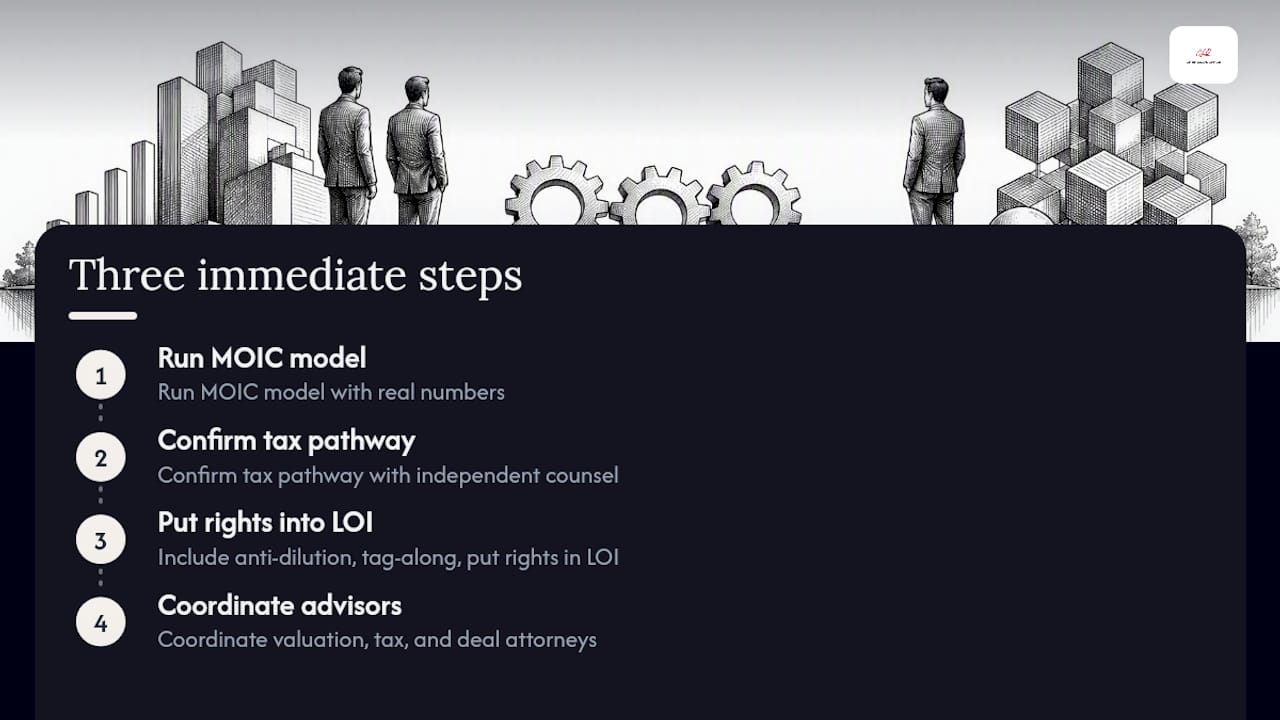
Three things to do this week if a rollover is on the table: run the MOIC model above with real numbers from your deal, confirm your tax pathway with independent counsel before agreeing to a structure, and get anti-dilution, tag-along, and put rights into the LOI, not just the final purchase agreement, where they’re much harder to add.
The trap in all of this is timing. The decisions that matter most, tax pathway, preference stack, governance rights, get locked in early, when everyone is focused on the headline price and no one is watching the fine print. Do the three things above before you agree to a percentage, and you have already avoided the mistakes that cost most founders real money.
Why the Conventional Rollover Advice Misses the Point
That’s the wrong question, or at least the wrong first question. The negotiation focus, preference stack, anti-dilution protection, and exit rights drive your outcome far more than the number itself.
The bigger blind spot is treating the rollover as a formality baked into the deal rather than as a genuine secondary investment you’re making in someone else’s execution. Don’t do it here either, just because the paperwork calls it a rollover instead of an investment.
If I had one priority to hand a founder facing this decision, it would be this: get the tax structure confirmed and the governance rights drafted before you agree to a percentage, not after. Everything else is negotiable. Those two things determine whether your rollover is a smart bet or an expensive lesson.
Get Your Rollover Terms Reviewed Before You Sign
A rollover deal moves fast, and most founders are negotiating the tax structure, the valuation methodology, and the governance rights all at once, usually without a team dedicated to catching what the sponsor’s lawyers already know to ask for. Chief Legal Office fills that gap as your fractional in-house legal department: one senior team that coordinates your tax counsel, your valuation specialist, and the actual term-sheet negotiation, so you’re not piecing together advice from three different vendors under deadline pressure.
If you’re heading into a sale with a rollover component, the smartest move is getting your LOI or term sheet reviewed before you sign, not after. Talk to Chief Legal Office about fractional General Counsel support for your transaction, and get the negotiation checklist, tax coordination, and valuation oversight built into your deal from day one.
Sources
For deeper detail on the mechanics covered here, the IRS guidance on tax-deferred exchange requirements lays out the conditions for deferral, while Stout’s analysis of rollover equity valuation explains the ASC 805 fair-value questions in more technical depth. Valuation Research’s guide to rollover equity covers governance protections from a practitioner’s angle.
This article is general information, not a substitute for advice from a qualified financial advisor. Consult a qualified financial professional about your own circumstances before acting on anything here.
Rollover equity valuation & why balance sheets might be wrong | Stout
Rollover equity — Middle-market founder guide | Glacier Lake Partners
Rollover equity: tax treatment, negotiation, and governance rights | Rob Melton
Recommended
The lawyerly fine print: This article is for general information, not legal advice…