Enforceable SLA Penalties With Clause Sketches for Legal & Procurement
SLA penalties are contractual remedies, most commonly tiered service credits, fee reductions, and termination rights, designed to compensate a customer or push a vendor toward better performance. In the U.S., the single rule that matters most: draft them as a reasonable, proportionate estimate of actual harm, not as punishment. Get that wrong and a court can throw the whole clause out, leaving you with nothing when a vendor’s outage costs you real money.
TL;DR:
Ensuring SLA penalties are proportionate and clearly linked to actual damages is critical to avoid court rejection as punitive measures.
Tiered service credits should be capped both monthly and annually to prevent vendor insolvency from high liability exposure.
Precise measurement sources, claim windows, and evidence requirements are essential to successfully enforce credits and avoid forfeiting owed remedies.
Drafting language should explicitly exclude maintenance, force majeure, and customer-caused outages with objective proof criteria to reduce disputes.
Using a fractional legal team can help structured drafting, enforceability, and operational management of SLA credits, claims, and dispute resolution.
Chief Legal OfficeMake SLA Remedies Work in PracticeChief Legal Office helps technology companies structure, manage, and enforce legal work across contracts, vendors, and operational priorities.Explore Chief Legal Office
Table of Contents
What Counts as an SLA Penalty (Service Credits, Refunds, Termination)
Are SLA Penalties Legally Enforceable? Liquidated Damages vs. Punitive Clauses
Structuring Service Credit Tiers, Caps, and Cure Periods
How to Monitor, Claim, and Enforce SLA Breach Credits
A Drafting Checklist and Two Clause Sketches for SLA Penalties
Do SLA Credits Count as Income? Tax and Accounting Treatment
When Credits Aren’t Enough: The In-House View
How a fractional legal department helps you draft and enforce SLA penalties
Sources
FAQ
What Counts as an SLA Penalty (Service Credits, Refunds, Termination)
Most people say “penalty” and picture a lump-sum fine. That’s rarely how it works in a real SLA. Service-level agreements convert vague promises about uptime or response time into measurable obligations, and the remedies attached to a missed metric usually fall into a handful of buckets.
Service credits. The most common remedy. A vendor doesn’t cut a check; it reduces a future invoice or extends free service. Big cloud providers structure this in tiers, often 10%, 25%, and up to 100% credit depending on how far uptime fell, but that credit typically applies only to the portion of the affected service, not your entire monthly spend. That distinction trips up a lot of procurement teams who read “100% credit” and assume a free month.
Refunds and cash remedies. Rarer, and vendors resist them because cash payments look more like damages than a fee adjustment, which raises the legal stakes if the vendor ever gets sued over the clause.
Termination rights. Usually tied to chronic failure, not a single bad day. A typical trigger: three consecutive months of missed SLA, or four missed months out of any rolling twelve.
Setoff and step-in rights. Less common but increasingly negotiated in enterprise deals: the customer can deduct credits directly from amounts owed, or in extreme cases, step in to run critical functions themselves while the vendor fixes the underlying problem.
Remediation obligations. A root-cause analysis, a remediation plan with deadlines, sometimes a dedicated escalation team. These don’t move money, but they’re often worth more than the credit itself.
The practical effect behind each of these varies wildly depending on how the clause is worded, which is exactly why the next section matters so much.
Are SLA Penalties Legally Enforceable? Liquidated Damages vs. Punitive Clauses
Here’s the part almost every SLA drafting guide glosses over: not every “penalty” clause survives a courtroom.
U.S. courts draw a hard line between liquidated damages (enforceable) and penalties (not enforceable). The test comes down to two questions: was the amount a reasonable pre-estimate of probable loss at the time of contracting, and is it proportionate rather than designed to punish? Fail either test, and a court can strike the clause entirely, leaving the injured party to prove actual damages from scratch, which is exactly the outcome the clause was supposed to avoid.
A handful of drafting signals push a clause toward the enforceable side:
Include a short recital explaining why calculating actual damages from downtime would be difficult or speculative. Courts want to see that the parties thought about this, not that they picked a scary number to scare a vendor into compliance.
Tie the credit amount to fees actually paid. A credit expressed as a percentage of the affected service, layered as liquidated damages with that commercial rationale, reads very differently to a judge than a flat penalty untethered to the contract’s economics.
Avoid language like “penalty,” “fine,” or “punish.” Courts read plain English too, and the label you choose becomes evidence of intent.
Watch how the credit clause interacts with your limitation-of-liability section. If the SLA credit is your “exclusive remedy,” make sure the cap doesn’t accidentally swallow the credit or contradict it. I’ve seen contracts where the liability cap was lower than the maximum credit the SLA promised, which is a drafting error nobody catches until it’s too late.
Pro Tip: If your SLA credit schedule was written by sales, not legal, assume it hasn’t been checked against your limitation-of-liability clause. Read them side by side before you sign anything.
Structuring Service Credit Tiers, Caps, and Cure Periods
Once you accept that credits need to look like damages, not punishment, the next question is how to build a schedule that actually protects you without bankrupting your vendor relationship.
Tier the credits to the severity of the miss. A typical schedule runs from around 5% to 20% of fees for moderate breaches, scaling up at the low end of uptime. Major cloud vendors show the pattern clearly: 10%, 25%, and up to 100% credit at progressively lower uptime breakpoints, applied to the affected component.
Cap the aggregate. Enterprise contracts commonly limit total monthly deductions to around 20 to 25% of the invoice, with an overall annual cap often expressed as a multiple of yearly fees. This isn’t just vendor self-protection. If your vendor can’t survive the credit exposure, you end up with a bankrupt supplier and a bigger problem than a slow API.
Define exclusions with evidence, not adjectives. Scheduled maintenance, force majeure, and customer-caused outages are standard carve-outs, but vague language (“issues beyond our reasonable control”) invites disputes. Attach objective evidence requirements: monitoring logs, incident tickets, timestamped alerts.
Build in earn-back. If a vendor hits every target for three straight months after a breach, some or all of the withheld credit can be restored. This keeps the vendor incentivized to fix the problem instead of treating the relationship as already burned.
Set a real cure period. Give the vendor a defined window, often 30 days, to fix a root cause before chronic-failure termination rights kick in. Skip this and you’ll find yourself threatening termination over what might be a one-off fluke.
The tension in every one of these negotiations is the same: the customer wants teeth, the vendor wants solvency, and the deal that survives is usually the one where both sides can point to the math and explain why it’s fair.
How to Monitor, Claim, and Enforce SLA Breach Credits
A well-drafted penalty clause is worthless if nobody submits the claim on time. This is the part legal teams draft carefully and operations teams then quietly fail to execute.
Lock down your measurement source before a dispute happens. Decide in the contract whose monitoring tool is authoritative, the vendor’s dashboard, a third-party monitor, or both, and define the measurement window (usually monthly) precisely.
Watch your claim window. Most well-drafted SLAs give the customer 30 to 60 days from the end of the measurement period to submit a claim with supporting evidence. Miss it, and you typically forfeit the credit entirely, no matter how badly the vendor performed.
Keep your evidence contemporaneous. Screenshots, ticket numbers, timestamped alerts. A claim submitted with “we’re pretty sure it was down most of Tuesday” gets disputed; a claim with logs gets paid.
Coordinate with finance before invoices go out. Credits usually net against the next invoice, and if your accounts payable team pays the full invoice before legal flags the credit, you’re now chasing a refund instead of applying an offset.
Escalate in writing, on schedule. If the vendor disputes a claim, your contract should specify an escalation path, business reviews first, then executive sponsors, before anyone mentions litigation.
The single biggest reason companies lose credits they’re entitled to isn’t a bad clause. It’s a missed deadline or a vague metric nobody bothered to define precisely when the contract was signed.
A Drafting Checklist and Two Clause Sketches for SLA Penalties
A one-page checklist beats a fifty-page memo when you’re actually drafting. Before you sign off on an SLA penalty regime, confirm it covers:
A recital explaining the commercial rationale for the credit schedule
Tiered credits proportionate to the severity of the miss, expressed as a percentage of fees for the affected service
An aggregate monthly and annual cap, aligned with your limitation-of-liability clause
A defined claim window (30 to 60 days) with specific evidence requirements
A cure period before termination rights trigger, plus a defined chronic-failure threshold
Clear, evidence-based exclusions (maintenance windows, force majeure, customer-caused outages)
A measurement period and an agreed authoritative data source
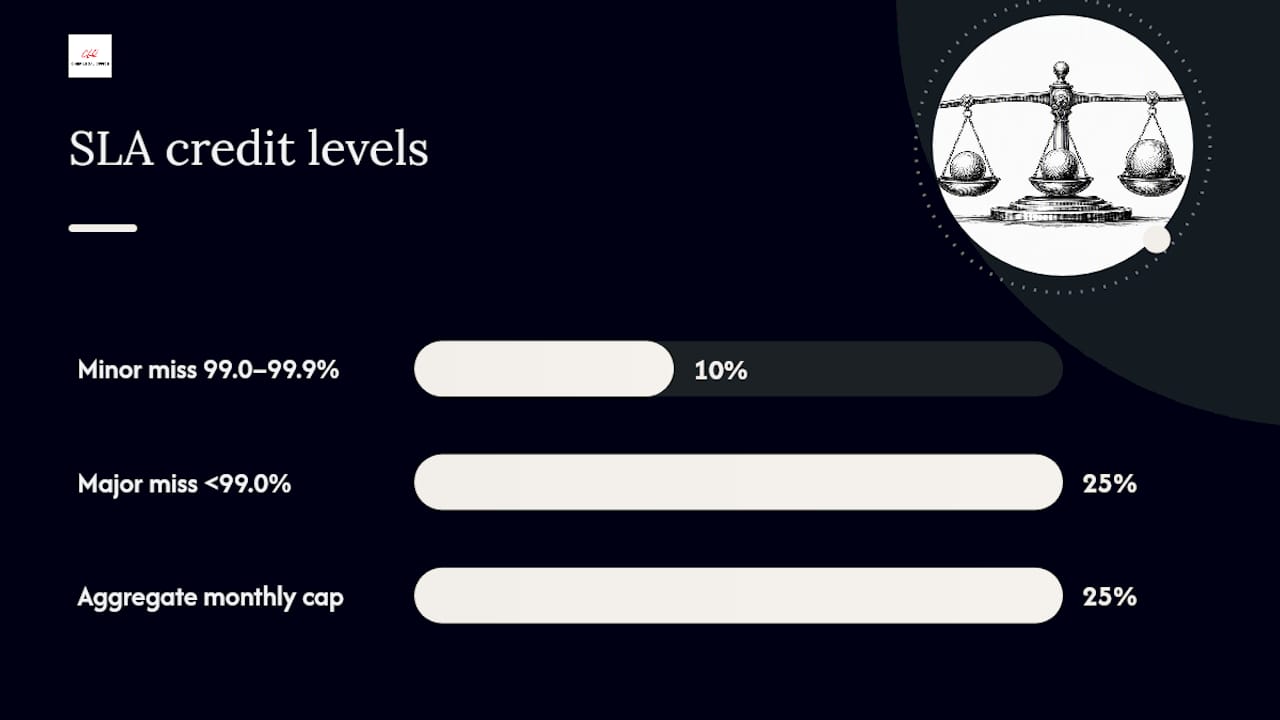
Clause sketch A (tiered credit): “If Monthly Uptime falls below 99.9% but at or above 99.0%, Customer shall receive a service credit equal to 10% of the fees paid for the affected Service for that month. If Monthly Uptime falls below 99.0%, the credit increases to 25%, subject to an aggregate cap of 25% of the monthly invoice.”
Clause sketch B (chronic failure termination): “If Vendor fails to meet the Service Level in any three consecutive months, or in four of any twelve consecutive months, Customer may terminate this Agreement for cause upon 30 days’ written notice, provided Vendor has failed to cure the underlying root cause within that period.”
Adapt both to your own fee structure. The terms governing this relationship matter as much as the specific percentages.
Do SLA Credits Count as Income? Tax and Accounting Treatment
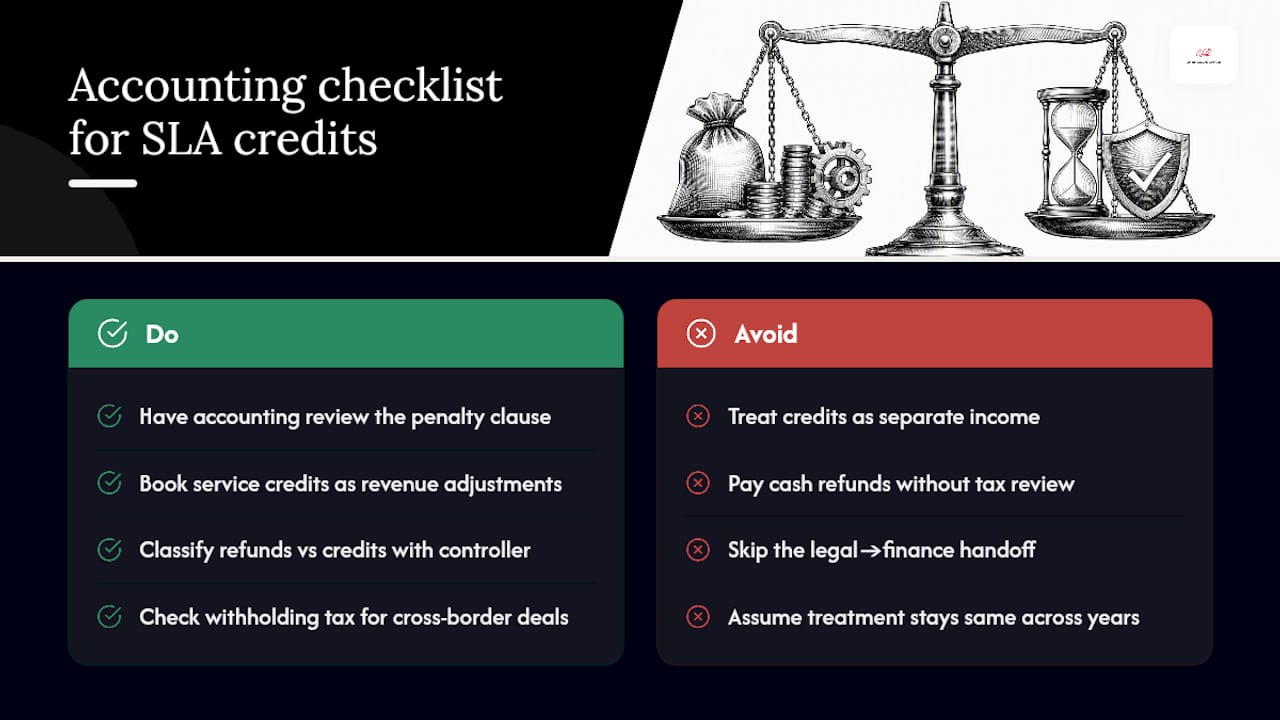
Legal teams draft the clause. Finance has to book it. That handoff gets skipped more often than it should.
Service credits generally reduce the vendor’s recognized revenue for the period rather than creating a separate expense line, since the credit adjusts the transaction price for services already invoiced or about to be invoiced. On the customer side, a credit applied against a future invoice typically lowers deductible expense for that period rather than counting as separate income, though the accounting treatment can shift depending on whether the credit is issued as a bill reduction, a refund, or a contract amendment.
Cash refunds are treated differently than credits in most accounting frameworks, which is one more reason vendors resist paying cash and prefer fee adjustments. A refund can look more like a payment for damages, which invites different tax characterization than a routine price adjustment.
None of this is a substitute for talking to your accounting team before you finalize a penalty structure, especially for multi-year contracts where credits might span fiscal years or trigger revenue recognition adjustments under ASC 606. If your SLA involves cross-border vendors, add another layer of review, since withholding tax treatment on penalty payments varies by jurisdiction and by whether the payment is characterized as a fee adjustment or as damages. Get your controller in the room before you sign, not after the first credit claim lands on their desk.
When Credits Aren’t Enough: The In-House View
Credits are useful, but they’re a blunt instrument. A 20% credit on a vendor invoice does nothing for the customer whose product went down during a launch week. That’s when step-in rights, escalation to a named executive sponsor, and remediation deadlines matter more than another percentage point on the credit table.
Sometimes the better strategic move isn’t demanding bigger credits. It’s negotiating a clean exit path, so you’re not stuck married to a vendor that keeps missing targets and paying its way out of accountability. Align the remedy with what you actually need: reliability, not a rebate.
— Amy Natasha Osteen
How a fractional legal department helps you draft and enforce SLA penalties
Getting an SLA penalty clause right takes someone who has actually negotiated these deals from both sides, not a template pulled from a contract library. Fractional legal departments give growing companies senior judgment without the cost of a full-time General Counsel: a dedicated legal team that drafts and negotiates SLAs, builds the claim and monitoring process procurement actually follows, and steps in when a vendor dispute needs firm-level backup.
You don’t need outside counsel for every vendor contract, and you don’t need to hand your CEO another agreement to read between board meetings. A fractional in-house legal department reviews the SLA, flags mismatches between caps, and builds the operational playbook your team needs to actually capture the credits you negotiated. If your company is signing or renegotiating vendor SLAs this quarter, get a fractional General Counsel on your side before the next contract goes out for signature.
Sources
For primary law on liquidated damages, see Cornell’s Legal Information Institute. For sample clause language, see LawInsider’s SLA penalty clause library.
This article is general information, not a substitute for advice from a qualified lawyer. Consult a qualified legal professional about your own circumstances before acting on anything here.
Vendor Service Level Agreement: Metrics, Credits & Penalties — LegalClarity
SaaS SLA Guide: Uptime tiers, service credits & penalty clauses — tosLawyer
Demystifying Service-Level Agreements and Avoiding the ‘Gotchas’ — Day Pitney (PDF)
FAQ
What happens if an SLA credit is never paid?
If a vendor fails to issue a service credit owed under the SLA, that’s a breach of contract, and the customer can typically demand payment, escalate under the contract’s dispute process, or pursue a claim for damages if the vendor refuses.
What happens if you violate an SLA?
Violating an SLA typically triggers the specific remedy the contract defines, most often a service credit or fee reduction, and repeated or chronic violations can trigger termination rights or, for vendors, reputational and renewal risk.
What are the downsides of using an SLA?
SLAs can create a false sense of security: service credits often under-compensate customers for catastrophic outages relative to actual business losses, and poorly drafted metrics or missed claim windows can leave real breaches uncompensated.
Are SLA penalty clauses legally binding?
They’re binding if drafted as reasonable, proportionate liquidated damages tied to fees paid; courts can void a clause as an unenforceable penalty if it looks punitive rather than a genuine pre-estimate of loss.
How long do I have to file an SLA breach claim?
Most well-drafted SLAs set a claim window of 30 to 60 days from the end of the measurement period, and missing that window usually forfeits the credit regardless of the merits.
Recommended
The lawyerly fine print: This article is for general information, not legal advice…