Avoid Vendor Lock: Software Escrow Agreement for Counsel & Tech Leaders
A software escrow agreement is a contract that puts a vendor’s source code and related materials in the hands of a neutral third party, to be released to you only if the vendor goes bankrupt, stops supporting the product, or breaches specific promises. You need one whenever a vendor’s product is mission-critical and you can’t easily switch to something else. It buys continuity, not ownership, and 11 U.S.C. § 365(n) backs it up if the vendor lands in bankruptcy court.
TL;DR:
SaaS escrow deposits must include infrastructure-as-code, database exports, credentials, and operational runbooks, not just source code, to ensure service restoration.
Objective release triggers such as bankruptcy or support cessation provide more reliable access than vague, subjective language, reducing dispute risks.
Verification testing, especially build-and-deploy, is essential for mission-critical systems and should be conducted regularly to confirm deposit completeness.
Cost structures vary with complexity, often including setup, annual maintenance, and verification, which should be negotiated based on your risk profile.
Escrow agreements should be tailored to operational criticality, with clear deposit contents, specific triggers, and verification clauses to ensure actual protection.
Table of Contents
What Is a Software Escrow Agreement, and Which Type Do You Need?
How the Escrow Process Actually Works
What Should Actually Be in the Deposit?
Release Triggers, Timelines, and What Happens When Things Go Sideways
What You Get After Release, and What You Don’t
What Does a Software Escrow Agreement Cost?
A Drafting Checklist You Can Actually Use
How We Think About Escrow Risk for Clients
Where to Go Deeper on Escrow Terms
The Real Problem With How Most Companies Handle Escrow
Get Escrow Terms That Actually Protect You
Sources
What Is a Software Escrow Agreement, and Which Type Do You Need?
Most escrow agreements come in one of three shapes, and picking the wrong one is the most common mistake I see in vendor negotiations.
The classic structure is a tri-party escrow agreement: the software vendor, the customer (beneficiary), and a neutral escrow agent all sign, and the agent holds the deposit until a defined trigger fires. You’ll also see single-beneficiary and multi-beneficiary versions. A multi-beneficiary setup lets several customers of the same vendor share one escrow account, which is common with enterprise SaaS platforms that serve dozens of large clients on similar terms.
Here’s where it gets interesting for anyone buying cloud software instead of installed software: traditional software escrow was built for a world where you got a CD-ROM and ran the application on your own servers. If the vendor vanished, you had the code, and you could theoretically compile and run it. SaaS escrow has to solve a much harder problem, because there’s no local install to fall back on. The vendor’s application lives on infrastructure you’ve never seen, wired into databases, credentials, and deployment pipelines you know nothing about.

That’s why SaaS escrow deposits typically include far more than code. According to a SaaS-specific escrow primer from LegalClarity, deposits need deployment scripts, infrastructure-as-code, database exports, credentials, and operational runbooks, because without them, the code alone can’t restore a working service.
Finally, consider tiered escrow, which lets you scale the arrangement to the actual risk:
Tier one: continuity materials only (documentation, configuration files, limited operational data)
Tier two: full source code plus build instructions
Tier three: source code plus deployment infrastructure, appropriate for SaaS platforms where “just the code” solves nothing
Match the tier to what you’d actually lose if the vendor disappeared tomorrow. A niche internal tool warrants less than the platform running your customer billing.
How the Escrow Process Actually Works
The mechanics aren’t complicated, but skipping a step usually shows up later as a fight nobody wanted.
Select an escrow agent and execute the agreement. Reputable agents specialize in this work and maintain secure, audited storage. The three-party contract should spell out each party’s obligations before anyone signs, and reviewing an example three-party escrow agreement from an SEC filing is a smart way to see how the recitals and obligations are typically framed.
Deliver the initial deposit. The vendor transmits the specified materials to the agent, usually through secure upload or encrypted media, depending on the agent’s protocol.
Confirm deposit receipt and validation. Escrow agents perform basic checks on receipt, confirming file formats, readability, and completeness against the deposit description. Full functional verification is a separate, optional service, as explained in LegalClarity’s breakdown of escrow release triggers.
Maintain update cadence. The vendor re-deposits updated materials on a schedule tied to product releases, not calendar dates. A deposit from three major versions ago is close to worthless.
Submit a release request when a trigger event occurs. The beneficiary notifies the agent, the agent notifies the vendor, and a dispute window runs before release, unless the agreement specifies an expedited path.
That last step is where most agreements either protect you or fail you, depending on how carefully the release language was drafted. More on that below.
What Should Actually Be in the Deposit?
Here’s an uncomfortable truth: a lot of escrow deposits are functionally useless. The vendor ships a zip file of source code, checks the compliance box, and everyone moves on, until the day you actually need it and discover the code doesn’t compile, references servers that no longer exist, or depends on credentials nobody kept.
A complete deposit for a SaaS product should include:
Full source code and version history
Build scripts and compilation instructions
Infrastructure-as-code templates (Terraform, CloudFormation, or equivalent)
Container images or Dockerfiles
Database schema and sample or full data exports
Administrative credentials and API keys (held securely, released only with the code)
Operational runbooks covering deployment, scaling, and monitoring
Verification is what separates a real safety net from a false sense of security. Basic verification confirms the deposit is complete and readable. Full verification, sometimes called build-and-deploy testing, actually compiles the code and attempts to run the application in a test environment.
Pro Tip: Verification testing is insurance. It costs money up front, but it’s far cheaper than discovering, during an actual outage, that the deposit is missing a critical configuration file nobody thought to include.
Verification is optional but strongly recommended for anything mission-critical, and it’s the single biggest lever for turning escrow from a paperwork exercise into a real contingency plan. Insist on annual re-verification tied to each material update, not a one-time check at signing.

Release Triggers, Timelines, and What Happens When Things Go Sideways
Release triggers are where escrow agreements either work or quietly fail, and vague language is the number one cause of both.
Common, well-drafted trigger events include:
Bankruptcy or insolvency of the vendor, often defined by reference to a filing under the Bankruptcy Code, an assignment for the benefit of creditors, or appointment of a receiver
Cessation of business or product support, defined objectively as, for example, “failure to maintain at least one support employee for 90 consecutive days” rather than a vague “vendor stops operating”
Material breach of specified service level or maintenance obligations under the underlying software licensing agreement, tied to defined cure periods
Vague triggers like “any service outage” invite disputes and delay access exactly when you need it fastest. Objective, documentable events, backed by specific evidence like a bankruptcy filing number or a support ticket log, get you released materials in weeks instead of months.
Once a release request goes in, the vendor typically gets a window of a few weeks to dispute the trigger before the agent releases materials. If the vendor disputes, the agreement should specify arbitration or another expedited resolution path rather than defaulting to standard litigation timelines. For contract disputes generally, understanding how arbitration and dispute resolution actually play out helps you negotiate realistic timeline expectations rather than aspirational ones.
Pro Tip: Negotiate for temporary or “beta” access to production systems during a dispute window, not just eventual code release. A frozen SaaS platform with no operator is a bigger emergency than a slow arbitration clock.
What You Get After Release, and What You Don’t
This is the part founders and even some in-house counsel get wrong most often: release from escrow gives you access, not ownership.
Standard escrow release grants a limited license to use the materials for continuity purposes, typically restricted to maintaining and operating the software for your own internal use. It does not transfer title, and it usually doesn’t grant broad rights to create and commercialize derivative works unless the underlying license agreement says otherwise.
That distinction matters enormously if the vendor’s failure is temporary. A vendor in Chapter 11 might reorganize and come back; a vendor that liquidates is gone for good, but your license rights survive either way if they’re structured correctly.
This is where 11 U.S.C. § 365(n) becomes relevant. Under this provision, if a software license is structured as an executory contract and the vendor rejects it in bankruptcy, you as licensee can elect to retain your rights under the license, including rights to intellectual property embodied in the licensed software, as detailed in this primer on IP protections in bankruptcy. Escrow release and § 365(n) rights are related but separate protections: escrow gets you the materials, § 365(n) preserves your legal right to keep using them even after rejection.
When drafting, push for:
Explicit rights to modify the released code for your own operational needs
The right to engage third-party contractors or a replacement vendor to maintain the code post-release
Clear language tying the license scope to the underlying SaaS or software licensing agreement, so there’s no gap between what escrow releases and what your license actually permits
What Does a Software Escrow Agreement Cost?
Escrow isn’t free, and the fee structure usually has three layers: setup, annual maintenance, and verification.
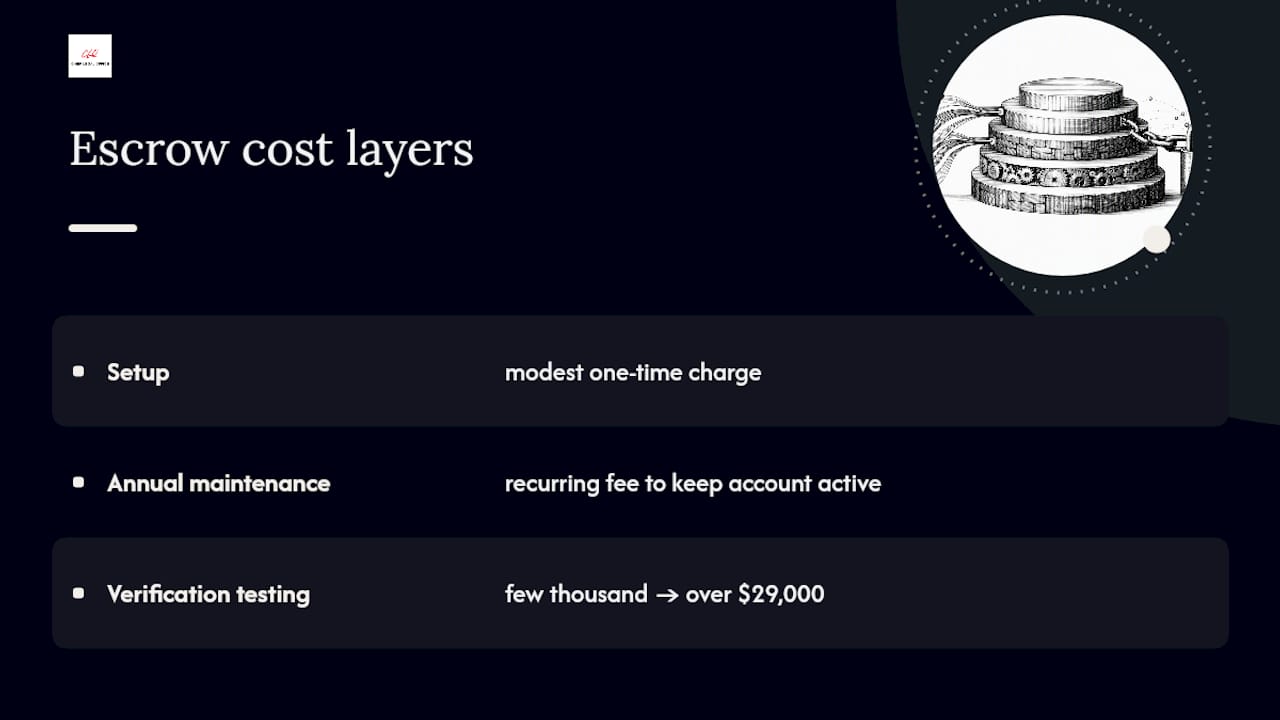
According to LegalClarity’s cost breakdown, setup fees are typically a modest one-time charge, annual maintenance runs as a recurring fee to keep the account active and current, and verification testing is where costs vary widely, ranging from a few thousand dollars for basic checks to over $29,000 for comprehensive build-and-deploy testing on complex systems.
The cost drivers are predictable: system complexity, the number of dependencies, whether infrastructure needs to be replicated for testing, and how often you require re-verification. Hosted continuity arrangements, where a mirror environment stands ready to take over, cost more than deposit-only escrow but cut recovery time dramatically, a tradeoff worth discussing directly, per this explainer on SaaS escrow arrangements.
Cost allocation between vendor and customer is negotiable. In smaller deals, the customer often absorbs the fee as a cost of doing business with an early-stage vendor. In larger enterprise deals, splitting the fee, or pushing it entirely to the vendor as a condition of the sale, is a reasonable ask, especially if you’re the customer bringing meaningful revenue to the table.
A Drafting Checklist You Can Actually Use
If you’re redlining a vendor’s proposed escrow terms, or drafting your own, these are the clauses that decide whether the agreement protects you or just looks good on paper.
Deposit description exhibit. List every category of material required, code, IaC, credentials, runbooks, and require the vendor to certify completeness at each deposit and update.
Objective release-event definitions. Avoid subjective language. Tie triggers to verifiable facts: filing dates, specific support failures, defined breach categories with cure periods attached.
Dispute timeline. Specify the vendor’s response window, the arbitration or expedited resolution mechanism, and whether temporary access is available during the dispute.
Post-release license scope. Define exactly what the beneficiary can do with released materials: maintain, modify, engage third parties, but not necessarily resell or sublicense.
Verification standards. State whether verification is basic or full build-and-deploy, who pays, and how often it recurs.
Agent obligations. Confirm the agent’s duties around secure storage, confidentiality, and its process for validating deposits on receipt.
Cross-reference to the master agreement. The escrow agreement should explicitly tie back to the underlying software licensing agreement so there’s no ambiguity about which document governs licensing terms after release.
Pro Tip: Practice guidance from sources like Practical Law’s escrow agreement summaries is worth reviewing before your first redline. Most disputes trace back to one of these seven clauses being vague, not to bad faith from either party.
How We Think About Escrow Risk for Clients
At Chief Legal Office, we don’t treat escrow as a box to check during procurement. We treat it as a risk calculation, and the calculation changes depending on three things: how critical the vendor’s software is to your operations, how financially stable the vendor is, and how long you’re locked into the relationship.
A five-year enterprise contract with a thinly capitalized startup vendor is a very different risk profile than a month-to-month tool from an established platform, and the escrow terms should reflect that difference, not a one-size-fits-all template.
When we negotiate on a client’s behalf, our priorities usually run in this order:
Push for SaaS-appropriate deposit contents (infrastructure, not just code) before arguing about fee splits
Insist on objective release triggers over vendor-friendly vague language
Negotiate verification into the deal, especially for anything touching revenue or customer data
Trade cost concessions, like accepting a lower verification tier, only where the underlying business risk genuinely supports it
If you’re negotiating a vendor contract with escrow terms attached and want a second set of eyes, that’s exactly the kind of work our team handles inside our technology industry practice.
Where to Go Deeper on Escrow Terms
For hands-on review, the SEC’s three-party escrow exhibit is a real sample contract worth reading clause by clause. The § 365(n) primer covers the bankruptcy analysis in depth, and LegalClarity’s SaaS escrow guide walks through deposit contents specific to cloud products.
The Real Problem With How Most Companies Handle Escrow
Most companies treat software escrow like an insurance policy they’ll never read again after signing. That’s backwards. An escrow agreement with a stale deposit, a vague trigger, and no verification history is worse than no agreement at all, because it creates false confidence.
The conventional advice, “just get an escrow clause in the contract,” misses the point entirely. The clause is the easy part. The hard part is making sure the deposit actually contains what you’d need to keep a product running, that the triggers are specific enough to survive a dispute, and that someone re-checks the whole arrangement every time the vendor ships a major update.
If I had to tell a general counsel or founder one thing to prioritize first, it’s this: don’t negotiate the fee split before you negotiate the deposit contents. I’ve seen companies save a few thousand dollars on verification costs and then discover, during an actual vendor collapse, that the escrowed materials couldn’t restore anything. Get the substance right first. The money conversation is easy by comparison.
— Amy Natasha Osteen
Get Escrow Terms That Actually Protect You
Reading this checklist is one thing. Getting a vendor to actually agree to objective triggers, real SaaS deposit contents, and verification testing in a live negotiation is another. Chief Legal Office is built for exactly that gap: a fractional in-house legal department that negotiates vendor contracts, including escrow terms, as part of an ongoing relationship, not a one-off document review.
Instead of hiring outside counsel for a single contract review or hoping your solo fractional GC has bandwidth this quarter, you get a senior in-house attorney backed by a full team who already understands your vendor stack, your risk tolerance, and your growth plans. That context is what turns a generic escrow clause into one that actually fits your business.
If you’re evaluating a vendor contract with escrow provisions right now, or building a vendor management process from scratch, talk to our team about fractional general counsel services and see what a dedicated legal department looks like for a company at your stage.
This article is general information, not a substitute for advice from a qualified lawyer. Consult a qualified legal professional about your own circumstances before acting on anything here.
Sources
Recommended
The lawyerly fine print: This article is for general information, not legal advice…