Contractors: Protect Cash and Records After Termination for Convenience
A termination for convenience is a contract clause that lets one party end an agreement early, without claiming the other side did anything wrong. If you’re a government contractor, it means the work stops, but you’re still owed payment for what you completed, your wind-down costs, and reasonable profit on that finished work. What you don’t get is profit on the work you never got to do. FAR 52.249-2 governs most federal fixed-price contracts, and it comes with real deadlines: an inventory schedule within 120 days, a final settlement proposal within one year. Your first move after getting the notice is simple. Stop work on the terminated portion and start documenting everything.
TL;DR:
Contractors should prepare detailed documentation of work performed, inventory schedules, and settlement costs within 120 days of termination notice to ensure proper recovery.
Settlement recovery typically includes costs for work completed, reasonable wind-down expenses, and profit on finished work, but excludes anticipated profit on unperformed work.
Early actions, such as securing government property and notifying subcontractors, are essential to protect cash flow and legal rights during the first 30 days after notice.
Negotiating specific termination clauses with longer notice periods, fees, and clear settlement formulas can reduce risks before signing contracts.
Understanding FAR 52.249-2 and related regulations helps contractors navigate federal termination procedures and appeal settlement decisions effectively.
Chief Legal OfficeProtect Your Position After TerminationChief Legal Office helps technology companies organize legal work, manage risk, and prepare for high-stakes commercial matters as business needs change.Explore legal support
Table of Contents
What Does Termination for Convenience Actually Mean?
FAR 52.249-2, Part 49, and the Rules You Can’t Ignore
What You Can Actually Recover in a Settlement
Your First 30 Days After a Termination Notice
How to Negotiate a Termination Clause Before You Sign
Sample Clause Language and Phrases That Should Worry You
Why Being Prepared Matters More Than the Notice Itself
Get Help Responding to a Termination Notice
Where to Read the Primary Rules Yourself
Sources
FAQ
What Does Termination for Convenience Actually Mean?
Termination for convenience is a contractual right, not a punishment. Whoever holds it can end the agreement even when you’ve done nothing wrong. That’s the entire point of the clause, and it’s why it catches so many business owners off guard the first time they see it in a contract they’re about to sign.
Compare that to termination for cause, which requires a breach: missed deadlines, defective work, a violation of contract terms. A cause termination puts you on the defensive and often triggers liability. A convenience termination doesn’t. It’s a no-fault exit, and it’s baked directly into the deal from day one.
The federal government uses this clause constantly, and for good reason. Agencies need the flexibility to end contracts when priorities shift, budgets get cut, or a program simply goes away. Nearly every federal fixed-price contract includes some version of FAR 52.249-2, which is why any company doing business with a federal agency needs to understand it before signing, not after receiving the notice.
Here’s where it gets interesting for contractors: if a contracting officer terminates you “for cause” but can’t actually support that decision, courts and boards will often convert it into a termination for convenience instead. That’s a meaningful shift. A default termination can expose you to liability and strip you of profit. A convenience termination, even a converted one, puts you back in settlement territory.
Two quick scenarios illustrate the difference:
A software vendor delivering a federal IT modernization project gets a convenience notice when the agency’s budget is reallocated mid-year. The vendor is paid for work performed and reasonable close-out costs.
A construction contractor is issued a default termination for missed milestones, then successfully argues the delays were caused by government-furnished materials arriving late. The termination gets converted to convenience, and the contractor recovers settlement costs instead of facing a breach claim.
FAR 52.249-2, Part 49, and the Rules You Can’t Ignore
If you take one citation away from this article, make it this one: FAR 52.249-2 is the standard clause governing terminations for convenience on fixed-price federal contracts. Its text gives the government the right to terminate performance in whole or in part whenever it serves the government’s interest, and it spells out exactly what happens next.
The clause is codified at 48 CFR § 52.249-2, which is the version you want if you’re citing this in a settlement proposal or an appeal brief. It’s the same substantive language, just the official regulatory home for it.
FAR Part 49 is where the procedural machinery lives. It lays out the duties of the Termination Contracting Officer (TCO) and the contractor once a notice goes out, and it treats commercial item contracts differently from standard fixed-price ones under FAR 12.403. If your contract is structured as a commercial item purchase, don’t assume the standard settlement rules apply automatically. They often don’t.
The timelines matter more than most contractors realize until they’ve missed one:
Inventory schedules: due no later than 120 days from the effective termination date.
Final settlement proposal: due promptly, but no later than one year from the effective termination date.
No timely proposal filed: the contracting officer can determine the settlement amount unilaterally, which is rarely in your favor.
The deadline to submit inventory schedules can feel tight if you’re managing multiple subcontractors and extensive inventories. Extensions are available, but you have to ask before the deadline passes, not after.
Appeal rights exist if you disagree with the TCO’s settlement determination. You can typically go to the agency’s board of contract appeals or the Court of Federal Claims, but those windows are time-limited too, so don’t sit on a disputed decision hoping it resolves itself.
What You Can Actually Recover in a Settlement
The math behind a convenience settlement isn’t complicated once you understand the two approaches contracting officers and contractors typically use.
Inventory-basis settlement works line by line. You itemize raw materials, work in process, tooling, and other direct costs tied to the terminated portion of the contract. From that total, you deduct any proceeds from selling off inventory you can’t use elsewhere, plus any advance or partial payments you’ve already received. This approach works well when your cost records are clean and your inventory is easy to isolate.
Total-cost-basis settlement is the fallback when itemizing by inventory line isn’t practical, usually on service contracts or projects where costs don’t map neatly to physical goods. Here you total your incurred costs across the whole terminated effort and back out costs attributable to unaffected, ongoing portions of the work. The NASBP guide on this is worth reading in full if you’re building your first settlement proposal, because it walks through common allowable items in more detail than most contract managers expect to need.
What’s actually recoverable, in plain terms:
Costs of work performed before the termination effective date.
Reasonable settlement costs, including subcontractor termination settlements you have to negotiate and pay.
Reasonable profit on the work you completed, calculated using standard profit formulas.
Wind-down costs like storage, disposal, and reasonable termination-related overhead.
What’s excluded, just as firmly:
Anticipated profit on the portion of work you never performed. This is the single most misunderstood part of the entire framework. You are made whole for what you did. You are not compensated for what you would have earned had the contract run its full course.
Costs the government already advanced or paid for separately.
Costs tied to unrelated, unaffected contract line items.
Keep contemporaneous records for every claimed line item. Timesheets, purchase orders, subcontractor invoices, disposal receipts. A settlement proposal without backup documentation invites a contracting officer to challenge every number, and challenges take months you don’t have.
Your First 30 Days After a Termination Notice
The notice lands. Now what? Follow this sequence and you’ll protect both your cash position and your legal rights.
Confirm the scope. Read the notice carefully. Is it a full termination or partial? What’s the effective date? Terminations often only cover part of the statement of work, and you’re still obligated to finish anything not terminated.
Stop work immediately on the terminated portion. Continuing to spend money on canceled work after the effective date is money you likely won’t recover.
Secure government property and materials. You’re responsible for protecting anything government-furnished until you get disposition instructions.
Notify your subcontractors right away. Their settlement claims flow through you, and delay on your end delays their payment and complicates your own proposal.
Start building your inventory schedule well before the 120 day deadline. Don’t wait until day 100.
Document mitigation efforts, including any attempts to resell, reuse, or salvage materials, since disposition proceeds get deducted from your claim either way.
Request a TCO conference early to align on settlement methodology before you’ve spent weeks preparing a proposal the government’s cost analysts will reject.
Preserve your appeal rights by tracking every deadline in writing, and ask for extensions in writing before a deadline passes, never after.
Pro Tip: Keep a single running file, digital or physical, that tracks chain of custody for every cost you plan to claim: who incurred it, when, why, and what supporting document proves it. Settlement negotiators pick apart weak documentation first, and a clean paper trail often shortens the entire process by weeks.
How to Negotiate a Termination Clause Before You Sign
Everything above assumes you’re already governed by FAR terms. Commercial contracts are a different story, and this is where you actually have leverage, because you’re negotiating the clause itself, not just responding to it.
The biggest mistake we see business owners make is treating a customer’s boilerplate termination for convenience clause as non-negotiable. It usually isn’t. If a client can cancel a multi-year agreement with zero notice and no payment obligation, your projected revenue on that deal is fiction. It looks great on a forecast and evaporates the moment a new VP decides to consolidate vendors.
Protections worth fighting for:
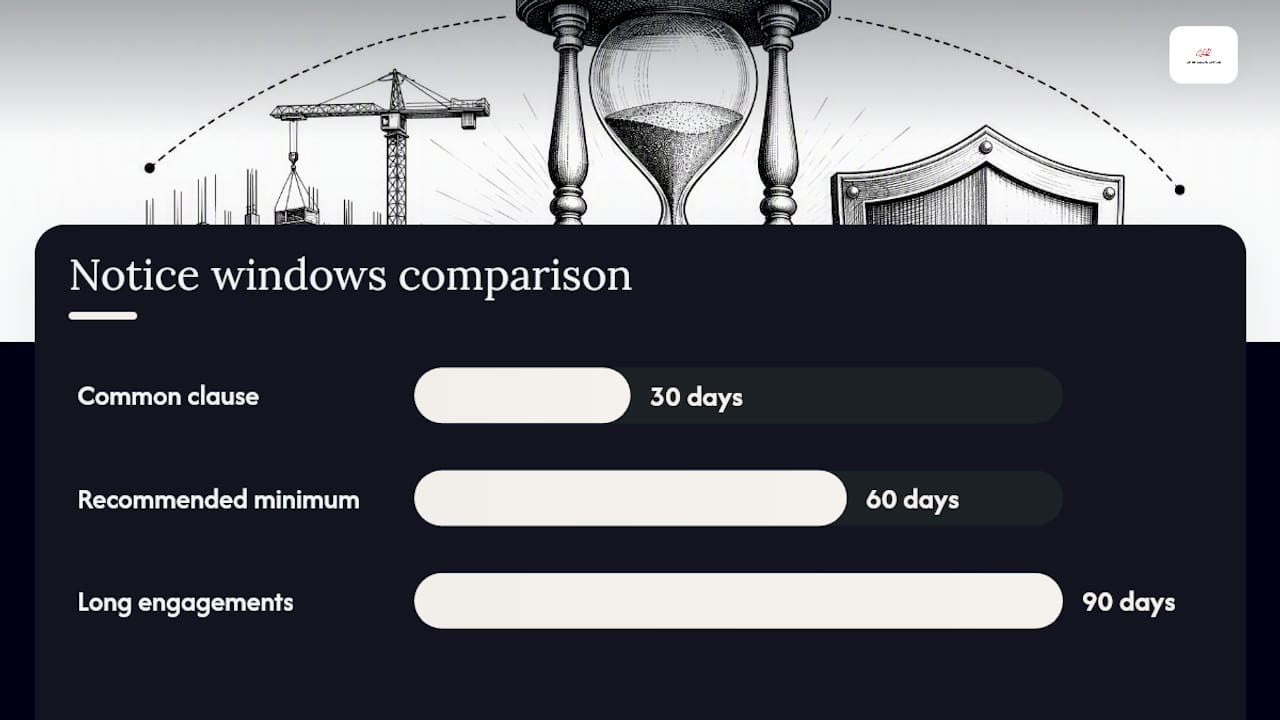
Longer notice windows. Thirty days is common in commercial clause libraries, but 60 to 90 days is reasonable for engagements requiring dedicated staffing or long-lead materials.
Termination fees. A defined kill fee, often a percentage of remaining contract value, converts an open-ended risk into a known number you can plan around.
Minimum commitment floors. Even if the customer can cancel early, they owe you for a guaranteed minimum term or spend.
Payment for non-cancelable commitments. If you had to buy equipment or commit to a lease specifically to service this client, the clause should require reimbursement for those costs.
Sometimes accepting real exposure makes sense, particularly if the trade-off is better pricing, a shorter overall term, or a strategic logo you want in your portfolio. That’s a legitimate business call. The problem isn’t accepting risk. It’s accepting risk you never noticed you were taking on.
Pro Tip: Push for a defined settlement formula in the clause itself rather than leaving “reasonable costs” undefined. Vague language sounds flexible but almost always favors whoever is doing the terminating, because they control the negotiation once the notice goes out.
Sample Clause Language and Phrases That Should Worry You
A vendor-protective clause might read something close to this: “Client may terminate this Agreement for convenience upon 60 days’ written notice, provided that Client shall pay Vendor for all work performed through the effective termination date, plus a termination fee equal to 20% of the remaining contract value, plus reimbursement for any non-cancelable commitments made in reliance on this Agreement.”
A government-style clause, by contrast, reads closer to the FAR standard: broad termination rights for the agency, paired with a defined settlement process rather than a flat fee. That structure works in federal contracting because Part 49 backs it with detailed settlement procedures. It works far less well when a commercial customer borrows the “convenience” language without borrowing the settlement mechanics that make it fair.
Watch for these phrases in anything you’re asked to sign:
“Terminate for convenience with immediate effect” and no notice period at all.
Termination language with no payment obligation attached for work already completed.
“In the Client’s sole discretion” paired with vague or absent settlement terms.
Broad termination rights for the customer with no reciprocal right for you.
Sample clause libraries like LawInsider’s collection are useful for seeing how these clauses actually get drafted across industries, but read them as a starting point for negotiation, not a template to copy blind.
Termination for Convenience vs. Termination for Cause
Basis: Convenience requires no fault; cause requires a breach.
Money: Convenience triggers a settlement, including profit on completed work; cause can expose the breaching party to damages and forfeit profit.
Process: Cause terminations often come with a cure period; convenience terminations do not, since there’s nothing to cure.
Why Being Prepared Matters More Than the Notice Itself
Every contractor thinks they’ll have time to figure out settlement mechanics after the notice arrives. You won’t. The 120 day inventory deadline moves fast when you’re also managing subcontractor calls, employee reassignments, and a client relationship you’re trying to preserve for future work.
The companies that come out of a convenience termination in decent shape are almost always the ones that had their documentation habits sorted out before the notice ever landed. Cost records that map to specific contract line items. Subcontractor agreements with termination language that mirrors the prime contract instead of contradicting it. A settlement proposal template sitting in a folder somewhere instead of being built from scratch under deadline pressure.
This is exactly where a fractional legal team earns its keep. A fractional legal team builds documentation discipline into a company’s contracting process long before a termination notice shows up, then moves fast on settlement proposal drafting, subcontractor coordination, and negotiation once one does. The value isn’t just legal knowledge. It’s having someone who already understands your contract portfolio picking up the phone the same day the notice arrives, instead of a lawyer meeting your business for the first time under a deadline.
— Amy Natasha Osteen
Get Help Responding to a Termination Notice
A fractional legal team is an alternative to hiring outside counsel by the hour when a termination notice lands and you need someone who already knows your contracts, not someone starting from a blank file. Such a team responds to the notice, drafts the settlement proposal, coordinates subcontractor settlements, and negotiates better termination language into your next contract before this ever happens again.
The Fractional General Counsel service covers exactly this kind of situation: fast-turnaround legal leadership when a contract event demands immediate attention. For redlines on notice periods, termination fees, and minimum commitments before you sign your next agreement, the Commercial Transactions team handles clause negotiation directly. Plans start with Foundations, Embedded Access, and Strategic Growth, all detailed on the pricing page. If you’re facing a termination notice right now, the fastest next step is reaching out through Chieflegaloffice to get a team looking at your contract today.
Where to Read the Primary Rules Yourself
FAR 52.249-2: the operative clause text for fixed-price federal contracts.
48 CFR § 52.249-2: the codified regulatory version.
FAR Part 49: full termination procedures and TCO duties.
NASBP’s contractor guide and the CRS FAQ report for settlement mechanics explained in plain language.
Sources
52.249-2 Termination for Convenience of the Government (Fixed-Price).
48 CFR § 52.249-2 - Termination for Convenience of the Government (Fixed-Price).
The Government Contractor’s Guide to Termination for Convenience - NASBP
FAQ
Can a Termination for Convenience Be Considered Bad Faith?
Yes, in limited circumstances. Courts have found bad faith when an agency terminates for convenience specifically to avoid paying anticipated profits it knows are owed, or when the decision is shown to be a pretext, but the bar for proving bad faith is high and requires clear evidence of an improper motive.
What Is the Difference Between Termination for Convenience and Termination for Cause?
Termination for convenience ends a contract with no fault on either side, and the terminating party owes a settlement covering completed work and reasonable costs. Termination for cause is breach-based, can expose the breaching party to damages, and typically forfeits any profit on unfinished work.
Can You Give an Example of a Termination for Convenience Clause?
A common commercial version reads: “Either party may terminate this Agreement for convenience upon 60 days’ written notice, with payment due for all work performed through the termination date.” Government contracts instead reference FAR 52.249-2 directly, which triggers the formal settlement process under FAR Part 49.
What Is the Purpose of a FAR Termination for Convenience Clause?
The clause gives federal agencies flexibility to end a contract when it serves the government’s interest, without needing to prove the contractor did anything wrong. It balances that flexibility against contractor protection by guaranteeing a settlement for completed work, submitted through an inventory schedule due within 120 days and a final proposal due within one year, as FAR 52.249-2 sets out.
Does Chief Legal Office Help With Termination Settlement Proposals?
Yes. The Fractional General Counsel service includes drafting and negotiating settlement proposals, coordinating subcontractor settlements, and reviewing termination clauses before they’re signed. Current pricing for ongoing engagements is listed on the pricing page.
Recommended
The lawyerly fine print: This article is for general information, not legal advice…