Transition Services Agreement for Buyers: Stop Month Three Blowouts
A transition services agreement (TSA) is a time-limited contract in which the seller keeps providing specified services, like payroll, IT, or facilities, so the buyer can run the business on day one without a hard operational stop. The parties are the seller (often called RemainCo) and the buyer (NewCo or the divested entity). The single most important negotiating principle: every clause should point toward the buyer’s independent end state, not toward preserving the seller’s comfortable status quo, a lesson that L.E.K. Consulting’s TSA research hammers home for good reason.
TL;DR:
Clear scope definition, including specific services and end dates for continuation services and deliverables for transition assistance, is essential to prevent disputes.
Pricing models should be supported by detailed, fully loaded cost breakdowns, with fixed fees or at-cost arrangements agreed upon before signing.
Appointing named service owners and establishing joint governance, including SLAs, escalation paths, and milestone dashboards, is critical to manage operational risks and deadlines.
Mapping interdependencies and setting milestone-based exit dates for each service, with provisions for extensions based on fault and advance notice, avoids delays and cost escalations.
Address licensing, regulatory, and data security issues should be thoroughly vetted during diligence to prevent legal or compliance disruptions during the TSA period.
Chief Legal OfficeKeep Your TSA Moving Toward ExitChief Legal Office helps companies organize legal work, manage priorities, and prepare for complex transactions, governance, and operational demands.Explore Chief Legal Office
Table of Contents
What Goes Into a Transition Services Agreement Scope?
How Should You Structure TSA Pricing?
What Governance Structure Keeps a TSA on Track?
How Do Timelines and Exit Mechanics Actually Work?
Where Do Consents and Licensing Create the Biggest Risk?
What Should Be On Your TSA Negotiation Checklist?
Where Can You Find Real TSA Templates and Sample Clauses?
What Chief Legal Office Has Learned Running TSAs From the Inside
Risk Management Strategies for TSAs
Integration Planning and Coordination With TSAs
Compliance and Regulatory Considerations Specific to TSAs
Data Security and Confidentiality Provisions in TSAs
This Week’s Tactical To-Do List for Counsel and Executives
Why Most Buyers Get TSAs Backward
Get Help Structuring and Running Your TSA
Sources
FAQ
What Goes Into a Transition Services Agreement Scope?
Most TSA disputes trace back to one root cause: nobody wrote down, precisely, what the seller was actually agreeing to do. “IT support” means one thing to a CIO and something entirely different to the person who has to answer the help desk ticket at 2 a.m. on close day. A transitional service contract lives or dies on specificity.
Start by splitting services into two buckets. Continuation services are things the seller was already doing for the business before the deal, like running the general ledger, hosting the ERP system, or processing payroll, and will keep doing for a defined period after close. Transition assistance is different: it’s help getting the buyer’s own systems stood up, like data migration, knowledge transfer sessions, or training the buyer’s new controller on quarter-close procedures. Conflating the two is a classic mistake. Continuation services should have a clear end date tied to system cutover. Transition assistance should have a clear deliverable, not just a clock.
Build the service schedule function by function, and involve the people who actually do the work, not just the deal lawyers:
IT and systems: which applications, which environments, data ownership during the transition, and who patches security vulnerabilities in the interim
Finance and accounting: month-end close support, AP/AR processing, tax filings that straddle the closing date
HR and payroll: benefits administration, payroll runs, COBRA notices, and access to HRIS data
Regulatory and compliance: license holders, permit renewals, and who signs regulatory filings during the gap
Supply chain and procurement: vendor relationships, purchase order systems, and inventory management continuity
Facilities: shared office space, security badges, and equipment leases that don’t cleanly split at close
Every schedule needs an omitted-services clause. No matter how careful the diligence, someone will forget a service, usually something unglamorous like the fax-to-email gateway or a niche compliance report nobody remembered existed. Rather than reopening negotiations every time that happens, drafting guidance from Montague Law recommends a standing mechanism: omitted services get added at a pre-agreed pricing methodology, so the parties aren’t renegotiating leverage mid-transition.
Finally, get real volume numbers from the functional leads before signing, not after. If finance processes 40,000 invoices a month, that number belongs in the schedule. Vague assumptions about “normal business volumes” turn into fee disputes the moment volume spikes, and it always spikes right when you can least afford a fight about it.
How Should You Structure TSA Pricing?
Pricing is where TSAs quietly become expensive, and where a poorly built model can eat the deal’s expected synergies before month three.
Four pricing approaches dominate the market, according to Mayer Brown’s negotiating guidance on carve-out TSAs:
At-cost: the buyer pays exactly what it costs the seller to deliver the service, no markup
Cost-plus: at-cost plus a margin, typically to cover the seller’s overhead and administrative burden
Fixed fee: a flat monthly rate regardless of actual usage, which rewards efficiency but risks disputes if usage assumptions were wrong
Pass-through: third-party costs (software licenses, outsourced vendors) get passed to the buyer at face value, usually with a small handling fee
Whichever model you pick, insist on a fully loaded cost breakdown before signing anything. That means salaries and benefits for the people delivering the service, allocated overhead, one-time stand-up costs, and any third-party fees baked into the number. A seller quoting “$40,000 a month for finance support” without showing the math is asking you to buy a black box.
Pro Tip: Ask for the cost model in a spreadsheet, not a summary paragraph. If the seller can’t produce a line-item breakdown, that’s a signal they built the number as a negotiating anchor, not an actual cost estimate.
Extension pricing deserves its own line of attack. TSAs routinely run long, and sellers have little incentive to help you get off their systems quickly if they’re earning steady, low-effort revenue every month. That turns the seller’s services into a genuinely priced feature instead of an indefinite rental, and gives the buyer’s own team real financial pressure to finish the migration on schedule.
Lock in the billing mechanics too. Define the invoicing cycle, the documentation the seller must provide to support each invoice, a dispute window (30 days is common), and audit rights so the buyer can verify usage-based charges against actual consumption.
What Governance Structure Keeps a TSA on Track?
A TSA without named owners is just a contract waiting to become an argument. The buyer’s ops team calls, nobody at the seller knows whose job it is to answer, and three weeks later you’re on a call with outside counsel instead of getting the invoice reconciled.
The fix is governance architecture, and it isn’t complicated:
Name a service owner on each side for every workstream. Not a department, a person. IT has an owner. Finance has an owner. HR has an owner. That person answers the phone.
Stand up a joint steering committee with executive-level representation from both companies, meeting on a fixed cadence, usually biweekly during the early months and monthly once things stabilize.
Attach SLAs and KPIs to every meaningful service, things like system uptime, invoice processing turnaround, or payroll accuracy, with defined remedies when they’re missed.
Build an escalation path so operational disputes get resolved at the working level first, then the steering committee, before anyone calls a lawyer.
Practical governance guidance is consistent on this point: TSAs without named owners and a defined escalation ladder tend to produce either litigation over disputed invoices or quiet, unplanned extensions nobody budgeted for. Neither outcome is good, and both are entirely avoidable with about two pages of governance language.
Service credits are the standard remedy for missed SLAs, a percentage reduction in that month’s fee tied to the severity of the miss. Pair credits with a remediation plan requirement: if a service misses SLA for two consecutive periods, the seller owes a written corrective plan, not just a discount.
Reporting cadence matters more than most deal teams expect. A single integrated milestone dashboard, tracking every workstream’s transition progress against the exit date, beats five separate spreadsheets that nobody reconciles. L.E.K.'s research points to exactly this: tie TSA exit milestones directly into the buyer’s broader separation workplan instead of tracking them as an island.
How Do Timelines and Exit Mechanics Actually Work?
Not every service exits on the same day, and pretending otherwise is how buyers end up stuck on seller systems six months longer than planned.
Map interdependencies before you set a single exit date. IT is almost always the critical path, because finance, HR, and supply chain systems typically run on top of the same infrastructure the seller controls. You can’t migrate payroll off the seller’s HRIS if the underlying network access hasn’t transitioned yet. Sequence the exits accordingly:
Set milestone-based exit dates per service, not one blanket termination date for the whole agreement
Include early termination rights for the buyer’s convenience on services it no longer needs, with reasonable notice, so you’re not paying for a service you’ve already replaced
Require the seller to give advance notice of anything that could delay a scheduled exit, not a surprise the week before cutover
Build the extension request process into the contract itself: written notice, a stated justification, a defined approval window, and automatically escalating pricing if the extension is granted
When a delay happens, and one usually does, the contract should force a clear diagnosis: was this a planning failure (the buyer’s migration team wasn’t ready) or a legitimate external circumstance (a vendor consent got stuck in a bureaucratic queue)? That distinction should drive who eats the extension cost. A TSA that charges the same escalated rate regardless of fault removes any incentive for the seller to actually help the buyer exit on time.
Where Do Consents and Licensing Create the Biggest Risk?
This is the part of TSA planning that gets skipped in the excitement of closing, and it’s the part most likely to blow up the transition schedule.
Software licenses are written for the company that signed them, not for whoever happens to own the business six months later. Many enterprise software agreements include internal-use-only restrictions or explicit assignment prohibitions, meaning the seller technically can’t extend that license’s use to the buyer’s employees, even temporarily, without the vendor’s sign-off.
Surface these issues in diligence, not after signing:
Inventory every material software license, SaaS subscription, and vendor contract the TSA scope depends on
Flag any license with internal-use restrictions, assignment clauses, or change-of-control triggers
Decide, contractually, who’s responsible for securing vendor consent and who pays any re-licensing or consent fee, before it becomes a surprise invoice
Address data-transfer and privacy constraints explicitly in scope, especially where personal data crosses from the seller’s systems to the buyer’s, which can trigger separate regulatory obligations depending on the data type and jurisdiction
Montague Law’s drafting notes lay out the three realistic paths when a license can’t simply be extended: get vendor consent before closing and bake the fee into the cost model, plan a parallel stand-up with an alternative vendor, or write explicit fallback language allocating the stranded cost if consent gets denied entirely. Pick one before close, not during a crisis call three weeks in.
What Should Be On Your TSA Negotiation Checklist?
Treat the TSA as a deal document, not paperwork to finish after the real negotiating is done. It deserves the same attention as the purchase agreement, because operationally, it often matters more in the first 100 days.
Start early, and get operations people, not just lawyers, into the drafting room. A functional leader can spot a missing service in five minutes that a lawyer would never catch. Run a services audit before you draft a single clause: walk through every function the target relies on today and confirm which ones the buyer can replace on day one versus which ones genuinely need seller support.
Here’s the working checklist:
Service mapping complete for every function, with volume assumptions attached
Consents inventory finished, flagging every license or contract with assignment restrictions
Cost model built with fully loaded numbers, not summary estimates
Named owners assigned on both sides for every workstream
Milestone dashboard built and integrated into the broader separation plan
Exit protocol defined per service, including early termination rights and extension pricing
The most common pitfalls, according to Protiviti’s review of TSA failures, cluster around a short list: vague scope language, pricing built on the wrong basis (fixed fees for a service with wildly variable volume, for example), missing third-party consents discovered post-close, weak or nonexistent governance structure, and no omitted-services clause to catch what everyone forgot.
There’s a competitive angle here too, particularly in auction processes. Sellers running a competitive sale process notice which buyers show up with a real services audit and cost model already drafted, versus which ones show up asking basic scoping questions for the first time. Coming prepared signals you’ll be an easier, faster counterparty to close with, which matters more than most buyers realize when a seller is choosing between comparable bids.
Where Can You Find Real TSA Templates and Sample Clauses?
You don’t have to draft a transition services agreement from a blank page. Public company filings include actual, negotiated TSAs, and they’re a far better starting point than a generic transition agreement template pulled from a legal forms site.
The SEC requires public companies to file material contracts as exhibits, and TSAs from completed carve-outs regularly show up as Exhibit 10.1 filings. The SEC’s publicly filed Form of Transition Services Agreement is a genuinely useful reference for clause structure, definitions, and how a real deal team organized its service schedules. A related public example, Exhibit F from a completed transaction, shows how one organization defined thresholds for what counts as a “material” TSA contract, useful if you’re deciding what belongs in your own schedules versus what’s immaterial enough to handle informally.
When adapting a public exhibit, treat these clauses as needing genuine customization, not just a find-and-replace of party names:
Service schedules: the filed exhibit’s schedule reflects that specific deal’s functions; rebuild yours from your own services audit
Limitation of liability: caps and carve-outs vary widely and should reflect your actual risk allocation, not whatever the template happened to include
Pricing mechanics: copy the structure, never the numbers
Watch for redlines that tend to sneak through: open-ended service commitments with no defined end date, pass-through cost provisions with no cap or audit right, and indemnity language broader than the actual risk the TSA covers. Those three issues account for a disproportionate share of post-signing regret.
What Chief Legal Office Has Learned Running TSAs From the Inside
Most of the friction in a transition services agreement doesn’t come from the drafting. It comes from nobody owning execution once the ink is dry. That’s the gap Chief Legal Office is built to close for founder-led and private-equity-backed businesses going through a carve-out.
In practice, that means assigning a named service owner on the client side for every workstream in the TSA, mirrored against whoever the seller names, and building the joint steering committee structure into the transition plan from week one, not after the first dispute. The transition dashboard gets built before close, not scrambled together after it, so the client’s leadership walks into day one already knowing which milestones matter and when they’re due.
The first 90 days set the tone for the whole transition. That window is when Chief Legal Office’s embedded teams focus on documenting every service handoff, confirming billing methodology matches what was actually negotiated, and flagging early any consent or licensing gap before it becomes a stalled migration. A fractional General Counsel leading this work brings the same judgment a full-time GC would apply, without the company needing to build that function internally before it’s ready.
Risk Management Strategies for TSAs
A TSA carries risk in three places: financial, operational, and legal, and treating them as one undifferentiated category is how buyers miss something important.
Financial risk shows up as uncapped or poorly estimated costs. The fix is the fully loaded cost model discussed earlier, plus contingency budgeting. Where volume data from diligence is thin, Protiviti’s guidance recommends building in a prudence factor rather than betting on optimistic assumptions you’ll have to renegotiate later under time pressure.
Operational risk is about continuity: what happens if a key person on the seller’s transition team leaves mid-TSA, or a system goes down during a critical handoff. Build in redundancy requirements, requiring the seller to maintain adequate staffing on transition-critical services, and require advance notice of any material staffing changes on the seller’s side.
Legal risk centers on liability allocation. Cap the seller’s liability at a reasonable multiple of TSA fees paid, but carve out gross negligence and willful misconduct, and make sure indemnity obligations run both directions, not just buyer-to-seller. A TSA’s limitation of liability terms deserve the same scrutiny as the purchase agreement’s, because a poorly capped liability provision on a service that turns out to be mission-critical can create exposure nobody priced into the deal.
Insurance is worth a specific conversation too: confirm whether the seller’s existing coverage extends to services performed for the buyer during the TSA period, and if not, who’s responsible for gap coverage.
Integration Planning and Coordination With TSAs
A TSA and an integration plan are not separate documents that happen to run at the same time. They’re the same plan viewed from two angles, and treating them separately is a common source of missed milestones.
The buyer’s separation or integration team should be reviewing the TSA scope in parallel with building the new operating environment, because every service scheduled to exit the TSA needs a corresponding “ready to receive” milestone on the integration side. If IT’s TSA exit date is month six, the buyer’s own systems need to be tested and operational well before that date, not scrambling in the final weeks.
Build a single coordination cadence between the TSA steering committee and the broader integration management office, ideally the same meeting or immediately adjacent ones, so decisions about scope changes or timeline shifts get made with full visibility into both sides. Splitting these into separate governance tracks is how a delay in one gets discovered too late to fix in the other.
For technology-heavy carve-outs specifically, coordination between legal and technical teams matters even more, since IT dependencies tend to touch nearly every other workstream on the exit timeline.
Compliance and Regulatory Considerations Specific to TSAs
Regulatory exposure during a TSA period is easy to underestimate because the business looks, on paper, like it’s operating normally. It isn’t, quite.
Licensed activities are a common trap. If the target business holds regulatory licenses, healthcare, financial services, insurance, in the seller’s name, and those licenses take time to transfer or reissue to the buyer, the TSA period may require the seller to continue certain regulated functions under its existing license while the buyer’s own license application is pending. That arrangement needs to be documented precisely, with clear allocation of regulatory responsibility and liability during the gap.
Employment and benefits compliance also needs attention where the seller continues to administer payroll or benefits for employees who have technically transferred to the buyer. Get clarity on which entity is the employer of record during the TSA period, since getting that wrong has real tax and benefits-compliance consequences.
Cross-border deals add another layer: data residency rules, export control considerations, and local labor law requirements can all attach differently depending on which entity is technically performing the service during the transition window. None of this is exotic, but all of it needs to be mapped during diligence rather than discovered after close.
Data Security and Confidentiality Provisions in TSAs
During a TSA, the buyer’s data often keeps living on the seller’s systems, sometimes for months. That arrangement needs security terms at least as strong as what existed before the deal, not weaker ones negotiated in a rush to get to signing.
Specify data access controls explicitly: who on the seller’s side can access the buyer’s data, under what conditions, and how that access gets revoked once the corresponding service exits. Require the seller to maintain the same security standards, encryption, access logging, incident response protocols, that applied before the transaction, and require prompt notification of any security incident affecting the buyer’s data, not a quarterly summary.
Confidentiality provisions need to run both directions, since the buyer will also have visibility into seller systems and, potentially, seller data about other parts of RemainCo’s business that has nothing to do with the divested unit. A clear data security framework in the TSA prevents the awkward situation where a departing employee, or a curious one, has access to information well outside the scope of what the transaction actually required.
Build in a data destruction or return obligation tied to each service’s exit date, so data doesn’t linger on seller systems indefinitely after the buyer no longer needs the seller’s help.
This Week’s Tactical To-Do List for Counsel and Executives
If you’re heading into a TSA negotiation right now, here’s where to spend your time first. Run the consents inventory immediately, before you get deep into pricing conversations, because a blocked license can reshape the entire scope. Assign service owners on your side this week, even before the seller has named theirs, so you know internally who’s accountable for each workstream. Lock the critical-path timeline, IT first, before setting exit dates for anything downstream of it. Confirm the billing method in writing before the first invoice arrives, not after you’re disputing it.
For your first 90-day dashboard, track three milestones per workstream: the exit date, the readiness check two weeks before that date, and the fallback plan if readiness slips. Pair each with a single key risk indicator, a consent still pending, a system test still failing, a staffing gap on the seller’s side.
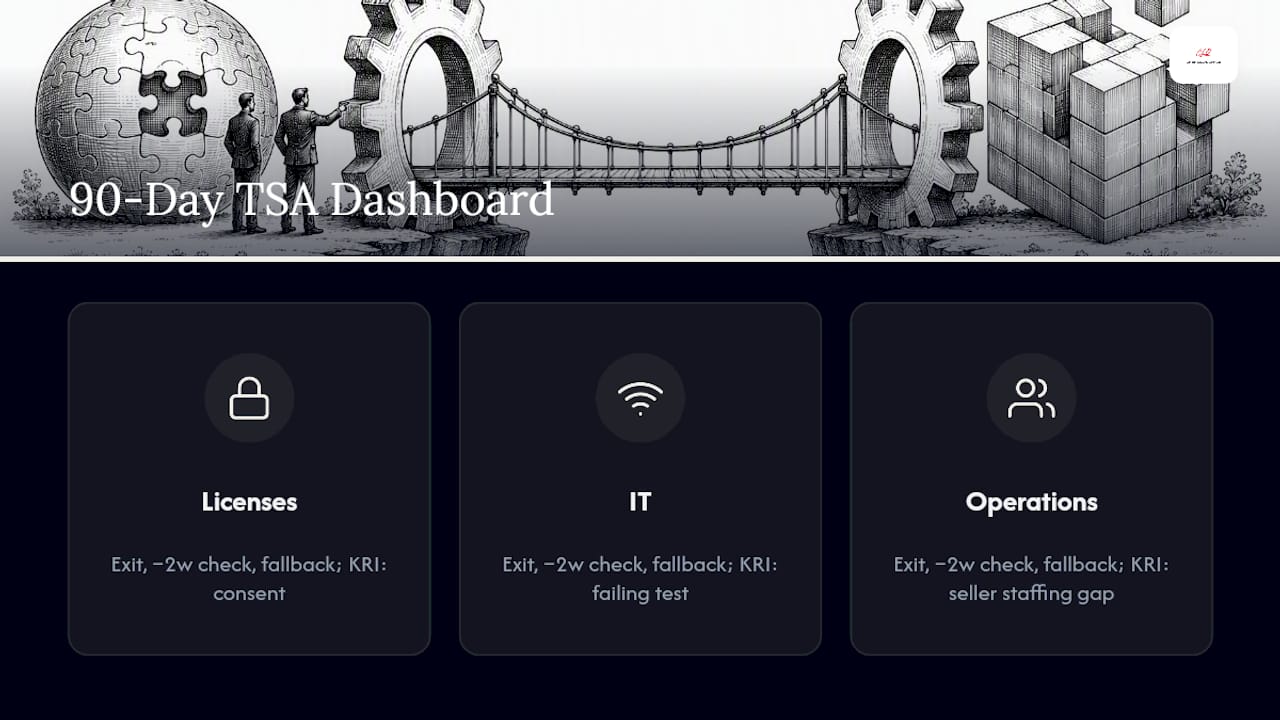
When you brief the board or CEO, skip the legal architecture and lead with three numbers: total monthly TSA cost, the longest remaining workstream on the critical path, and the single biggest unresolved risk (usually a consent or a licensing gap). Executives don’t need the clause structure. They need to know what it’s costing, when it ends, and what could still go wrong.
Why Most Buyers Get TSAs Backward
Here’s the uncomfortable truth about most TSA negotiations: the buyer’s deal team spends six weeks fighting over the purchase price and six days on the transition services agreement, then acts surprised when the TSA turns into the most expensive, most disputed part of the entire transaction.
The conventional wisdom treats the TSA as a formality, something outside counsel drafts from a template while the real negotiators focus on the economics that matter. That’s backwards. The purchase price is a number you negotiate once. The TSA is a relationship you live inside for six, twelve, sometimes eighteen months, and every day inside a badly built one costs real money and real operational risk.
What people consistently underestimate is how much a TSA’s quality determines whether the deal’s underlying economics actually materialize. You can negotiate a brilliant purchase price and still lose the deal’s value if the buyer spends a year stuck on the seller’s systems, paying escalating fees, because nobody built exit discipline into the contract. L.E.K.'s research makes this point precisely: the single biggest strategic error is treating the TSA as a substitute for making hard operational decisions, rather than a bridge with a defined destination.
The fix isn’t more legal language. It’s involving operations people in the drafting from day one, pricing extensions so they hurt enough to motivate real migration effort, and naming actual humans as service owners instead of letting the agreement float without accountability. None of that is complicated. Most of it just requires treating the TSA with the seriousness it actually deserves, rather than the seriousness deal teams tend to give it under closing-week time pressure.
— Amy Natasha Osteen
Get Help Structuring and Running Your TSA
A TSA negotiated well and executed badly still costs you the year. Chief Legal Office exists for the gap most carve-outs fall into: a company that needs senior legal judgment on scope, pricing, and governance, plus the operational bandwidth to actually run the transition, without hiring a full internal legal department to do it.
Through the Fractional Chief Legal Office model, clients get a Client Success Team led by a senior former General Counsel, backed by attorneys and legal operations staff who handle the day-to-day work of building service schedules, tracking consents, and keeping the milestone dashboard current. For deals already in motion, Capital Raises and M&A support covers TSA negotiation directly, from scope mapping through governance design. Companies that need ongoing leadership beyond the transaction itself can also engage Fractional General Counsel support to carry that structure forward past close.
Pricing runs through three published plans, Foundations, Embedded Access, and Strategic Growth, detailed on the pricing page, where you can see which level fits a transaction of your size. If you’re heading into a carve-out and want a second set of eyes on your TSA before you sign it, that’s the page to start with.
Sources
The L.E.K. Consulting TSA report lays out the strategic case for end-state orientation and remains the clearest articulation of why TSAs fail when treated as stopgaps. The SEC-filed Form of Transition Services Agreement gives deal teams an actual drafted example to work from. Mayer Brown’s negotiating guidance and Protiviti’s pitfalls review each cover the negotiation and execution mistakes that show up most often in practice.
FAQ
Can You Provide an Example of a Transition Services Agreement?
Yes. The SEC’s filed Form of Transition Services Agreement is a real, publicly available exhibit showing full clause structure and service schedules from a completed transaction. Public exhibits like this and Exhibit F from a separate filing are strong starting points for drafting, though the schedules and pricing still need to be rebuilt around your own deal.
Who Needs an MSA Agreement?
A master service agreement (MSA) is used by any two businesses establishing an ongoing vendor or service relationship covering multiple future work orders under one umbrella contract, common between companies and their recurring outside vendors, contractors, or software providers. It’s a different tool from a TSA: an MSA governs an ongoing commercial relationship, while a transition services agreement is a temporary, deal-specific arrangement tied to a specific closing date and exit timeline.
What Is a Transition Agreement?
In the M&A context, a transition agreement, more precisely a transition services agreement, is the contract governing which services the seller keeps providing to the buyer after closing so the business can operate without interruption. It runs for a defined period, typically several months to a couple of years, and ends once the buyer has stood up its own replacement capabilities for each service.
What Is the Difference Between an MSA and a Contract?
An MSA is a specific type of contract, not a separate category from “contract” generally. It’s a framework agreement that sets standard terms for a repeated business relationship, so the parties don’t renegotiate core terms every time they sign a new work order or statement of work under it.
How Much Does Chief Legal Office Charge for TSA Support?
Chief Legal Office offers three published plans, Foundations, Embedded Access, and Strategic Growth, listed on the pricing page, with current rates available there. TSA and M&A-specific work is scoped individually depending on deal complexity and timeline.
Recommended
The lawyerly fine print: This article is for general information, not legal advice…