Make Vendor Due Diligence Enforceable: Checklist for Legal Teams
A vendor due diligence checklist has to do five jobs at once: verify who you are dealing with, confirm they can pay their bills, check for reputational or regulatory landmines, validate their cybersecurity posture, and lock all of it into contract language you can actually enforce. Do an initial check before signing, then reassess at least annually or whenever something material changes.
TL;DR:
Vendors touching sensitive or regulated data require deeper due diligence, including independent security tests, enhanced financial checks, and site visits.
Contract clauses must specify security standards, breach notification timelines, audit rights, and clear termination conditions to ensure enforceability.
Regular reassessment, at least annually or after major incidents or changes, is essential to maintain current vendor risk profiles.
Verification of cybersecurity evidence should go beyond self-reports, including reviewing certifications like SOC 2 or ISO 27001 and conducting independent vulnerability scans.
Industry-specific regulations, insurance coverage, ESG commitments, and operational capacity significantly influence vendor risk and must be integrated into the due diligence process.
Chief Legal Officechieflegaloffice.comMake Vendor Risk Part of Legal OperationsChief Legal Office helps growing technology companies organize legal work, manage priorities, and prepare enforceable agreements as vendor risks evolve.Visit Chief Legal Office
Table of Contents
What the checklist covers and when to escalate
Basic company information to collect and verify
Financial health checks and red flags
Reputational and regulatory risk checks
Cybersecurity and data protection evidence to request and validate
Contracts and enforceable security rights to include
Operational resilience, SBOM, and supply-chain provenance
Risk-based classification and scoring you can implement quickly
Monitoring, reassessment triggers, and reporting
Sample questionnaire and immediate next steps
Legal and regulatory compliance specific to the vendor’s industry
Review of vendor insurance coverage and indemnity provisions
Environmental, social, and governance (ESG) considerations related to the vendor
Assessment of vendor operational capabilities and capacity
Converting diligence into enforceable control
How we help you operationalize vendor due diligence
FAQ
Sources
What the checklist covers and when to escalate
Think of this as the map before we walk through each room. Every vendor relationship needs the same basic skeleton of evidence, but how deep you dig depends on what that vendor touches.
Company facts: confirms you’re dealing with a real, properly structured business.
Financial health: tells you whether the vendor will still exist next year.
Reputational and regulatory screening: flags litigation, sanctions, or exclusions.
Cybersecurity evidence: shows whether they can actually protect your data.
Contract terms: turns everything above into something you can enforce.
Monitoring plan: keeps the picture current after signing.
As a rule of thumb, escalate from basic to enhanced due diligence when the vendor touches sensitive data, has broad system access, or operates in a regulated industry. The NIST C-SCRM Due Diligence Quick-Start Guide and CIS Control 15 both build their frameworks around this same basic versus enhanced distinction.
Basic company information to collect and verify
Before you worry about cybersecurity or financials, confirm the vendor is actually who they claim to be. This sounds obvious until you’ve seen how many procurement teams skip it because the sales rep seemed nice.
Legal identifiers: legal entity name, EIN, state of incorporation, registered addresses.
Ownership structure: ultimate beneficial owners, parent companies, and foreign ownership, control, or influence (FOCI) screening for vendors touching sensitive systems.
Leadership and contacts: who runs the company and who you call when something breaks.
Insurance certificates: proof of coverage that matches the risk of the engagement.
Business model and critical functions: what the vendor actually does and whether your contract depends on a function they treat as core or incidental.
Verify these against independent sources, not just the vendor’s own representations: SAM.gov for federal exclusions, state Secretary of State filings, and commercial databases like Dun & Bradstreet. The NIST guide specifically recommends checking traceable company information against these kinds of external records rather than taking a questionnaire at face value.
Financial health checks and red flags
A vendor with great technology and a shaky balance sheet is still a risky vendor. If they go under mid-contract, your legal rights on paper won’t matter much if there’s no one left to enforce them against.
Request audited financial statements or, for smaller vendors, recent management accounts.
Pull a credit agency report to check payment history and credit utilization.
Watch for red flags: repeated annual losses, recent bankruptcy filings, or a pattern of late payments to their own suppliers.
When the financials look thin but the vendor is otherwise a good fit, don’t just shrug and sign. Build in protections: parent company guarantees, escrow arrangements for critical deliverables, staged payments tied to milestones, or tighter monitoring with shorter reassessment cycles.
Reputational and regulatory risk checks
Some risks don’t show up in a balance sheet. A vendor can be financially solid and still be a legal and reputational problem waiting to happen.
Screen against government exclusion lists, including SAM and the Consolidated Screening List, for sanctions or debarment.
Search litigation databases and news coverage for pending lawsuits, regulatory actions, or public controversies.
Check for politically exposed persons (PEPs) and related-party relationships that could create conflicts of interest.
A single lawsuit doesn’t automatically disqualify a vendor. Weigh what you find against the vendor’s own response and controls: did they settle quickly and fix the underlying problem, or is this part of a pattern? For deeper investigative work on PEPs or background issues, a specialized investigator like Hub Security and Investigative Group can take screening further than a desktop search alone.
Cybersecurity and data protection evidence to request and validate
This is the section where most vendor questionnaires fall apart, because a questionnaire answer and actual security posture are two different things. The vendor saying “yes, we encrypt data at rest” means nothing without something behind it.
Request recognized artifacts: SOC 2 Type II reports, ISO 27001 certification, PCI Attestation of Compliance, and recent penetration test summaries.
Ask for operational evidence: a written incident response plan, encryption standards for data at rest and in transit, identity and access management practices, and a software bill of materials (SBOM) for any software components.
Validate, don’t just collect: review the artifacts for scope and dates, spot-check a sample of controls, and consider independent vulnerability scanning for vendors with significant access.
The NIST Quick-Start Guide notes that SBOMs in CycloneDX or SPDX format meaningfully improve software supply-chain assessments when paired with component-level vulnerability tracking. A CIS case study on vendor assessments makes a related point: there’s no universal standard for this, so best practice is augmenting self-reported questionnaires with independent artifacts rather than trusting the questionnaire alone. We outline how we think about this in our own data security overview.
Pro Tip: Don’t accept a SOC 2 report older than 12 months without asking what’s changed since the audit period closed.
Contracts and enforceable security rights to include
Here’s the part most checklists skip entirely: none of the evidence above matters if your contract doesn’t give you the right to demand it again later, or to do anything when a vendor falls short.
Security obligations clause: specific, not aspirational. Name the standards (encryption type, access controls) rather than promising “reasonable security.”
Breach notification and cooperation: a defined notification window and a duty to cooperate with your investigation.
Audit rights: the right to request updated evidence (SOC 2, pen test results) on a set schedule, with remediation timelines if gaps turn up.
Termination triggers: clear conditions, like an unremediated critical vulnerability, that let you exit without a fight.
The FTC Safeguards Rule guidance is blunt about this: regulated entities are expected to put security expectations into written contracts and verify ongoing compliance, not just ask questions once at onboarding. Our information technology practices page walks through how these clauses translate into day-to-day vendor oversight.
Operational resilience, SBOM, and supply-chain provenance
A vendor can have excellent security controls and still leave you stranded if their systems go down for a week. Business continuity deserves its own line of questioning, separate from cybersecurity.
Request business continuity and disaster recovery plans, including redundancy and failover arrangements for critical systems.
Ask for SBOMs on any software or hardware components, since provenance gaps are a common entry point for supply-chain attacks.
Push for visibility into subcontractors and third-tier suppliers, since your vendor’s weakest link is often someone you’ve never heard of.
Our business continuity overview covers how we think about continuity planning as part of broader vendor risk.
Risk-based classification and scoring you can implement quickly
You don’t need a complicated scoring model to get this right. You need a consistent one.
Score each vendor across four axes: data sensitivity, system access level, availability impact if they fail, and regulatory exposure.
Set a threshold for escalation: a vendor scoring high on two or more axes moves from basic to enhanced due diligence, with legal review required before signing.
Tie the score to a reassessment cadence: low-risk vendors get annual review; high-risk vendors get more frequent check-ins and tighter contract audit rights.
Require sign-off gates: no contract execution for a high-risk vendor without documented legal and security approval.
This mirrors how CIS Control 15 frames service provider management: inventory, classify, assess, monitor, and decommission, all tied to the provider’s actual risk level rather than a flat checklist applied to everyone equally.
Monitoring, reassessment triggers, and reporting
A due diligence file from two years ago tells you almost nothing about a vendor’s current risk. Treat the checklist as a living file, not a folder you open once and forget.
Set a minimum annual reassessment cadence, with event-driven triggers: a security incident, leadership change, merger, or contract renewal should all restart the clock.
Choose continuous monitoring tools for high-risk vendors, and periodic manual checks for everyone else.
Report findings upward: risk owners and, for material vendors, the board should see a summary, not just a pass or fail.
The FTC Safeguards Rule specifically calls for reassessment at least annually or after a security incident, which is a useful floor if you’re building your cadence from scratch.
Sample questionnaire and immediate next steps
You don’t need to reinvent this from a blank page. Start with ten questions and build from there.
Who are your ultimate beneficial owners, and have there been recent ownership changes?
Can you provide your most recent audited financial statements?
Have you been named in litigation or regulatory action in the past three years?
Can you provide a current SOC 2 report or equivalent certification?
What is your data encryption standard at rest and in transit?
Do you maintain a documented incident response plan?
What is your breach notification timeline to customers?
Can you provide an SBOM for relevant software components?
What subcontractors or fourth parties support this engagement?
What is your business continuity and disaster recovery plan?
This week’s action items: build a vendor inventory, classify existing vendors by risk, set your escalation thresholds, and flag any contracts missing audit rights or breach notification clauses. Loop in legal, security, procurement, and finance early, since each catches different gaps.
Legal and regulatory compliance specific to the vendor’s industry
A generic checklist misses industry-specific rules that can expose you to liability you didn’t know existed. A payment processor carries PCI obligations that a marketing agency never will. A healthcare vendor touching patient data carries HIPAA business associate obligations that a logistics vendor doesn’t.
The practical move is to ask, for every vendor category, what regulatory regime applies to them and whether that regime creates obligations that flow through to you. If you’re a financial institution working with a service provider, the FTC Safeguards Rule requires you to select providers capable of maintaining appropriate safeguards and to put those expectations in writing, which means your vendor’s compliance gaps become your compliance gaps. The same logic applies in healthcare, where a vendor’s HIPAA posture directly affects your own exposure, and in any sector with sector-specific data rules.
Don’t rely on a vendor’s self-certification that they’re compliant with whatever applies to their industry. Ask which specific regulations apply to their business, request evidence of how they meet those obligations, and have someone who understands that regulatory area review the answer. A vendor saying “we’re compliant” without specifying compliant with what is not an answer, it’s a deflection. Build industry-specific compliance review into your intake process rather than treating it as a one-time question, since regulations change and a vendor’s compliance posture can slip between your initial review and your next renewal.
Review of vendor insurance coverage and indemnity provisions
Insurance certificates get treated as a box to check, but the coverage type, limits, and exclusions matter enormously once something actually goes wrong. A vendor with a certificate of insurance and a vendor with adequate insurance for your specific risk are not the same thing.
Start by matching coverage to exposure. A vendor with system access to your data needs cyber liability coverage, not just general liability. A vendor providing professional services needs errors and omissions coverage. Check the limits against the scale of harm a failure could cause you, not just against what seems like a reasonable number. A $1 million cyber policy on a vendor handling your entire customer database is a mismatch worth flagging.
Indemnity provisions deserve the same scrutiny as the insurance itself. A vendor agreeing to indemnify you is only as good as their ability to actually pay, which is why insurance and indemnity need to be reviewed together rather than as separate boxes on a form. Watch for indemnity caps that are lower than your realistic exposure, and watch for carve-outs that exclude the exact scenario you’re most worried about, like data breaches or IP infringement claims.
Request a current certificate of insurance naming you as an additional insured where appropriate, and set a reminder to request an updated certificate before the current one expires. An insurance gap that opens up six months into a contract is not something you want to discover after an incident.
Environmental, social, and governance (ESG) considerations related to the vendor
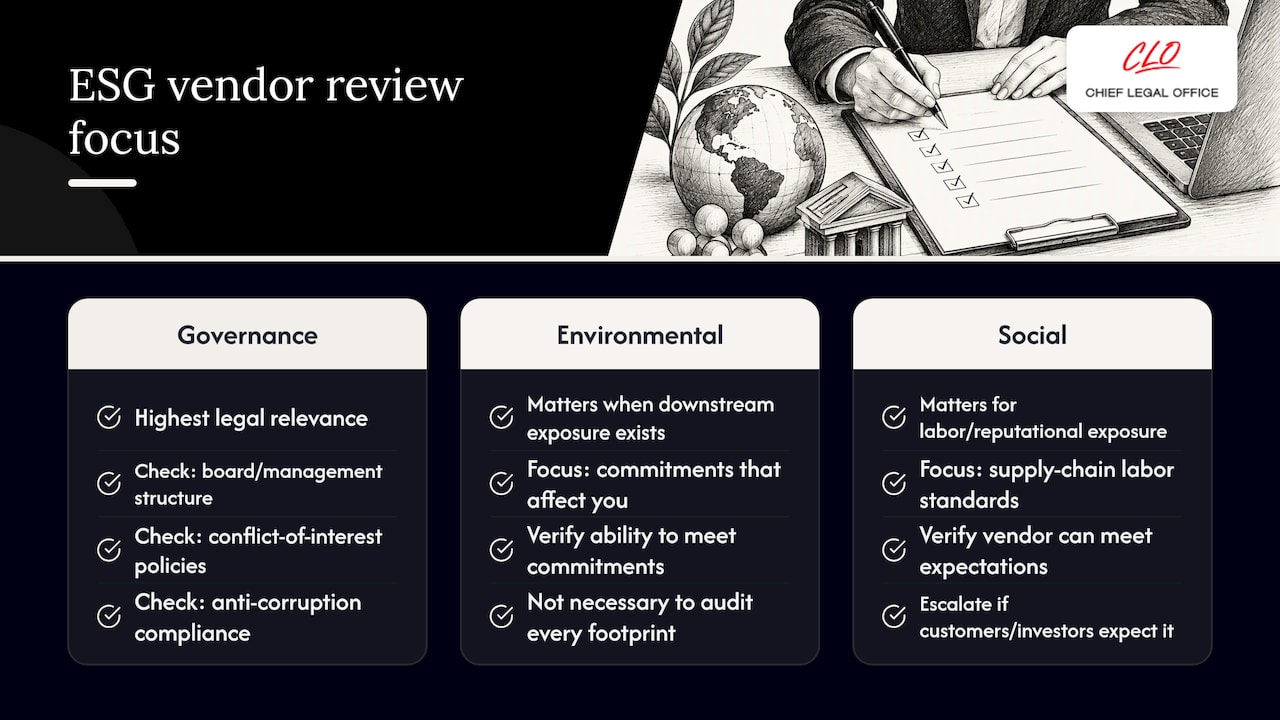
ESG due diligence on vendors used to be a nice-to-have for companies with sustainability reports to fill. It’s increasingly a practical risk issue, especially for companies with investors, enterprise customers, or supply chains that include regulated industries with their own ESG disclosure obligations.
The governance piece is usually the most legally relevant. Does the vendor have basic governance controls: a functioning board or management structure, conflict of interest policies, anti-corruption compliance for vendors operating internationally. Weak governance at a vendor often correlates with the other risks already on this checklist, like financial instability or regulatory exposure, so it’s worth treating governance review as connected to rather than separate from your broader risk assessment.
The environmental and social pieces matter most when they create downstream legal or reputational exposure for you. If your own customers or investors expect supply chain labor standards or environmental commitments, your vendor contracts need language addressing those expectations, and your due diligence needs to verify the vendor can actually meet them rather than just claim to. This is less about auditing every vendor’s carbon footprint and more about understanding which ESG commitments you’ve made publicly or contractually that depend on vendor behavior you don’t directly control.
Keep this proportionate. A vendor providing office supplies doesn’t need the same ESG scrutiny as a manufacturing partner in your core supply chain. Match the depth of ESG review to how much that vendor’s practices could actually affect your own obligations and reputation.
Assessment of vendor operational capabilities and capacity
A vendor can pass every financial, security, and compliance check and still fail you by simply not having the operational capacity to do the job at the scale you need. This gets overlooked because it feels less like a legal question and more like a business one, but capacity failures create legal exposure too, through missed SLAs, breach of contract claims, and the scramble to find a replacement vendor under time pressure.
Ask directly about capacity: how many clients similar in size and scope do they currently serve, what’s their current utilization, and what happens to your account if they land three new large clients next quarter. A vendor’s sales team will say yes to almost anything during a pitch. Reference checks with existing clients, particularly ones of similar size to you, tend to surface capacity problems that the vendor’s own answers won’t.
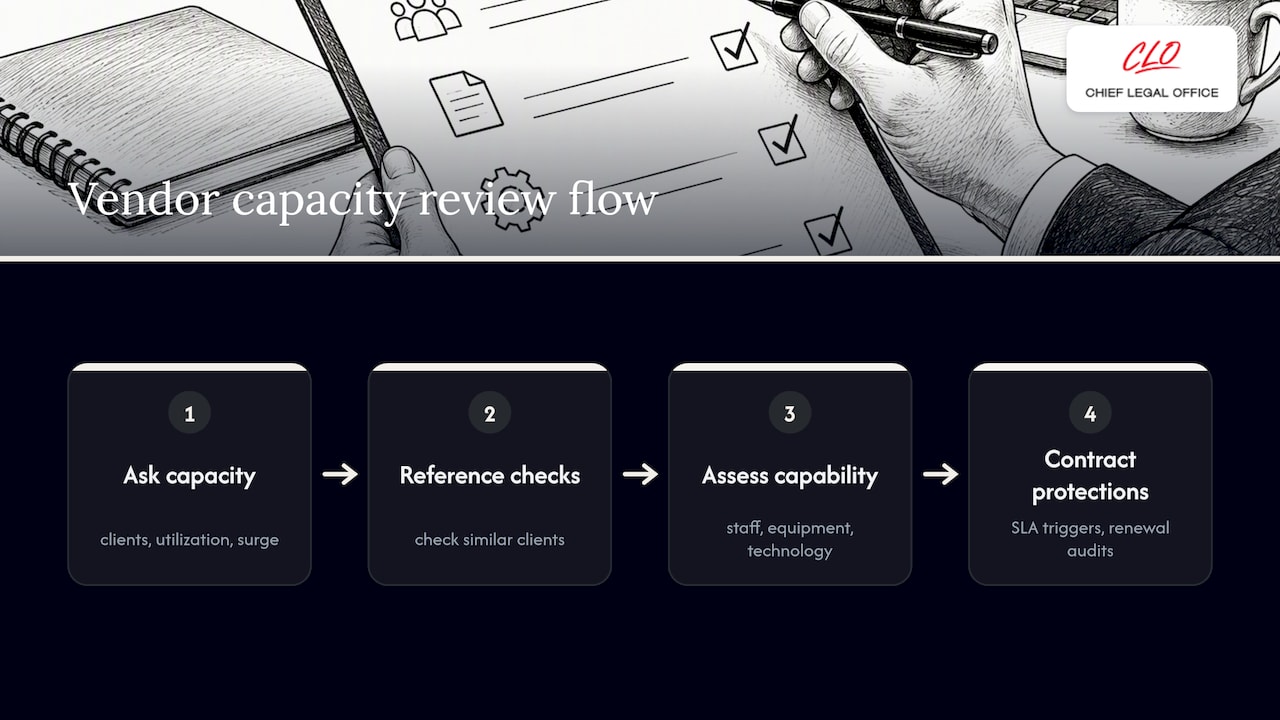
Operational capability also covers whether the vendor has the right staff, equipment, or technology to deliver what the contract promises, not just enough headcount. A vendor can be fully staffed and still lack the specific expertise your engagement requires. This connects directly back to the business continuity questions covered earlier: a vendor without redundancy or cross-training on key accounts is one departure away from a capacity problem becoming a contract failure.
Build capacity checks into your contract, not just your pre-signing review. Service level agreements should specify what happens if the vendor’s capacity changes materially, and your audit rights should let you ask capacity questions again at renewal, not just at the start of the relationship.
Converting diligence into enforceable control
Most checklists die because nobody writes the findings into the contract. A pen test summary that never shows up in a security exhibit is just a PDF in a folder. If a vendor misses a remediation deadline, your contract should say what happens next (a cure period, then termination) rather than leaving it to a phone call. We built our own supplier intake policy around exactly this gap between collecting evidence and being able to act on it.
— Amy Natasha Osteen
How we help you operationalize vendor due diligence
Running a vendor diligence program well means someone owns it full time: updating the questionnaire, chasing evidence, drafting the clauses, and knowing when to escalate. That’s the gap we fill. As your embedded legal team, we build the intake policy, draft and negotiate the contract language that makes diligence enforceable, and stay on call when an incident actually happens.

Fractional General Counsel: ongoing legal leadership that owns your vendor program instead of reviewing it once a year.
Commercial Transactions: contract drafting and negotiation that builds audit rights and breach notification into every vendor agreement.
Investigations & Litigation Support: help when a vendor issue turns into something that needs a real response.
Our Foundations, Embedded Access, and Strategic Growth plans start at different levels of involvement depending on how much of this you need handled. Check current pricing and get started on our pricing page.
FAQ
What is a vendor due diligence checklist?
A vendor due diligence checklist is a structured set of evidence requests and verification steps used to confirm a vendor’s legal standing, financial health, regulatory compliance, and security posture before and during a contract. It typically covers company facts, financials, reputational screening, cybersecurity evidence, and contract terms, reassessed on a regular cadence.
How often should vendor due diligence be refreshed?
At minimum, reassess annually, and sooner if a security incident, leadership change, merger, or contract renewal occurs. The FTC Safeguards Rule sets annual reassessment, or reassessment after an incident, as a practical floor for regulated entities.
What’s the difference between basic and enhanced due diligence?
Basic due diligence covers standard verification steps suitable for lower-risk vendors, while enhanced due diligence adds deeper checks like independent security testing, site visits, or detailed financial review for vendors with significant data access or regulatory exposure. The NIST C-SCRM Quick-Start Guide ties this distinction directly to supplier criticality.
Can we rely on a vendor’s security questionnaire alone?
No, a questionnaire alone tends to produce inconsistent results because vendors self-report their own answers without independent verification. A CIS case study on vendor assessments recommends augmenting questionnaire responses with artifacts like SOC 2 reports or PCI attestations.
What contract clauses actually make due diligence enforceable?
The clauses that matter most are specific security obligations, breach notification timelines, ongoing audit rights with defined evidence schedules, and termination triggers tied to unremediated findings. Vague promises to use “reasonable security” are far harder to enforce than clauses naming specific standards and deadlines.
Sources
FTC Safeguards Rule: What Your Business Needs to Know | Federal Trade Commission
NIST Cybersecurity Supply Chain Risk Management: Due Diligence Assessment Quick-Start Guide
Global retailer uses the CIS Controls for Vendor Assessments | CIS
The lawyerly fine print: This article is for general information, not legal advice…