Nonprofit Conflict of Interest Policy: The Form 990 Test for Boards
A nonprofit conflict of interest policy has two jobs: force disclosure of any financial or personal stake that could color a board decision, and stop the conflicted person from voting or steering that decision. If your board hasn’t adopted a written policy, collected signed annual disclosures, and kept minutes that prove the process actually ran, you have a gap that shows up the moment the IRS, a funder, or a journalist asks to see it.
TL;DR:
Require covered directors, officers, key employees, and decision making volunteers to file annual disclosures, report new conflicts immediately, and document recusals and votes in minutes.
For compensation or related party deals, use disinterested advance approval, comparable data, and contemporaneous minutes; completing all three shifts the burden to the IRS.
When an undisclosed conflict surfaces, a disinterested committee should review records, hear the person’s explanation, decide whether correction is needed, and document its reasoning.
State nonprofit laws vary, so adapt any sample policy to the organization’s state and size, and connect it to whistleblower, retention, and bylaw provisions.
Specify who investigates violations and possible consequences, ranging from correcting a missed form to removing a conflicted member from a vote or board service.
Chief Legal OfficeKeep Board Governance on TrackChief Legal Office provides senior legal leadership and a dedicated team to help organizations manage governance, legal priorities, and ongoing work.Explore legal support
Table of Contents
What a Nonprofit Conflict of Interest Policy Should Include
An Annotated Sample Policy You Can Adapt
Turning the Policy Into an Annual Routine
The IRS Rebuttable-Presumption Checklist for Compensation
Building a Culture Where Disclosure Actually Happens
How Chief Legal Office Helps Nonprofit Boards Operationalize This
When a Conflict Surfaces Without Disclosure
Keeping the Policy Alive Through Training
What Happens When Someone Breaks the Policy
How the Conflict Policy Fits With Your Other Governance Documents
What I Keep Seeing Go Wrong on Nonprofit Boards
Get Help Building a Policy That Holds Up
FAQ
Sources
What a Nonprofit Conflict of Interest Policy Should Include
A policy that only says “disclose your conflicts” isn’t a policy. It’s a suggestion. The IRS and watchdog groups expect something more structured, and so should you. The National Council of Nonprofits frames it simply: require disclosure, prohibit the interested person from voting, and spell out how the board manages what gets disclosed.
Here’s what belongs in the document itself:
Purpose and scope: name who’s covered, meaning directors, officers, key employees, committee members, and often volunteers in decision-making roles.
Definitions: define “interested person,” “financial interest,” “immediate family,” and the ownership or control thresholds that trigger the policy.
Disclosure mechanics: require both an annual signed disclosure and immediate, event-driven disclosure the moment a new conflict arises, with a clear statement of who receives and reviews the forms.
Decision and recusal rules: the conflicted person discloses, answers questions if asked, then leaves the room for the vote; minutes record who stayed and who left.
Transaction controls: for compensation or related-party deals, require advance approval by disinterested board members, comparability data, and contemporaneous documentation.
Recordkeeping: retain signed disclosure forms and full minutes for as long as your document retention schedule requires, not just the current fiscal year.
None of this is exotic. It’s the kind of governance scaffolding that Form 990 governance questions are specifically built to check for, because the IRS has seen what happens when boards skip it.
An Annotated Sample Policy You Can Adapt
You don’t need outside counsel to draft a conflict policy from scratch. A clean skeleton, adapted to your organization’s size and state, gets you most of the way there. Here’s a structure to build from:
Purpose: State plainly that the policy protects the organization’s interest when a transaction might benefit a person connected to the board or staff. This section sets the tone and gives the policy legal weight when someone later asks why it exists.
Definitions: Define “interested person” and “financial interest” precisely, including family members and any entity where a board member holds a significant ownership stake. Vague definitions are the single most common reason a policy fails to catch a real conflict.
Procedures for disclosure: Require written disclosure before any vote involving a potential conflict, plus an annual refresh. Specify who collects the forms (usually the board secretary or a governance committee).
Procedures for addressing the conflict: The interested person presents relevant facts, then exits the room for discussion and the vote. The remaining board determines whether the transaction is fair and in the organization’s interest.
Compensation and related-party review: Layer in the rebuttable-presumption steps (more on that below) whenever the transaction involves pay or a related entity.
Recordkeeping: Minutes must name who disclosed, the substance of the disclosure, who was present for the vote, and the decision reached.
Enforcement: Describe what happens when someone fails to disclose, including corrective action and, where relevant, removal from a role.
State nonprofit statutes vary on minimum requirements, so a template built for a California 501©(3) may need tweaks before it works for an Ohio board. You can find adaptable clause language in resources like our outside counsel guidelines, which many boards use as a starting point for drafting language they can hand to a committee.
Turning the Policy Into an Annual Routine
A policy that lives in a binder does nothing. The goal is a repeatable annual cycle that produces the same kind of paper trail every year, so when someone asks “how do you know this works,” you have an answer instead of a shrug.
Start at orientation. Every new board member or key employee should read the policy and sign a disclosure form before their first vote, not sometime “when there’s time.” From there, build a simple annual rhythm:
Circulate the disclosure form to all covered persons once a year, typically ahead of the annual meeting.
Review and update the conflicts register as disclosures come in, noting any changes from the prior year.
Discuss the conflicts list as a standing agenda item at least once annually, even if nothing new surfaced.
Require immediate disclosure when a new conflict arises mid-year, with temporary recusal until the board addresses it.
Record in the minutes exactly what was disclosed, who left the room, how the vote went, and what comparability data (if any) supported the decision.
Pro Tip: Keep a standing “conflicts log” spreadsheet that tracks disclosure dates, recusals, and vote outcomes across years, it turns a scattered paper trail into one document you can hand a grant officer or auditor without digging.
A governance officer or board secretary should own this calendar. It takes a few hours a year and it’s the difference between a policy that exists and a policy that functions.
The IRS Rebuttable-Presumption Checklist for Compensation
Whenever your board approves pay for an executive, or any transaction involving someone connected to a decision-maker, the stakes go up. The IRS rebuttable-presumption framework gives boards a shield against intermediate-sanctions exposure, but only if you follow a specific three-part process.
Advance approval by an authorized, disinterested body, meaning the people voting have no stake in the outcome.
Appropriate comparability data, such as compensation studies, independent surveys, or comparable organizations’ Form 990 filings.
Contemporaneous documentation, meaning minutes written at the time, not reconstructed later, showing the terms approved, the approval date, who was present, who disclosed a conflict and who recused, and the comparability data relied on.
The IRS has stated that satisfying all three elements shifts the burden to the agency to prove a transaction was unreasonable, rather than leaving the organization to prove it was fair after the fact. That single structural shift is why contemporaneous documentation matters more than a confident verbal assurance that “everyone agreed it was fine.”
If a transaction later turns out to exceed fair value, the disqualified person generally has to repay the excess plus interest, and the organization should document the correction and loop in counsel early rather than waiting for a notice.
Building a Culture Where Disclosure Actually Happens
Policies fail quietly, long before anyone notices. The most common failure isn’t a missing document, it’s a board that treats disclosure as a formality instead of a habit.
A few low-cost practices change that:
Measure your own compliance by checking whether disclosures come in every year, from everyone, and whether minutes actually name who recused and why.
Run a short role-play once a year: present a hypothetical conflict (a board member’s company bidding on a vendor contract) and have the group work through disclosure and recusal live.
Coordinate with HR and finance staff, who often spot vendor relationships or hiring conflicts before the board ever sees them.
Bring in counsel when a disclosed conflict involves a compensation decision, a related-party loan, or anything that could qualify as an excess-benefit transaction.
A board that rehearses the awkward conversation in a low-stakes setting handles the real one far better.
How Chief Legal Office Helps Nonprofit Boards Operationalize This
We work alongside nonprofit boards and executives to turn conflict policies from static documents into running programs. That means drafting or refreshing the policy language itself, building the annual disclosure cycle, training board members at orientation, and reviewing minutes before they’re finalized so the record actually supports a rebuttable-presumption defense if it’s ever tested.
Our team includes former General Counsel and Assistant General Counsel who have run these programs inside mission-driven organizations, which means we know where the process typically breaks (usually at the “we forgot to send the annual form” stage) and how to fix it before it becomes a Form 990 red flag. Learn more about how we support nonprofits and social enterprises.
When a Conflict Surfaces Without Disclosure
Eventually, someone will find out about a conflict that was never disclosed, maybe a staff member notices a vendor shares a last name with a board member, or an auditor flags a payment pattern. How your board responds in that moment matters as much as the policy itself.
Start by gathering facts quietly before confronting anyone: pull the contract, the vote record, and any prior disclosures from that person. Bring the matter to a committee of disinterested board members, not the full board on the spot, so the review itself isn’t compromised by the same conflict you’re investigating.
Give the individual a chance to explain, then decide whether the transaction was fair despite the missed disclosure, or whether it needs to be unwound or corrected. If money changed hands improperly, document the correction (repayment, contract termination, whatever fits) and record the board’s reasoning in minutes just as carefully as you would for a properly disclosed matter.
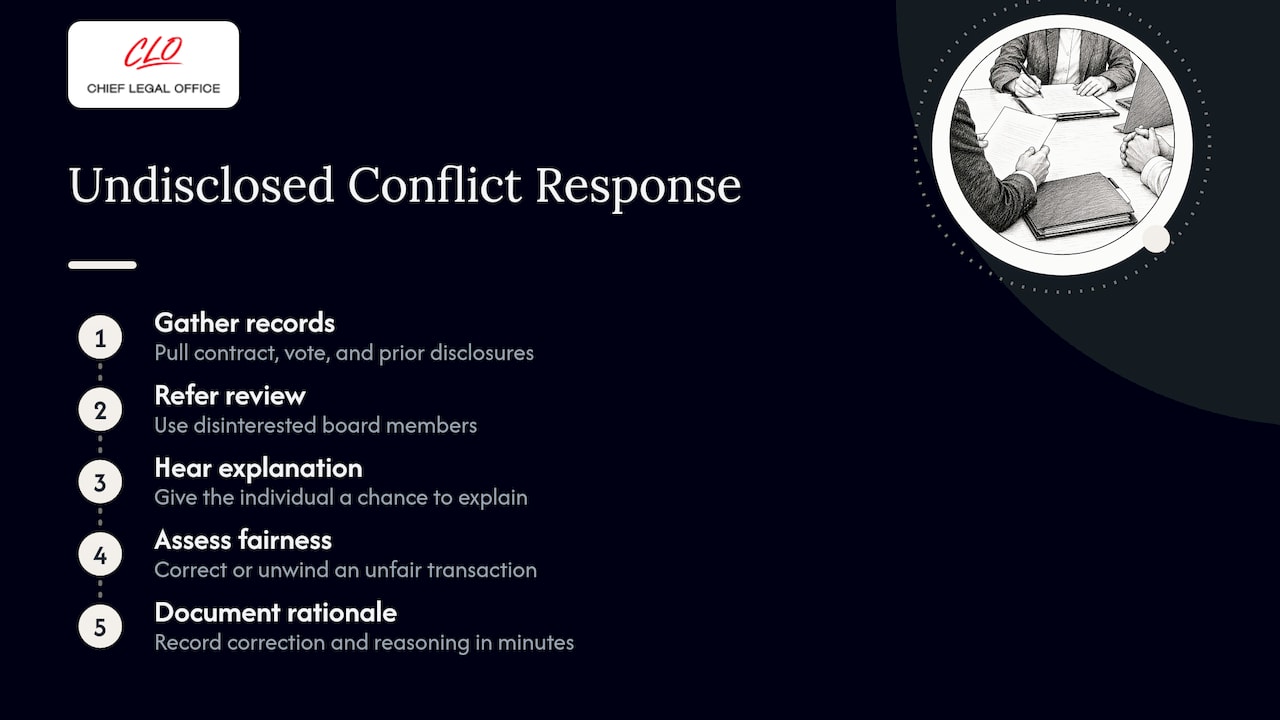
The instinct to handle this informally, a quiet conversation and a handshake, is understandable and usually wrong. An undisclosed conflict that gets “resolved” without a paper trail looks, from the outside, exactly like one that got covered up. Document the investigation the same way you’d document a disclosed conflict: who knew what, when, and what the board decided to do about it.
Keeping the Policy Alive Through Training
A conflict policy that board members read once, at orientation, and never again is a policy that will fail exactly when it matters. Awareness has to be renewed, not assumed.
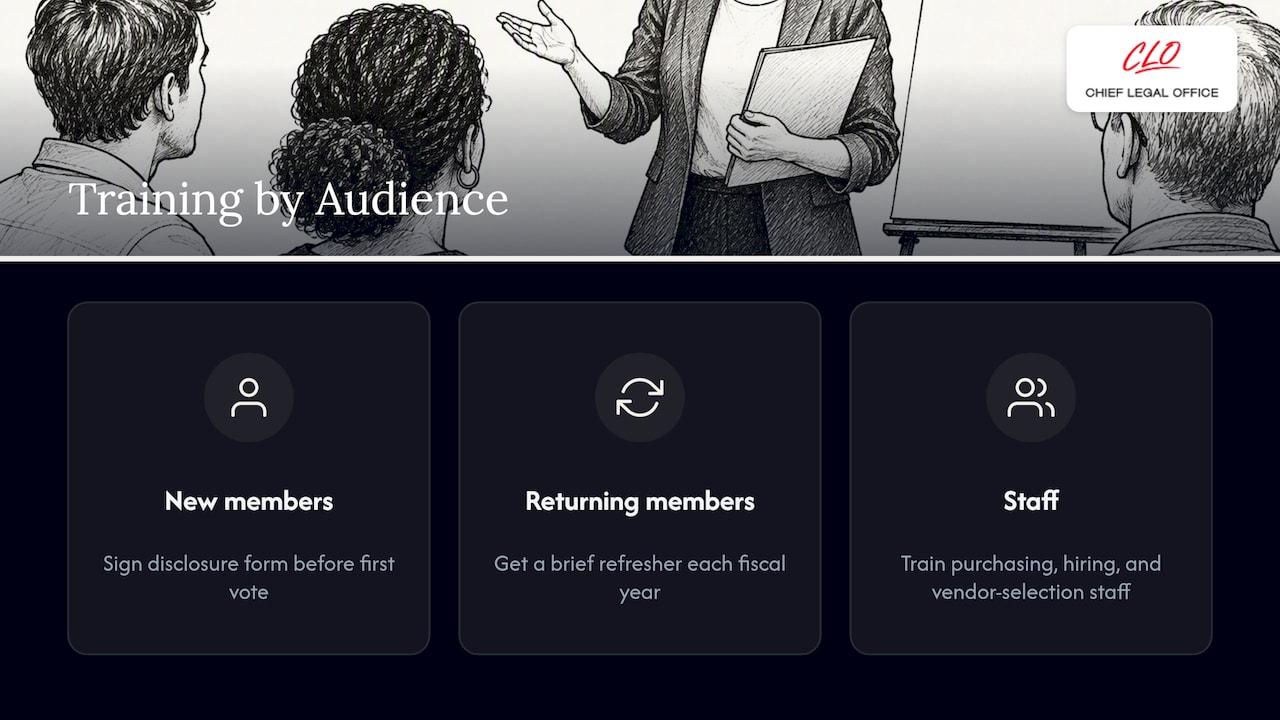
Build training into moments people already pay attention to. New board members sign the disclosure form and walk through a short explanation of what counts as a conflict before their first vote. Returning board members get a brief refresher, not a re-read of the full policy, at the start of each fiscal year, timed to when the annual disclosure form goes out.
Staff need a version of this too, especially anyone involved in purchasing, hiring, or vendor selection. A short training module through a partner like Visionova HR’s workplace civility training can reinforce conflict-recognition skills for staff alongside broader workplace conduct training, which tends to land better than a standalone legal memo nobody reads.
The goal isn’t memorization. It’s making disclosure feel normal rather than like an accusation, so people raise a hand before a transaction closes instead of after someone else notices.
What Happens When Someone Breaks the Policy
A conflict policy without consequences is a suggestion box. Your document should spell out, in plain terms, what happens when someone fails to disclose, votes while conflicted, or misrepresents a relationship.
Enforcement generally scales with severity. A missed annual disclosure form, caught and corrected quickly, might warrant a reminder and a note in the file. A board member who voted on a contract benefiting a company they own, without disclosing it, is a different situation entirely, and should trigger a formal review by the governance committee, a decision on whether the transaction stands, and a conversation about whether that person continues serving on the board.
Your policy should name who investigates (usually a governance or audit committee), what range of outcomes is on the table (reprimand, removal from a vote, removal from the board), and how decisions get documented. Boards that skip this section often find themselves improvising consequences in real time, which rarely goes well and almost never looks consistent across similar cases.
How the Conflict Policy Fits With Your Other Governance Documents
A conflict of interest policy doesn’t operate alone. It should connect directly to your whistleblower policy, your document retention policy, and your bylaws, because conflicts often surface through the same channels those documents are designed to protect.
If a staff member or board member spots an undisclosed conflict, your whistleblower policy should make clear that reporting it is protected, and your conflict policy should point back to that protection explicitly. Otherwise you end up with two documents that each assume the other handles the hard part, and neither actually does.
Your document retention policy should name conflict disclosures and related minutes specifically, since these are exactly the records a funder, regulator, or litigant is most likely to request. And your bylaws should reference the conflict policy’s existence and authority, so no one can argue later that the board lacked power to enforce it.
Treat these documents as one system, not four unrelated files in a shared drive.
What I Keep Seeing Go Wrong on Nonprofit Boards
The failures I see most often aren’t dramatic. They’re minutes that say “discussed and approved” with no mention of who disclosed what, annual disclosure forms that go out once and never get updated when circumstances change, and compensation decisions made with no comparability data anywhere in the file.
One board I worked with fixed this by adding a single line to their meeting template: “Conflicts disclosed this meeting: ___.” That one field turned a habit of silence into a habit of checking.
Three things to do in the next ninety days: adopt or refresh your written policy, collect signed disclosures from everyone covered, and rewrite your minutes template to force the disclosure question every time.
— Amy Natasha Osteen
Get Help Building a Policy That Holds Up
Drafting the policy is the easy part. Running it every year, documenting it the way the IRS expects, and knowing when a disclosed conflict needs outside judgment is where boards usually need a hand.
We help nonprofit clients by providing conflict of interest policies as part of fractional legal department services, which includes policy drafting, contract review, governance advice, and transaction preparation.
A governance audit of your current policy, disclosure records, and minutes.
Drafting or refreshing policy language tailored to your state and organization size.
Ongoing support through our Fractional Chief Legal Office for boards that want a legal department on call, not just a one-time document.
Plans start with Foundations at $1,000 per month, with Embedded Access and Strategic Growth available as needs grow. Reach out through our nonprofit services page to talk through where your board stands today.
FAQ
Does a nonprofit need a conflict of interest policy?
A written conflict of interest policy isn’t universally required by federal law, but Form 990 directly asks whether one exists and how it’s enforced, and most state nonprofit statutes expect one as a matter of fiduciary duty. In practice, funders, auditors, and the IRS all treat the absence of one as a governance red flag.
Can you give me an example of a conflict of interest in a nonprofit organization?
A common example is a board member whose company bids on a contract the nonprofit is awarding, or an executive director hiring a family member for a paid staff role. Another frequent scenario involves a board member voting on their own compensation package without recusing.
What should be included in a conflict of interest policy?
At minimum, the policy needs clear definitions of who and what counts as a conflict, a disclosure process covering both annual and event-driven situations, recusal rules for conflicted votes, and documentation requirements for minutes and records. For compensation decisions specifically, it should incorporate the IRS rebuttable-presumption steps: disinterested approval, comparability data, and contemporaneous documentation.
What is the 33% rule for nonprofits?
There isn’t an official IRS rule by that name, and definitions of board independence thresholds vary by source and state. If you’ve seen a specific percentage cited for your situation, it’s worth confirming against your state’s nonprofit statute or your own bylaws rather than treating it as a fixed federal standard.
Recommended
U.S. Nonprofit Boards: 5 Form 990 Policies That Prevent IRS Flags
One Page Risk Appetite Statement for Boards: Templates & Checklist - Unified CLO
The lawyerly fine print: This article is for general information, not legal advice…